



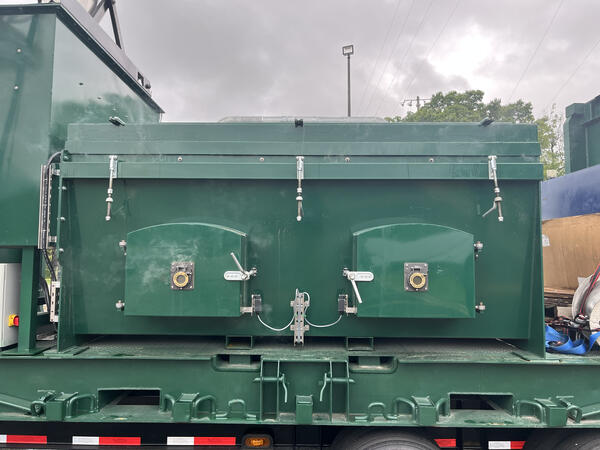
In summer 2026, USDA APHIS provided mobile incinerators from the National Veterinary Stockpile to our Madison, Wisconsin campus, where we incinerated 1,000 lbs of CWD-positive and 1,000 lbs of CWD-negative samples. We're now testing residues for prions to assess incineration efficacy.
Allen Herbst
Allen Herbst is a Prion Biologist at the USGS National Wildlife Health Center.
Science and Products

Understanding and Containing Chronic Wasting Disease
Chronic wasting disease (CWD) is a contagious and fatal neurodegenerative disease affecting cervids (deer, elk, caribou, and moose) that is threatening the health and sustainability of cervid populations across North America. CWD is caused by misfolded proteins known as prions, which can be transmitted by direct contact or environmental exposure. The USGS National Wildlife Health Center conducts...

Tracking Chronic Wasting Disease Strains to Understand Transmission and Detect Emerging Threats
At least ten distinct chronic wasting disease (CWD) prion strains with unique biochemical properties affect disease transmission and host range, prompting development and validation of biochemical assays to surveil and track these strains in endemic regions like Wisconsin, with ongoing efforts to standardize these methods for epidemiological tracking and management of CWD variants .

Assessing the Ability of Incineration to Inactivate CWD Prions from Carcasses
Chronic wasting disease (CWD), a fatal neurologic disease of cervids, presents a monumental management challenge, in part because the etiologic agent, an infectious prion, can be transmitted directly or indirectly and is extremely difficult to inactivate. As CWD expands geographically and increases in prevalence, additional disposal options are desired to safely dispose of CWD-contaminated tissues...

Advancing the Use of RT-QuIC for Applications in CWD Management
Chronic wasting disease (CWD) is an emerging infectious disease that is fatal to free-ranging and captive animals in Cervidae, the deer family. The development of the real-time quaking-induced conversion (RT-QuIC) assay has the potential to transform laboratory research of prions and provide new opportunities for improved surveillance and management.

Examining PRNP gene frequencies and ‘resistance’ to chronic wasting disease
Multiple studies have demonstrated that various alleles of the cervid prion protein (PRNP) gene affect chronic wasting disease (CWD) progression.

Chronic Wasting Disease
Chronic wasting disease (CWD) is an emerging infectious disease that is fatal to free-ranging and captive animals in Cervidae, the deer family. CWD is one member of a family of diseases called transmissible spongiform encephalopathies (TSEs), and is thought to be caused by prions. CWD is the only TSE known to affect free-ranging wildlife.
Deer_Incinerator.jpg
In summer 2026, USDA APHIS provided mobile incinerators from the National Veterinary Stockpile to our Madison, Wisconsin campus, where we incinerated 1,000 lbs of CWD-positive and 1,000 lbs of CWD-negative samples. We're now testing residues for prions to assess incineration efficacy.
Science and Products
Understanding and Containing Chronic Wasting Disease
Chronic wasting disease (CWD) is a contagious and fatal neurodegenerative disease affecting cervids (deer, elk, caribou, and moose) that is threatening the health and sustainability of cervid populations across North America. CWD is caused by misfolded proteins known as prions, which can be transmitted by direct contact or environmental exposure. The USGS National Wildlife Health Center conducts...
Tracking Chronic Wasting Disease Strains to Understand Transmission and Detect Emerging Threats
At least ten distinct chronic wasting disease (CWD) prion strains with unique biochemical properties affect disease transmission and host range, prompting development and validation of biochemical assays to surveil and track these strains in endemic regions like Wisconsin, with ongoing efforts to standardize these methods for epidemiological tracking and management of CWD variants .
Assessing the Ability of Incineration to Inactivate CWD Prions from Carcasses
Chronic wasting disease (CWD), a fatal neurologic disease of cervids, presents a monumental management challenge, in part because the etiologic agent, an infectious prion, can be transmitted directly or indirectly and is extremely difficult to inactivate. As CWD expands geographically and increases in prevalence, additional disposal options are desired to safely dispose of CWD-contaminated tissues...
Advancing the Use of RT-QuIC for Applications in CWD Management
Chronic wasting disease (CWD) is an emerging infectious disease that is fatal to free-ranging and captive animals in Cervidae, the deer family. The development of the real-time quaking-induced conversion (RT-QuIC) assay has the potential to transform laboratory research of prions and provide new opportunities for improved surveillance and management.
Examining PRNP gene frequencies and ‘resistance’ to chronic wasting disease
Multiple studies have demonstrated that various alleles of the cervid prion protein (PRNP) gene affect chronic wasting disease (CWD) progression.
Chronic Wasting Disease
Chronic wasting disease (CWD) is an emerging infectious disease that is fatal to free-ranging and captive animals in Cervidae, the deer family. CWD is one member of a family of diseases called transmissible spongiform encephalopathies (TSEs), and is thought to be caused by prions. CWD is the only TSE known to affect free-ranging wildlife.
Deer_Incinerator.jpg
In summer 2026, USDA APHIS provided mobile incinerators from the National Veterinary Stockpile to our Madison, Wisconsin campus, where we incinerated 1,000 lbs of CWD-positive and 1,000 lbs of CWD-negative samples. We're now testing residues for prions to assess incineration efficacy.
In summer 2026, USDA APHIS provided mobile incinerators from the National Veterinary Stockpile to our Madison, Wisconsin campus, where we incinerated 1,000 lbs of CWD-positive and 1,000 lbs of CWD-negative samples. We're now testing residues for prions to assess incineration efficacy.