



Groundwater Decision Support Software Release
In the Great Lakes Region, water is abundant and is a key driver for economic benefit through its many uses, including public supply, industry, and agriculture. Groundwater and surface water systems are tightly connected in the region, with groundwater supplying water to lakes and streams – particularly in times of lower rainfall.
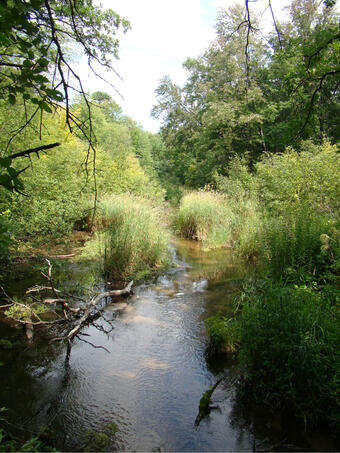
For this reason, timely decision making is vital for sustainable water use. In support of the Great Lakes Region, the USGS formally released the pycap-dss decision support software to address this decision-making framework. The pycap-dss software is a python-based code that implements analytical solutions that quantify streamflow depletion and water level declines that result from groundwater pumping. The software is modular and allows for different analytical solutions to be interchanged.
The specific laws differ, but in principle, each state in the region relies on scientific tools with rapid turnaround to evaluate the connections between existing and proposed high-capacity wells and lakes, streams, and wetlands. One option for informing these resource decisions is numerical modeling, but intermediate calculations, such as the analytical solutions in pycap-dss, can provide the important natural resources information to make decisions at a faster pace. This leads to lower costs and shorter wait times for farmers, industry, and municipalities to plan for their water use.
The Wisconsin Department of Natural Resources (WDNR) created a spreadsheet-based tool for making these evaluations. Across Lake Michigan, The Michigan Department of Environment, Great Lakes, and Energy (EGLE) was using software created by the USGS nearly a decade ago. The calculations made by these tools were accurate but the interface, maintenance, and ability to scale to large numbers of wells and responses were limited and posed challenges.
Recently, WDNR collaborated with the USGS to update and modernize their software. WDNR Water Use Section Manager Adam Freihoefer acknowledged the need for transparent and defensible decision support tools in managing Wisconsin’s water resources.
“Wisconsin’s review of high capacity well applications are complicated by factors such as conceptual and parameter uncertainty, a need to balance water quality and quantity concerns, and the demand for timely analysis to address complex conditions. The Pycap-dss provides a tool that states across the Upper Midwest can use to meet that need.”
EGLE heard about the developments in Wisconsin and approached the USGS to ask about including a solution that was not originally being included. Leveraging the flexible software design for pycap-dss, USGS was able to readily incorporate the solution EGLE needed. Lena Pappas, Senior Geologist at EGLE stated:
“EGLE is committed to open collaboration with external parties by using transparent, fact-based decision making in environmental regulatory decision making.”
In addition to providing a reliable and valuable scientific tool in collaboration with states, the USGS follows open software principles so that pycap-dss software is both transparent and open to use or scrutiny from the public and industry. Dr. Bryan Burroughs, Tri-Chair, Michigan Water Use Advisory Council stated,
"This project is a valuable step in perpetually reinforcing the integrity of important regulatory programs. It helps to ensure the transparency, repeatability, and understanding of some complex steps in regulatory programs, bolstering trust and confidence in the outcomes. The speed in which these agencies collaborated to identify needs and solutions and implement them is applauded and appreciated."
The State of Michigan featured this work in their recent “State of the Great Lakes” report. In that document, Pat Staskiewicz, Tri-Chair of the Michigan Water Use Advisory Council states:
“…release of open-source decision support software is a great example of USGS leadership in water management.”
and
“…improvements to the speed and accuracy of decision making by regulators are important, and doing so openly and transparently is vital for trust among regulated communities.”