



Mercury contamination interacts with stress hormones to influence the immune and endocrine systems of adult northern elephant seals
A 10-year USGS collaborative study explores the interactive effects of mercury contamination and stress on northern elephant seals.
Mercury is a potent neurotoxin and can negatively affect critical physiological systems in animals. High mercury bioaccumulation from deep-ocean prey (200-1000 m depths) in the North Pacific Ocean and the extreme life history strategies of northern elephant seals provided USGS researchers a unique system to assess the interactive effects of mercury contamination and stress on animal health.
USGS researchers led a collaborative research effort over 10 years to collect tissue samples from northern elephant seals and examine how mercury and the main mammalian stress hormone (cortisol) may act singularly or interact to affect the mammalian endocrine and immune systems. USGS researchers quantified 10 blood biomarkers that represented thyroid function (thyroid hormones), immune function (immunoglobulins and inflammatory cytokines), and reproduction (estradiol and progesterone) and related those to mercury contamination in blood and muscle.
Results from this study revealed that mercury contamination and cortisol concentrations were related to physiological responses in adult female northern elephant seals. The thyroid hormone thyroxine (tT4) and the antibody immunoglobulin E were associated with mercury and cortisol concentrations interactively. In addition, two thyroid hormones (tT3 and rT3) were associated with mercury concentrations and cortisol in an additive manner. Lastly, researchers observed that immunoglobulin M, the pro-inflammatory cytokine IL-6, and a reproductive hormone, estradiol, were negatively related to mercury concentrations in seal muscle, but were not related to cortisol. As an example, concentrations of the reproductive hormone, estradiol, in late molting seals (the time in the year when implantation of the fertilized egg occurs) decreased by 50% across the range of muscle mercury concentrations.
Mercury, cortisol, and thyroid regulation in elephant seals
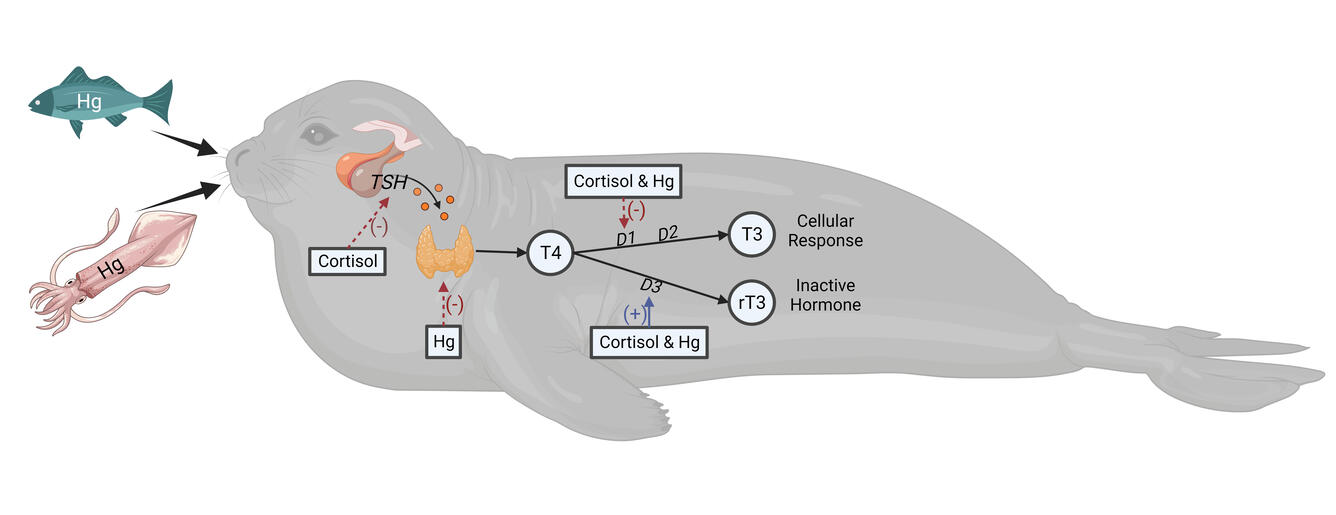
The results of this study indicate important physiological effects of mercury on free-ranging apex marine predators and interactions between mercury bioaccumulation and extrinsic stressors. Deleterious effects on marine mammals’ abilities to maintain relatively constant internal conditions (homeostasis, regulated by thyroid hormones), fight off pathogens and disease (innate and adaptive immune system), and successfully reproduce (endocrine system) can have significant individual and population level consequences.
Ecotoxicological Implications
- This study provided novel insights into how mercury and cortisol concentrations interact. The physiological responses to mercury contamination and cortisol indicate negative consequences for animal health.
- Negative effects on animals’ abilities to maintain homeostasis (thyroid hormones), fight off pathogens and disease (innate and adaptive immune system), and successfully reproduce (endocrine system) can have significant individual and population level consequences.