



Sinabung volcano in Indonesia on August 14, 2016. Photograph credit: Christoph Kern, USGS
How dangerous are pyroclastic flows?
A pyroclastic flow is a hot (typically >800 °C, or >1,500 °F ), chaotic mixture of rock fragments, gas, and ash that travels rapidly (tens of meters per second) away from a volcanic vent or collapsing flow front.
Pyroclastic flows can be extremely destructive and deadly because of their high temperature and mobility. For example, during the 1902 eruption of Mont Pelee in Martinique (West Indies), a pyroclastic flow (also known as a “nuee ardente”) demolished the coastal city of St. Pierre, killing nearly 30,000 inhabitants.
Learn More: Pyroclastic flows move fast and destroy everything in their path
Related

Can an eruption at one volcano trigger an eruption at another volcano? Can an eruption at one volcano trigger an eruption at another volcano?
There is no definitive evidence that an eruption at one volcano can trigger an eruption at a volcano that’s hundreds of kilometers/miles away or on a different continent. There are a few historic examples of simultaneous eruptions from volcanoes (or volcanic vents) located within about 10 kilometers (6 miles) of each other, but it's difficult to determine whether one eruption caused the other...

Do earthquakes large enough to collapse buildings and roads accompany volcanic eruptions? Do earthquakes large enough to collapse buildings and roads accompany volcanic eruptions?
Not usually. Earthquakes associated with eruptions rarely exceed magnitude 5, and these moderate earthquakes are not big enough to destroy buildings and roads. The largest earthquakes at Mount St. Helens in 1980 were magnitude 5, large enough to sway trees and damage buildings, but not destroy them. During the huge eruption of Mount Pinatubo in the Philippines in 1991, dozens of light to moderate...

Can volcanic eruptions endanger helicopters and other aircraft? Can volcanic eruptions endanger helicopters and other aircraft?
Yes. Encounters between aircraft and clouds of volcanic ash are a serious concern. Jet engines and other aircraft components are vulnerable to damage by fine, abrasive volcanic ash, which can drift in dangerous concentrations hundreds of miles downwind from an erupting volcano. In the past, many aircraft have accidentally encountered volcanic ash clouds, and in some cases jet engines have...

Can lakes near volcanoes become acidic enough to be dangerous to people and animals? Can lakes near volcanoes become acidic enough to be dangerous to people and animals?
Yes. Crater lakes atop volcanoes are typically the most acid, with pH values as low as 0.1 (very strong acid). Normal lake waters, in contrast, have relatively neutral pH values near 7.0. The crater lake at El Chichon volcano in Mexico had a pH of 0.5 in 1983 and Mount Pinatubo's crater lake had a pH of 1.9 in 1992. The acid waters of these lakes are capable of causing burns to human skin but are...

How many active volcanoes are there on Earth? How many active volcanoes are there on Earth?
There are about 1,350 potentially active volcanoes worldwide, aside from the continuous belts of volcanoes on the ocean floor at spreading centers like the Mid-Atlantic Ridge. About 500 of those 1,350 volcanoes have erupted in historical time. Many of those are located along the Pacific Rim in what is known as the " Ring of Fire." In the United States, volcanoes in the Cascade Range and Alaska...

How Do Volcanoes Erupt? How Do Volcanoes Erupt?
Deep within the Earth it is so hot that some rocks slowly melt and become a thick flowing substance called magma. Since it is lighter than the solid rock around it, magma rises and collects in magma chambers. Eventually, some of the magma pushes through vents and fissures to the Earth's surface. Magma that has erupted is called lava. Some volcanic eruptions are explosive and others are not. The...

Sinabung Volcano
Sinabung volcano in Indonesia on August 14, 2016. Photograph credit: Christoph Kern, USGS

Volcano Hazards
The United States has 169 active volcanoes. More than half of them could erupt explosively, sending ash up to 20,000 or 30,000 feet where commercial air traffic flies. USGS scientists are working to improve our understanding of volcano hazards to help protect communities and reduce the risks.
Video Sections:
The United States has 169 active volcanoes. More than half of them could erupt explosively, sending ash up to 20,000 or 30,000 feet where commercial air traffic flies. USGS scientists are working to improve our understanding of volcano hazards to help protect communities and reduce the risks.
Video Sections:

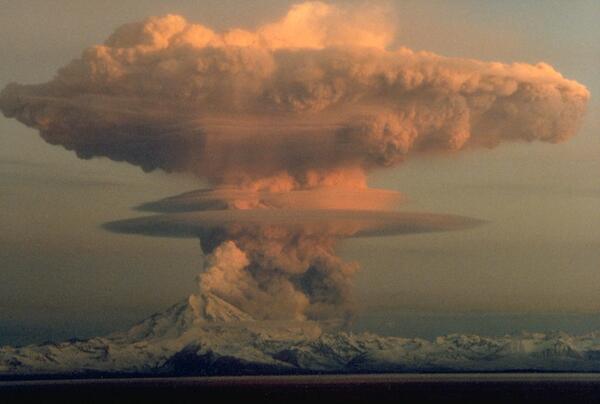
Redoubt Volcano
Ascending eruption cloud from Redoubt Volcano as viewed to the west from the Kenai Peninsula. The mushroom-shaped plume rose from avalanches of hot debris (pyroclastic flows) that cascaded down the north flank of the volcano. A smaller, white steam plume rises from the summit crater.
Ascending eruption cloud from Redoubt Volcano as viewed to the west from the Kenai Peninsula. The mushroom-shaped plume rose from avalanches of hot debris (pyroclastic flows) that cascaded down the north flank of the volcano. A smaller, white steam plume rises from the summit crater.
Related
Can an eruption at one volcano trigger an eruption at another volcano? Can an eruption at one volcano trigger an eruption at another volcano?
There is no definitive evidence that an eruption at one volcano can trigger an eruption at a volcano that’s hundreds of kilometers/miles away or on a different continent. There are a few historic examples of simultaneous eruptions from volcanoes (or volcanic vents) located within about 10 kilometers (6 miles) of each other, but it's difficult to determine whether one eruption caused the other...
Do earthquakes large enough to collapse buildings and roads accompany volcanic eruptions? Do earthquakes large enough to collapse buildings and roads accompany volcanic eruptions?
Not usually. Earthquakes associated with eruptions rarely exceed magnitude 5, and these moderate earthquakes are not big enough to destroy buildings and roads. The largest earthquakes at Mount St. Helens in 1980 were magnitude 5, large enough to sway trees and damage buildings, but not destroy them. During the huge eruption of Mount Pinatubo in the Philippines in 1991, dozens of light to moderate...
Can volcanic eruptions endanger helicopters and other aircraft? Can volcanic eruptions endanger helicopters and other aircraft?
Yes. Encounters between aircraft and clouds of volcanic ash are a serious concern. Jet engines and other aircraft components are vulnerable to damage by fine, abrasive volcanic ash, which can drift in dangerous concentrations hundreds of miles downwind from an erupting volcano. In the past, many aircraft have accidentally encountered volcanic ash clouds, and in some cases jet engines have...
Can lakes near volcanoes become acidic enough to be dangerous to people and animals? Can lakes near volcanoes become acidic enough to be dangerous to people and animals?
Yes. Crater lakes atop volcanoes are typically the most acid, with pH values as low as 0.1 (very strong acid). Normal lake waters, in contrast, have relatively neutral pH values near 7.0. The crater lake at El Chichon volcano in Mexico had a pH of 0.5 in 1983 and Mount Pinatubo's crater lake had a pH of 1.9 in 1992. The acid waters of these lakes are capable of causing burns to human skin but are...
How many active volcanoes are there on Earth? How many active volcanoes are there on Earth?
There are about 1,350 potentially active volcanoes worldwide, aside from the continuous belts of volcanoes on the ocean floor at spreading centers like the Mid-Atlantic Ridge. About 500 of those 1,350 volcanoes have erupted in historical time. Many of those are located along the Pacific Rim in what is known as the " Ring of Fire." In the United States, volcanoes in the Cascade Range and Alaska...
How Do Volcanoes Erupt? How Do Volcanoes Erupt?
Deep within the Earth it is so hot that some rocks slowly melt and become a thick flowing substance called magma. Since it is lighter than the solid rock around it, magma rises and collects in magma chambers. Eventually, some of the magma pushes through vents and fissures to the Earth's surface. Magma that has erupted is called lava. Some volcanic eruptions are explosive and others are not. The...
Sinabung Volcano
Sinabung volcano in Indonesia on August 14, 2016. Photograph credit: Christoph Kern, USGS
Sinabung volcano in Indonesia on August 14, 2016. Photograph credit: Christoph Kern, USGS
Volcano Hazards
The United States has 169 active volcanoes. More than half of them could erupt explosively, sending ash up to 20,000 or 30,000 feet where commercial air traffic flies. USGS scientists are working to improve our understanding of volcano hazards to help protect communities and reduce the risks.
Video Sections:
The United States has 169 active volcanoes. More than half of them could erupt explosively, sending ash up to 20,000 or 30,000 feet where commercial air traffic flies. USGS scientists are working to improve our understanding of volcano hazards to help protect communities and reduce the risks.
Video Sections:
Redoubt Volcano
Ascending eruption cloud from Redoubt Volcano as viewed to the west from the Kenai Peninsula. The mushroom-shaped plume rose from avalanches of hot debris (pyroclastic flows) that cascaded down the north flank of the volcano. A smaller, white steam plume rises from the summit crater.
Ascending eruption cloud from Redoubt Volcano as viewed to the west from the Kenai Peninsula. The mushroom-shaped plume rose from avalanches of hot debris (pyroclastic flows) that cascaded down the north flank of the volcano. A smaller, white steam plume rises from the summit crater.
Updated Date: May 8, 2023