



On July 8, 2019, California Geological Survey and USGS geologists and geophysicists with National Guard and Navy personnel, view the road damage resulting from 3 to 5 feet of right-lateral motion near the expected maximum slip locality along the primary tectonic rupture associated with the M 7.1 Ridgecrest earthquake on July 5, 2019.
What is the USGS doing to mitigate and respond to earthquake hazards?
The U.S. Geological Survey performs the following functions related to earthquake hazard mitigation:
- Receives, analyzes, maintains, and distributes data on earthquake activity worldwide. Satellites link our National Earthquake Information Center in Golden, Colorado to a network of seismograph stations. These stations, located throughout the world, are maintained by the U.S. Geological Survey, State geological surveys, universities, research institutions, and foreign governments.
- Provides rapid notification of earthquake events to civil defense and government officials in the affected area, and to the public through the news media.
- Produces regional assessments of earthquake hazards in conjunction with State and local governments. This information is used by: local planners and building officials in setting appropriate building and retrofitting standards in an area government and civil defense officials in planning for disaster recovery professionals conducting detailed site assessments researchers engaged in basic and applied research.
- Engages in basic research to learn more about the nature of earthquake activity.
- Provides education on earthquake hazards and safety to the public by publishing and distributing literature, and through a variety of other outreach efforts.
Related

What is seismic hazard? What is a seismic hazard map and how are they used? What is seismic hazard? What is a seismic hazard map and how are they used?
Seismic hazard is the hazard associated with potential earthquakes in a particular area, and a seismic hazard map shows the relative hazards in different areas. The maps are made by considering what we currently know about: Past faults and earthquakes The behavior of seismic waves as they travel through different parts of the U.S. crust The near-surface site conditions at specific locations of...

What is a seismic zone, or seismic hazard zone? What is a seismic zone, or seismic hazard zone?
Although you may hear the terms “seismic zone” and “seismic hazard zone” used interchangeably, they really describe two slightly different things. A seismic zone is used to describe an area where earthquakes tend to focus; for example, the New Madrid Seismic Zone in the Central United States. A seismic hazard zone describes an area with a particular level of hazard due to earthquakes. Typically, a...

What are the earthquake hazards/risks where I live? What are the earthquake hazards/risks where I live?
Determining your risk with regard to earthquakes, or more precisely shaking from earthquakes, isn't as simple as finding the nearest fault. The chances of experiencing shaking from an earthquake and/or having property damage is dependent on many different factors. The National Hazard Maps use all available data to estimate the chances of shaking (of different strengths and frequencies) across the...

How will my house hold up in an earthquake? Can the USGS send someone out to evaluate my property? How will my house hold up in an earthquake? Can the USGS send someone out to evaluate my property?
Published maps will only provide generalized, uninterpreted information about specific areas. Every property consists of a unique combination of geologic and structural factors that must be considered to determine what might happen to a house during an earthquake. Therefore, an individual site study is necessary. Geologic factors include: type of underlying material, depth to bedrock, depth of...

How do I decide whether or not to get earthquake insurance? How do I decide whether or not to get earthquake insurance?
You should consider the following factors when deciding whether or not to get earthquake insurance: proximity to active earthquake faults seismic history of the region (frequency of earthquakes) time since last earthquake building construction (type of building and foundation) architectural layout materials used quality of workmanship extent to which earthquake resistance was considered by the...

How do earthquakes affect buildings? How do earthquakes affect buildings?
Ground shaking is the primary cause of earthquake damage to man-made structures. Many factors influence the strength of earthquake shaking at a site including the earthquake's magnitude, the site's proximity to the fault, the local geology, and the soil type. More than 250 structures throughout the United States have been outfitted with seismic sensors by the USGS National Strong Motion Project...

Road Damage from the Ridgecrest, CA Earthquake
On July 8, 2019, California Geological Survey and USGS geologists and geophysicists with National Guard and Navy personnel, view the road damage resulting from 3 to 5 feet of right-lateral motion near the expected maximum slip locality along the primary tectonic rupture associated with the M 7.1 Ridgecrest earthquake on July 5, 2019.

ShakeAlert sensor station being serviced by USGS personnel
ShakeAlert sensor station being serviced by USGS personnelA USGS electronics technician performs maintenance on a ShakeAlert Earthquake Early Warning (EEW) sensor station, located in the San Francisco Bay Area. ShakeAlert station components include strong-motion accelerometers, solar panel and battery power systems, and communications & telemetry equipment for communication with the wider ShakeAlert network.
ShakeAlert sensor station being serviced by USGS personnel
ShakeAlert sensor station being serviced by USGS personnelA USGS electronics technician performs maintenance on a ShakeAlert Earthquake Early Warning (EEW) sensor station, located in the San Francisco Bay Area. ShakeAlert station components include strong-motion accelerometers, solar panel and battery power systems, and communications & telemetry equipment for communication with the wider ShakeAlert network.

PubTalk 9/2018 - Hayward Earthquake
Title: The 150th Anniversary of the Damaging 1868 Hayward Earthquake: Why It Matters and How We Can Prepare for Its Repeat
Title: The 150th Anniversary of the Damaging 1868 Hayward Earthquake: Why It Matters and How We Can Prepare for Its Repeat

PubTalk 1/2018 — ShakeAlert: Path to West Coast EQ Early Warning
PubTalk 1/2018 — ShakeAlert: Path to West Coast EQ Early WarningTitle: ShakeAlert: The Path to West Coast Earthquake Early Warning ... how a few seconds can save lives and property
PubTalk 1/2018 — ShakeAlert: Path to West Coast EQ Early Warning
PubTalk 1/2018 — ShakeAlert: Path to West Coast EQ Early WarningTitle: ShakeAlert: The Path to West Coast Earthquake Early Warning ... how a few seconds can save lives and property

PubTalk 8/2014 — Ground Shaking in '89 Loma Prieta Quake: 25 yrs later
PubTalk 8/2014 — Ground Shaking in '89 Loma Prieta Quake: 25 yrs laterby Brad Aagaard, USGS Research Geophysicist
PubTalk 8/2014 — Ground Shaking in '89 Loma Prieta Quake: 25 yrs later
PubTalk 8/2014 — Ground Shaking in '89 Loma Prieta Quake: 25 yrs laterby Brad Aagaard, USGS Research Geophysicist
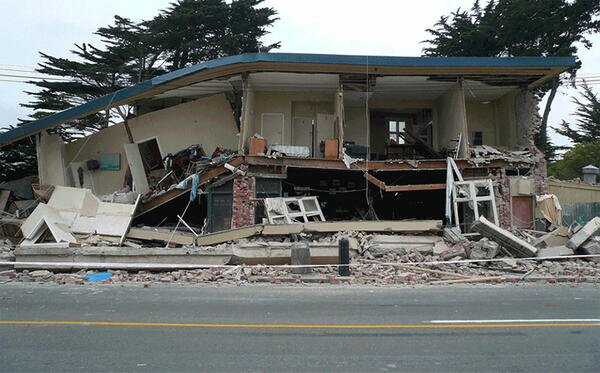
Earthquake-damaged building
Building damanged by the February 2011 earthquake in Christchurch, New Zealand.
Building damanged by the February 2011 earthquake in Christchurch, New Zealand.

Installing Antenna and Solar Panel for Seismic Station
Installing Antenna and Solar Panel for Seismic StationWith funding from the American Recovery and Reinvestment Act of 2009, The USGS Hawaiian Volcano Observatory recently upgraded its seismic monitoring network. Here, HVO staff, assisted by an HVO volunteer, installs the solar panel and antenna for one of the upgraded seismic stations on Kīlauea.
Installing Antenna and Solar Panel for Seismic Station
Installing Antenna and Solar Panel for Seismic StationWith funding from the American Recovery and Reinvestment Act of 2009, The USGS Hawaiian Volcano Observatory recently upgraded its seismic monitoring network. Here, HVO staff, assisted by an HVO volunteer, installs the solar panel and antenna for one of the upgraded seismic stations on Kīlauea.

Schematic of Atwood array and boreholes
The Advanced National Seismic System (ANSS) structural monitoring system in the 20- story Atwood Building is one of the most sophisticated systems in the country. Sensors are deployed on the parking and street levels, the electrical and mechanical levels, the roof level, and the 2nd, 7th, 8th, 13th, 14th, and 19th floors.
The Advanced National Seismic System (ANSS) structural monitoring system in the 20- story Atwood Building is one of the most sophisticated systems in the country. Sensors are deployed on the parking and street levels, the electrical and mechanical levels, the roof level, and the 2nd, 7th, 8th, 13th, 14th, and 19th floors.

Northridge, CA Earthquake Damage
Collection of USGS still images taken after the January 17, 1994 Northridge earthquake highlighting the damage to buildings and infrastructure.
Collection of USGS still images taken after the January 17, 1994 Northridge earthquake highlighting the damage to buildings and infrastructure.

Northridge, CA Earthquake Damage
Collection of USGS still images taken after the January 17, 1994 Northridge earthquake highlighting the damage to buildings and infrastructure.
Collection of USGS still images taken after the January 17, 1994 Northridge earthquake highlighting the damage to buildings and infrastructure.
Related
What is seismic hazard? What is a seismic hazard map and how are they used? What is seismic hazard? What is a seismic hazard map and how are they used?
Seismic hazard is the hazard associated with potential earthquakes in a particular area, and a seismic hazard map shows the relative hazards in different areas. The maps are made by considering what we currently know about: Past faults and earthquakes The behavior of seismic waves as they travel through different parts of the U.S. crust The near-surface site conditions at specific locations of...
What is a seismic zone, or seismic hazard zone? What is a seismic zone, or seismic hazard zone?
Although you may hear the terms “seismic zone” and “seismic hazard zone” used interchangeably, they really describe two slightly different things. A seismic zone is used to describe an area where earthquakes tend to focus; for example, the New Madrid Seismic Zone in the Central United States. A seismic hazard zone describes an area with a particular level of hazard due to earthquakes. Typically, a...
What are the earthquake hazards/risks where I live? What are the earthquake hazards/risks where I live?
Determining your risk with regard to earthquakes, or more precisely shaking from earthquakes, isn't as simple as finding the nearest fault. The chances of experiencing shaking from an earthquake and/or having property damage is dependent on many different factors. The National Hazard Maps use all available data to estimate the chances of shaking (of different strengths and frequencies) across the...
How will my house hold up in an earthquake? Can the USGS send someone out to evaluate my property? How will my house hold up in an earthquake? Can the USGS send someone out to evaluate my property?
Published maps will only provide generalized, uninterpreted information about specific areas. Every property consists of a unique combination of geologic and structural factors that must be considered to determine what might happen to a house during an earthquake. Therefore, an individual site study is necessary. Geologic factors include: type of underlying material, depth to bedrock, depth of...
How do I decide whether or not to get earthquake insurance? How do I decide whether or not to get earthquake insurance?
You should consider the following factors when deciding whether or not to get earthquake insurance: proximity to active earthquake faults seismic history of the region (frequency of earthquakes) time since last earthquake building construction (type of building and foundation) architectural layout materials used quality of workmanship extent to which earthquake resistance was considered by the...
How do earthquakes affect buildings? How do earthquakes affect buildings?
Ground shaking is the primary cause of earthquake damage to man-made structures. Many factors influence the strength of earthquake shaking at a site including the earthquake's magnitude, the site's proximity to the fault, the local geology, and the soil type. More than 250 structures throughout the United States have been outfitted with seismic sensors by the USGS National Strong Motion Project...
Road Damage from the Ridgecrest, CA Earthquake
On July 8, 2019, California Geological Survey and USGS geologists and geophysicists with National Guard and Navy personnel, view the road damage resulting from 3 to 5 feet of right-lateral motion near the expected maximum slip locality along the primary tectonic rupture associated with the M 7.1 Ridgecrest earthquake on July 5, 2019.
On July 8, 2019, California Geological Survey and USGS geologists and geophysicists with National Guard and Navy personnel, view the road damage resulting from 3 to 5 feet of right-lateral motion near the expected maximum slip locality along the primary tectonic rupture associated with the M 7.1 Ridgecrest earthquake on July 5, 2019.
ShakeAlert sensor station being serviced by USGS personnel
ShakeAlert sensor station being serviced by USGS personnelA USGS electronics technician performs maintenance on a ShakeAlert Earthquake Early Warning (EEW) sensor station, located in the San Francisco Bay Area. ShakeAlert station components include strong-motion accelerometers, solar panel and battery power systems, and communications & telemetry equipment for communication with the wider ShakeAlert network.
ShakeAlert sensor station being serviced by USGS personnel
ShakeAlert sensor station being serviced by USGS personnelA USGS electronics technician performs maintenance on a ShakeAlert Earthquake Early Warning (EEW) sensor station, located in the San Francisco Bay Area. ShakeAlert station components include strong-motion accelerometers, solar panel and battery power systems, and communications & telemetry equipment for communication with the wider ShakeAlert network.
PubTalk 9/2018 - Hayward Earthquake
Title: The 150th Anniversary of the Damaging 1868 Hayward Earthquake: Why It Matters and How We Can Prepare for Its Repeat
Title: The 150th Anniversary of the Damaging 1868 Hayward Earthquake: Why It Matters and How We Can Prepare for Its Repeat
PubTalk 1/2018 — ShakeAlert: Path to West Coast EQ Early Warning
PubTalk 1/2018 — ShakeAlert: Path to West Coast EQ Early WarningTitle: ShakeAlert: The Path to West Coast Earthquake Early Warning ... how a few seconds can save lives and property
PubTalk 1/2018 — ShakeAlert: Path to West Coast EQ Early Warning
PubTalk 1/2018 — ShakeAlert: Path to West Coast EQ Early WarningTitle: ShakeAlert: The Path to West Coast Earthquake Early Warning ... how a few seconds can save lives and property
PubTalk 8/2014 — Ground Shaking in '89 Loma Prieta Quake: 25 yrs later
PubTalk 8/2014 — Ground Shaking in '89 Loma Prieta Quake: 25 yrs laterby Brad Aagaard, USGS Research Geophysicist
PubTalk 8/2014 — Ground Shaking in '89 Loma Prieta Quake: 25 yrs later
PubTalk 8/2014 — Ground Shaking in '89 Loma Prieta Quake: 25 yrs laterby Brad Aagaard, USGS Research Geophysicist
Earthquake-damaged building
Building damanged by the February 2011 earthquake in Christchurch, New Zealand.
Building damanged by the February 2011 earthquake in Christchurch, New Zealand.
Installing Antenna and Solar Panel for Seismic Station
Installing Antenna and Solar Panel for Seismic StationWith funding from the American Recovery and Reinvestment Act of 2009, The USGS Hawaiian Volcano Observatory recently upgraded its seismic monitoring network. Here, HVO staff, assisted by an HVO volunteer, installs the solar panel and antenna for one of the upgraded seismic stations on Kīlauea.
Installing Antenna and Solar Panel for Seismic Station
Installing Antenna and Solar Panel for Seismic StationWith funding from the American Recovery and Reinvestment Act of 2009, The USGS Hawaiian Volcano Observatory recently upgraded its seismic monitoring network. Here, HVO staff, assisted by an HVO volunteer, installs the solar panel and antenna for one of the upgraded seismic stations on Kīlauea.
Schematic of Atwood array and boreholes
The Advanced National Seismic System (ANSS) structural monitoring system in the 20- story Atwood Building is one of the most sophisticated systems in the country. Sensors are deployed on the parking and street levels, the electrical and mechanical levels, the roof level, and the 2nd, 7th, 8th, 13th, 14th, and 19th floors.
The Advanced National Seismic System (ANSS) structural monitoring system in the 20- story Atwood Building is one of the most sophisticated systems in the country. Sensors are deployed on the parking and street levels, the electrical and mechanical levels, the roof level, and the 2nd, 7th, 8th, 13th, 14th, and 19th floors.
Northridge, CA Earthquake Damage
Collection of USGS still images taken after the January 17, 1994 Northridge earthquake highlighting the damage to buildings and infrastructure.
Collection of USGS still images taken after the January 17, 1994 Northridge earthquake highlighting the damage to buildings and infrastructure.
Northridge, CA Earthquake Damage
Collection of USGS still images taken after the January 17, 1994 Northridge earthquake highlighting the damage to buildings and infrastructure.
Collection of USGS still images taken after the January 17, 1994 Northridge earthquake highlighting the damage to buildings and infrastructure.
Updated Date: February 20, 2026