



New Study Reveals Accessible Ice Beneath Mars’ Surface Near Proposed Mars Landing Sites
Today, the mid-latitudes of Mars are too warm and dry for surface ice to persist; any exposed frost or ice would quickly sublimate into the atmosphere. But a new scientific study, published in JGR: Planets, provides insights into the presence of near-surface ice at several sites in Mars’ northern mid-latitudes—information that could prove critical for future human exploration.
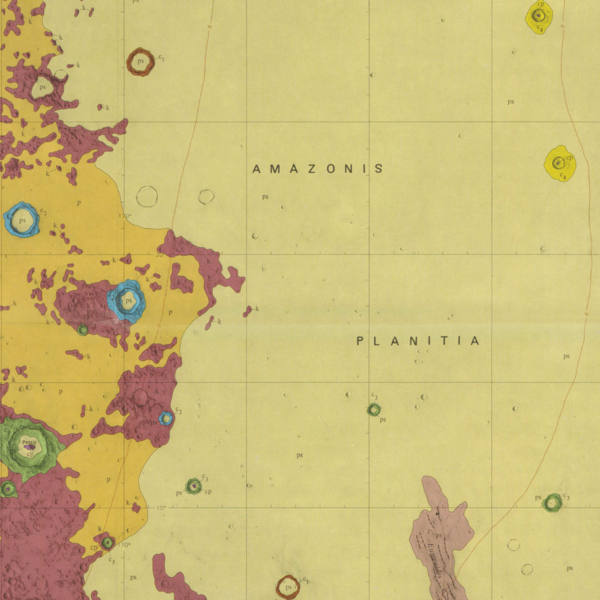
The paper, titled “Geomorphological Evidence of Near-Surface Ice at Candidate Landing Sites in Northern Amazonis Planitia, Mars,” investigates three locations identified as promising sites for future Mars landings. The research team, which includes scientists from several institutions such as NASA Ames and the USGS Astrogeology Science Center, used high-resolution orbital imagery to map and analyze features that suggest the presence of buried ice just tens of centimeters below the Martian surface.
Among the coauthors is Dr. Kaj Williams of USGS Astrogeology. “Our goal was to assess whether ground ice is present, how shallow it might be, and what landforms help reveal that story,” said Williams. “Understanding where and how ice is preserved tells us not only about past surface processes on Mars but also helps us plan for future missions.”
The team focused on features like thermal contraction polygons, expanded and inverted craters, brain coral terrain, and pingo-like mounds—landforms suggestive of freezing, thawing, and sublimation processes over time. Their findings point to widespread evidence of ground ice that could be accessible with relatively simple excavation.
So why does this matter? If humans are going to explore and eventually live on Mars, they’ll need access to ice—for drinking water, making fuel, and supporting other mission needs. While there’s plenty of ice at the poles, those regions are tough to land in, often covered in rough terrain, and receive limited sunlight—making them less practical for solar-powered missions. This study identifies sites where ice appears to be shallow and accessible, and just as importantly, where the ground is smooth and flat enough for safe landings. That combination of resources and favorable terrain makes these mid-latitude locations especially promising as we plan for the next steps in Mars exploration.
We spoke with Dr. Williams to learn more:
Q: On a scale of 1 to 10, how excited were you for this discovery? Why?
A: I’d say an 8. From a science perspective, it’s always rewarding when multiple lines of evidence point to the same conclusion—especially when that conclusion has real operational utility. Finding shallow ice in smooth, flat terrain is a big step forward for mission planning, since those are exactly the kinds of areas preferred for safe landings.
Q: What methods do you use to detect buried ice on Mars, and how do they compare to those used on other planetary bodies?
A: We primarily used high-resolution orbital imagery and digital elevation models to identify surface features that typically form in cold, icy conditions. Much of our approach is grounded in terrestrial geomorphology—comparing Martian landforms to those seen in ice-rich regions on Earth. While this is one way to infer the presence of subsurface ice, it’s complementary to other methods like radar sounding or neutron spectroscopy, which detect physical properties below the surface. On bodies like the Moon or Europa, scientists also rely on a combination of surface morphology and geophysical data to understand what lies beneath.
Q: How might future missions to Mars target and utilize buried ice for scientific study or human exploration?
A: Any future surface mission—robotic or human—would benefit from targeting areas where ice is close to the surface. For human missions, that ice could be used for drinking water, fuel production, and other life support needs. From a science perspective, sampling the ice could help reveal how surface conditions on Mars have changed over time and whether the planet ever had conditions suitable for life.
Q: What do you believe are the primary processes that lead to the formation and preservation of ice beneath the Martian surface?
A: Changes in Mars’ orbit and tilt (its obliquity) play a big role. During periods of high obliquity, more atmospheric water vapor reaches the mid-latitudes, allowing snow or frost to accumulate there. Later, as orbital conditions change, this ice can get buried and preserved beneath a dry protective soil layer.
Q: In your opinion, does the presence of ice increase the likelihood of finding evidence of current or past life on Mars?
A: Ice is a valuable scientific target because it can preserve material for long periods—possibly even organic molecules or other chemical traces of past biological activity, if any ever existed. While we’re not expecting signs of life in the specific areas we studied, the presence of shallow, well-preserved ice does make these sites scientifically interesting. Exploring such locations helps us understand where and how Mars may once have supported conditions favorable to life.
Q: Is there a possibility that AI will have its place in future missions to Mars?
A: Absolutely. AI can help with terrain analysis, landing site selection, and autonomous decision-making for rovers or habitats. As mission complexity increases, so will our reliance on intelligent systems to adapt in real time.
Read the full article
The complete study—“Geomorphological Evidence of Near-Surface Ice at Candidate Landing Sites in Northern Amazonis Planitia, Mars”—was published in the Journal of Geophysical Research: Planets. It includes high-resolution maps and detailed analysis of ice-related landforms across three candidate landing sites.
Access the paper here: https://doi.org/10.1029/2024JE008724