



Carbon in Urban River Biogeochemistry Project
Carbon in Urban River Biogeochemistry Project
The Issue:
In aquatic ecosystems, dissolved organic carbon represents the largest flux of carbon in streams and it is a primary energy source in aquatic food webs. There is limited understanding of how human activities related to urban development influence the timing and scale of carbon cycling in aquatic ecosystems.
How USGS will help:
The USGS is working with university partners to assess how urban development impacts in-stream dissolved organic carbon quality, quantity, and timing in five U.S. cities.
Problem
Most ecosystems worldwide are impacted by human activities; yet the effects of human activities at variable scales are not adequately represented by existing ecosystem models. This is especially true for models of aquatic carbon cycling and fluxes.
Objectives
The Carbon in Urban River Biogeochemistry Project’s main goal is to understand how the things humans build – like wastewater systems and residential neighborhoods – and natural factors – like streamflow and rainfall – influence the amount, makeup, and how easily carbon can be used by organisms and how those effects change in different types of urban areas.
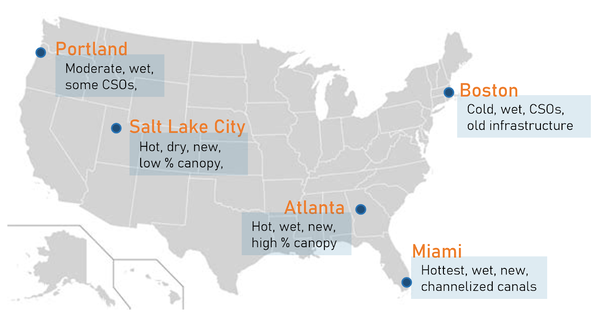
The USGS, in collaboration with university partners, is studying how the quality, quantity, and timing of dissolved organic carbon in streams vary across different urban environments. This research is taking place in five U.S. cities that represent a wide range of climates and eras of urban development. Cities include Portland, Oregon, Salt Lake City, Utah, Atlanta, Georgia, Miami, Florida, and Boston, Massachusetts. By comparing these different urban environments, the study aims to better understand how urban landscapes influence carbon dynamics in freshwater systems.
Approach
Synoptic water quality sampling
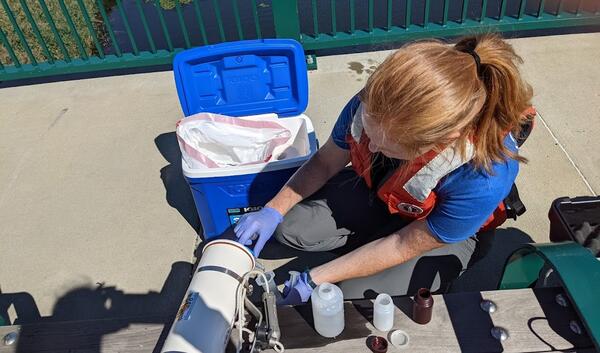
University partners collected water samples over four seasons at 100 urban stream sites in each city. Water samples were analyzed for dissolved organic carbon concentration, bioavailability (via enzyme activity), and fluorescence. Additional measurements of stream discharge, water temperature, pH, specific conductance, and dissolved oxygen were also taken to help contextualize spatial and temporal trends in dissolved organic carbon. These data will be used to assess how human and natural controls on water quality vary across urban contexts.
In-stream water quality sensors
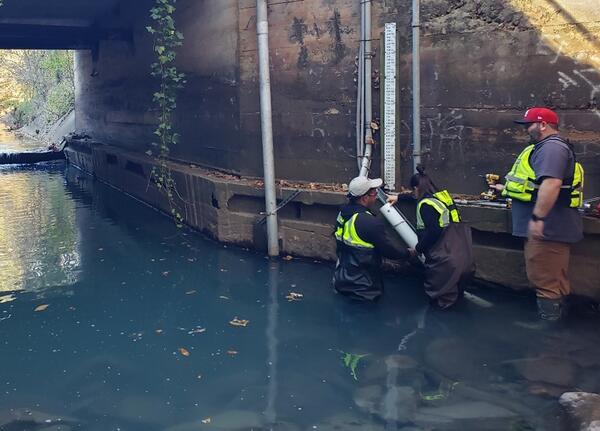
At three sites in each city, university partners installed sensors to measure dissolved organic matter, temperature, pH, conductivity, turbidity, and optical brighteners (an indicator of wastewater contamination). Measurements were recorded at 15-minute intervals for roughly one year. These data will be used to understand how stream water characteristics change over time in urban watersheds.
Relevance and Benefits
By studying how human activities affect carbon in rivers, scientists can better predict when and how carbon is released into the environment—and come up with smarter ways to reduce it. Since organic carbon plays a key role in keeping aquatic ecosystems healthy, this research also helps us understand how streams and rivers work. That means we can make better decisions when restoring urban waterways, leading to cleaner, more vibrant places for both people and wildlife.
The important role of dissolved organic carbon in streams
- Source of energy and carbon for heterotrophic organisms: Dissolved organic carbon is a primary energy source in aquatic food webs and the cycling of nutrients (nitrogen and phosphorous) is tied to these carbon metabolizing processes.
- Influences with light and UV radiation: Dissolved organic carbon absorbs both ultraviolet and visible light, meaning its concentration directly affects how much light is available for organisms that rely on photosynthesis.
- Contaminant transport: Organic compounds and trace metals can bind to dissolved organic carbon thereby influencing their transport and release into aquatic ecosystems.

Data
Data associated with this project are listed below.
Landscape Characteristics
- Hopkins, K.G., Hale, R., Capps, K., Kominoski, J., Morse, J., Roy, A., Blinn, A., Chen, S., Ortiz Muñoz, L., Quick, A., Rudolph, J., 2024, Landscape characteristics for urban gradients in United States cities across multiple scales: U.S. Geological Survey data release, https://doi.org/10.5066/P13UZYZF.
Synoptic Water Quality Data
Data collected by university partners for the synoptic water quality sampling events are available through the Environmental Data Initiative.
Boston, Massachusetts
- Chen, S., L.D. Ortiz Munoz, C.B. Rizzie, J.S. Kominoski, A.M. Quick, A.H. Roy, R.L. Hale, and J.C. Rudolph. 2025. Dissolved organic matter characterization for seasonal synoptic sampling of 100 urban streams in Boston, Massachusetts (USA) from 2021-2022 ver 1. Environmental Data Initiative. https://doi.org/10.6073/pasta/99b6ae080cad891c56175e0f6be93e62
- Ortiz Munoz, L.D., C.B. Rizzie, A.M. Quick, A.H. Roy, J.S. Kominoski, and A. Wang. 2025. Dissolved organic carbon concentrations for seasonal synoptic sampling of 100 urban streams in Boston, Massachusetts (USA) from 2021-2022 ver 1. Environmental Data Initiative. https://doi.org/10.6073/pasta/715dd34e65f50366c8616859287f7d95
- Quick, A.M., A.H. Roy, and A. Wang. 2025. Field data for seasonal synoptic sampling of 100 urban streams in Boston, Massachusetts (USA) from 2021-2022 ver 1. Environmental Data Initiative. https://doi.org/10.6073/pasta/837f189bb5f6e3666f6c175a5bff082e
- Quick, A.M., R.L. Hale, A.H. Roy, A. Wang, and J. Soucie. 2025. High-frequency water quality data for three urban streams in Boston, MA (USA), 2021-2022 ver 1. Environmental Data Initiative. https://doi.org/10.6073/pasta/19f91acc139591ab4e5c6269a025c510 (Accessed 2025-01-13).
Miami, Florida
- Ortiz Muñoz, L.D., J.S. Kominoski, and C.B. Rizzie. 2025. Field data for seasonal synoptic sampling of 100 urban streams in Miami, Florida (USA), 2021-2022 ver 1. Environmental Data Initiative. https://doi.org/10.6073/pasta/e5c0e15e0c96eaaf9123e13727dbff4a
- Chen, S., L.D. Ortiz Muñoz, C.B. Rizzie, and J.S. Kominoski. 2025. Dissolved organic matter characterization for seasonal synoptic sampling of 100 urban streams in Miami, Florida (USA) from 2021-2022 ver 1. Environmental Data Initiative. https://doi.org/10.6073/pasta/8c9eb1f73f1303c758b6731ebf436414
- Ortiz Muñoz, L.D., J.S. Kominoski, and C.B. Rizzie. 2025. Dissolved organic carbon concentrations for seasonal synoptic sampling of 100 urban streams in Miami, Florida (USA) from 2021-2022 ver 1. Environmental Data Initiative. https://doi.org/10.6073/pasta/859b2a48dcd1611568f21ead4f20a487
Portland, Oregon
- Chen, S., J.C. Rudolph, J.L. Morse, R.L. Hale, and J. Ribera. 2025. Dissolved organic matter characterization for seasonal synoptic sampling of 100 urban streams in Portland, Oregon (USA) from 2023-2024 ver 1. Environmental Data Initiative. https://doi.org/10.6073/pasta/f30c3e8a66bde1572d63c8f56eca789a
- Pelc, C., J.C. Rudolph, J.L. Morse, and R.L. Hale. 2025. Dissolved organic carbon concentrations for seasonal synoptic sampling of 100 urban streams in Portland, Oregon (USA) from 2023-2024 ver 1. Environmental Data Initiative. https://doi.org/10.6073/pasta/1704aa9589536e0f91ebc7ebc0045337
- Rudolph, J.C., J.L. Morse, Z. Brauser, and M. Munt. 2025. Field data for seasonal synoptic sampling of 100 urban streams in Portland, Oregon (USA), 2023-2024 ver 1. Environmental Data Initiative. https://doi.org/10.6073/pasta/5ce0fb531349f8be9e9d5b1ae6d7e59a
Salt Lake City, Utah
- Chen, S., A. Blinn, R.L. Hale, and C.B. Rizzie. 2025. Dissolved organic matter characterization for seasonal synoptic sampling of 100 urban streams in Salt Lake City, Utah (USA) from 2023-2024 ver 1. Environmental Data Initiative. https://doi.org/10.6073/pasta/716059e6ea64ce8365deea7e48c85798 (Accessed 2025-08-25).
- Pelc, C., A.J. Blinn, and R.L. Hale. 2025. Dissolved organic carbon concentrations for seasonal synoptic sampling of 100 urban streams in Salt Lake City, Utah (USA) from 2022-2023 ver 1. Environmental Data Initiative. https://doi.org/10.6073/pasta/10cdf2d5f24d63f84499809c701074bb
- Blinn, A.J., R.L. Hale, C. Pelc, and G. Folk. 2025. Field data for seasonal synoptic sampling of 100 urban streams in Salt Lake City, Utah (USA), 2023-2024 ver 1. Environmental Data Initiative. https://doi.org/10.6073/pasta/5ad2734ee474fe8fcf278339de2e3b64
The Issue:
In aquatic ecosystems, dissolved organic carbon represents the largest flux of carbon in streams and it is a primary energy source in aquatic food webs. There is limited understanding of how human activities related to urban development influence the timing and scale of carbon cycling in aquatic ecosystems.
How USGS will help:
The USGS is working with university partners to assess how urban development impacts in-stream dissolved organic carbon quality, quantity, and timing in five U.S. cities.
Problem
Most ecosystems worldwide are impacted by human activities; yet the effects of human activities at variable scales are not adequately represented by existing ecosystem models. This is especially true for models of aquatic carbon cycling and fluxes.
Objectives
The Carbon in Urban River Biogeochemistry Project’s main goal is to understand how the things humans build – like wastewater systems and residential neighborhoods – and natural factors – like streamflow and rainfall – influence the amount, makeup, and how easily carbon can be used by organisms and how those effects change in different types of urban areas.
The USGS, in collaboration with university partners, is studying how the quality, quantity, and timing of dissolved organic carbon in streams vary across different urban environments. This research is taking place in five U.S. cities that represent a wide range of climates and eras of urban development. Cities include Portland, Oregon, Salt Lake City, Utah, Atlanta, Georgia, Miami, Florida, and Boston, Massachusetts. By comparing these different urban environments, the study aims to better understand how urban landscapes influence carbon dynamics in freshwater systems.
Approach
Synoptic water quality sampling
University partners collected water samples over four seasons at 100 urban stream sites in each city. Water samples were analyzed for dissolved organic carbon concentration, bioavailability (via enzyme activity), and fluorescence. Additional measurements of stream discharge, water temperature, pH, specific conductance, and dissolved oxygen were also taken to help contextualize spatial and temporal trends in dissolved organic carbon. These data will be used to assess how human and natural controls on water quality vary across urban contexts.
In-stream water quality sensors
At three sites in each city, university partners installed sensors to measure dissolved organic matter, temperature, pH, conductivity, turbidity, and optical brighteners (an indicator of wastewater contamination). Measurements were recorded at 15-minute intervals for roughly one year. These data will be used to understand how stream water characteristics change over time in urban watersheds.
Relevance and Benefits
By studying how human activities affect carbon in rivers, scientists can better predict when and how carbon is released into the environment—and come up with smarter ways to reduce it. Since organic carbon plays a key role in keeping aquatic ecosystems healthy, this research also helps us understand how streams and rivers work. That means we can make better decisions when restoring urban waterways, leading to cleaner, more vibrant places for both people and wildlife.
The important role of dissolved organic carbon in streams
- Source of energy and carbon for heterotrophic organisms: Dissolved organic carbon is a primary energy source in aquatic food webs and the cycling of nutrients (nitrogen and phosphorous) is tied to these carbon metabolizing processes.
- Influences with light and UV radiation: Dissolved organic carbon absorbs both ultraviolet and visible light, meaning its concentration directly affects how much light is available for organisms that rely on photosynthesis.
- Contaminant transport: Organic compounds and trace metals can bind to dissolved organic carbon thereby influencing their transport and release into aquatic ecosystems.
Data
Data associated with this project are listed below.
Landscape Characteristics
- Hopkins, K.G., Hale, R., Capps, K., Kominoski, J., Morse, J., Roy, A., Blinn, A., Chen, S., Ortiz Muñoz, L., Quick, A., Rudolph, J., 2024, Landscape characteristics for urban gradients in United States cities across multiple scales: U.S. Geological Survey data release, https://doi.org/10.5066/P13UZYZF.
Synoptic Water Quality Data
Data collected by university partners for the synoptic water quality sampling events are available through the Environmental Data Initiative.
Boston, Massachusetts
- Chen, S., L.D. Ortiz Munoz, C.B. Rizzie, J.S. Kominoski, A.M. Quick, A.H. Roy, R.L. Hale, and J.C. Rudolph. 2025. Dissolved organic matter characterization for seasonal synoptic sampling of 100 urban streams in Boston, Massachusetts (USA) from 2021-2022 ver 1. Environmental Data Initiative. https://doi.org/10.6073/pasta/99b6ae080cad891c56175e0f6be93e62
- Ortiz Munoz, L.D., C.B. Rizzie, A.M. Quick, A.H. Roy, J.S. Kominoski, and A. Wang. 2025. Dissolved organic carbon concentrations for seasonal synoptic sampling of 100 urban streams in Boston, Massachusetts (USA) from 2021-2022 ver 1. Environmental Data Initiative. https://doi.org/10.6073/pasta/715dd34e65f50366c8616859287f7d95
- Quick, A.M., A.H. Roy, and A. Wang. 2025. Field data for seasonal synoptic sampling of 100 urban streams in Boston, Massachusetts (USA) from 2021-2022 ver 1. Environmental Data Initiative. https://doi.org/10.6073/pasta/837f189bb5f6e3666f6c175a5bff082e
- Quick, A.M., R.L. Hale, A.H. Roy, A. Wang, and J. Soucie. 2025. High-frequency water quality data for three urban streams in Boston, MA (USA), 2021-2022 ver 1. Environmental Data Initiative. https://doi.org/10.6073/pasta/19f91acc139591ab4e5c6269a025c510 (Accessed 2025-01-13).
Miami, Florida
- Ortiz Muñoz, L.D., J.S. Kominoski, and C.B. Rizzie. 2025. Field data for seasonal synoptic sampling of 100 urban streams in Miami, Florida (USA), 2021-2022 ver 1. Environmental Data Initiative. https://doi.org/10.6073/pasta/e5c0e15e0c96eaaf9123e13727dbff4a
- Chen, S., L.D. Ortiz Muñoz, C.B. Rizzie, and J.S. Kominoski. 2025. Dissolved organic matter characterization for seasonal synoptic sampling of 100 urban streams in Miami, Florida (USA) from 2021-2022 ver 1. Environmental Data Initiative. https://doi.org/10.6073/pasta/8c9eb1f73f1303c758b6731ebf436414
- Ortiz Muñoz, L.D., J.S. Kominoski, and C.B. Rizzie. 2025. Dissolved organic carbon concentrations for seasonal synoptic sampling of 100 urban streams in Miami, Florida (USA) from 2021-2022 ver 1. Environmental Data Initiative. https://doi.org/10.6073/pasta/859b2a48dcd1611568f21ead4f20a487
Portland, Oregon
- Chen, S., J.C. Rudolph, J.L. Morse, R.L. Hale, and J. Ribera. 2025. Dissolved organic matter characterization for seasonal synoptic sampling of 100 urban streams in Portland, Oregon (USA) from 2023-2024 ver 1. Environmental Data Initiative. https://doi.org/10.6073/pasta/f30c3e8a66bde1572d63c8f56eca789a
- Pelc, C., J.C. Rudolph, J.L. Morse, and R.L. Hale. 2025. Dissolved organic carbon concentrations for seasonal synoptic sampling of 100 urban streams in Portland, Oregon (USA) from 2023-2024 ver 1. Environmental Data Initiative. https://doi.org/10.6073/pasta/1704aa9589536e0f91ebc7ebc0045337
- Rudolph, J.C., J.L. Morse, Z. Brauser, and M. Munt. 2025. Field data for seasonal synoptic sampling of 100 urban streams in Portland, Oregon (USA), 2023-2024 ver 1. Environmental Data Initiative. https://doi.org/10.6073/pasta/5ce0fb531349f8be9e9d5b1ae6d7e59a
Salt Lake City, Utah
- Chen, S., A. Blinn, R.L. Hale, and C.B. Rizzie. 2025. Dissolved organic matter characterization for seasonal synoptic sampling of 100 urban streams in Salt Lake City, Utah (USA) from 2023-2024 ver 1. Environmental Data Initiative. https://doi.org/10.6073/pasta/716059e6ea64ce8365deea7e48c85798 (Accessed 2025-08-25).
- Pelc, C., A.J. Blinn, and R.L. Hale. 2025. Dissolved organic carbon concentrations for seasonal synoptic sampling of 100 urban streams in Salt Lake City, Utah (USA) from 2022-2023 ver 1. Environmental Data Initiative. https://doi.org/10.6073/pasta/10cdf2d5f24d63f84499809c701074bb
- Blinn, A.J., R.L. Hale, C. Pelc, and G. Folk. 2025. Field data for seasonal synoptic sampling of 100 urban streams in Salt Lake City, Utah (USA), 2023-2024 ver 1. Environmental Data Initiative. https://doi.org/10.6073/pasta/5ad2734ee474fe8fcf278339de2e3b64