



Dryland Carbon



Detailed Description
While it’s easy to assume there’s not much going on in deserts and other types of drylands, the opposite is true! Come with us to learn more about these underappreciated ecosystems; once you get to know them, we are sure you will love drylands as much as we do!
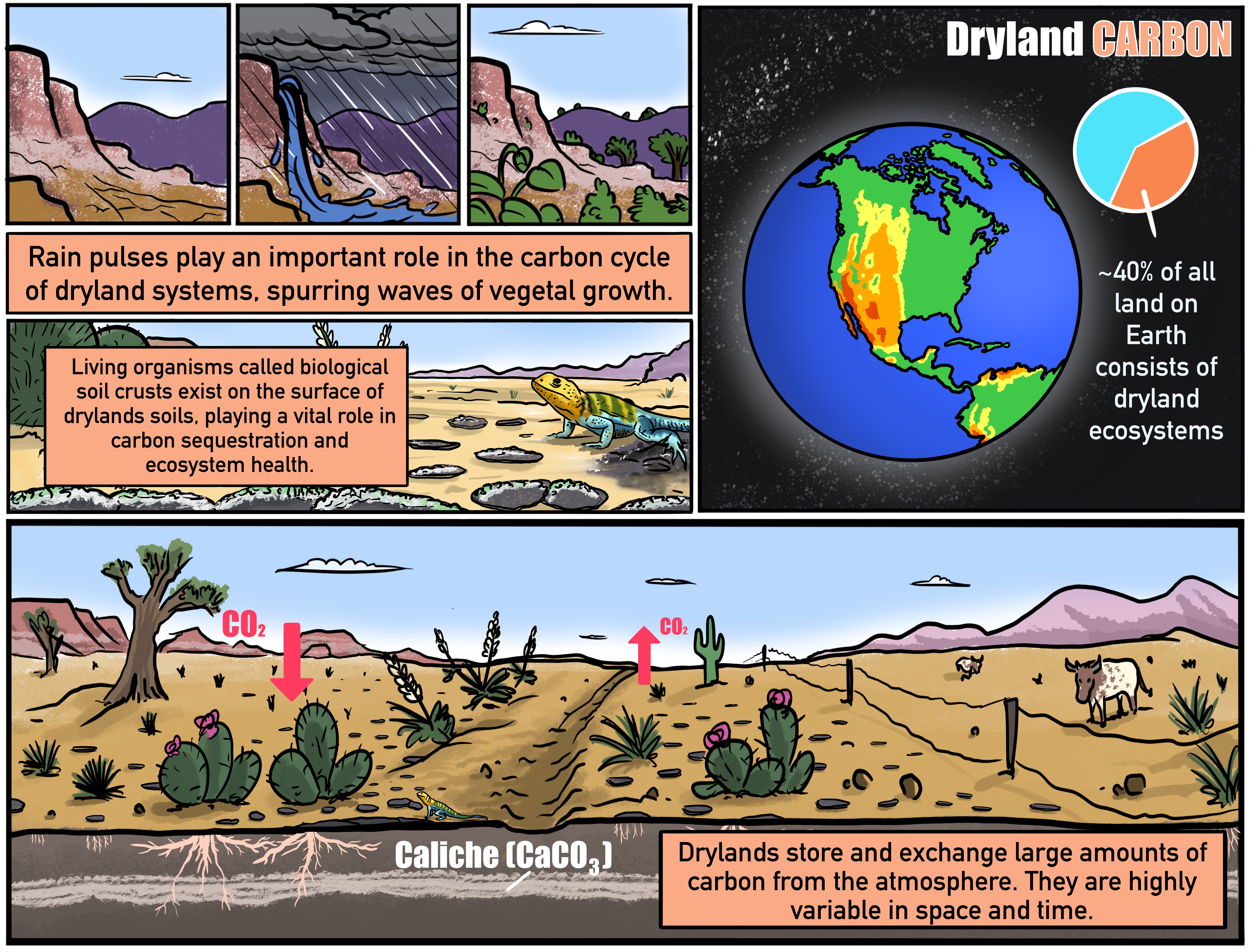
Drylands are landscapes that have a scarcity of water, including deserts such as the Sonoran Desert with its iconic Saguaro cacti and the sagebrush steppes of the American West. Covering roughly 40% of Earth’s land surface, drylands are our planet’s largest terrestrial biome - one in every three people lives in a dryland. These ecosystems are critical for ranching and grazing (drylands produce 60% of our food!), as well as maintaining biodiversity, supplying energy and minerals, and hiking and recreation. Because of their large spatial extent, drylands are also important ecosystems for the global carbon cycle, storing and exchanging large amounts of carbon with the atmosphere.
Drylands are super dynamic systems, which affects the carbon cycle in big ways. Infrequent rain spurs an explosion of plant growth, turning seemingly barren lands into lush floral meadows and temporarily green oases. These pulses of activity suck up lots of carbon dioxide and store it underground in robust root systems. Evaporation of moisture from dryland soils also drives accumulation of inorganic carbon in the soil as a caliche layer – or a chalky, carbon-rich layer unique to dryland soils. We’re talking biological AND geological carbon sequestration – so cool!
In drylands, the soil is alive! There is a photosynthetic living skin covering dryland soils around the world, and it’s called Biological Soil Crust. Biocrusts are a consortium of mosses, lichens, and cyanobacteria that live on the soil surface and play a vital role in carbon sequestration and ecosystem health. Biological crusts stabilize soil from erosion, provide fertility, host biodiversity, and retain moisture, facilitating plant growth.
The IPCC has determined drylands are one of three biomes most vulnerable to climate change, at risk of becoming even hotter and even drier in the future. USGS science is at the forefront of studying how dryland systems work, how they are changing, and what they mean for the communities and ecosystems that rely on them. So the next time someone calls a desert a wasteland, you can let them know that drylands are actually super important and dynamic ecosystems that support life and play big roles in Earth’s carbon cycle and climate!
Designed by ORISE Participant, Ben Slyngstad.
You can find more climate illustrations here.
Sources/Usage
Public Domain.