





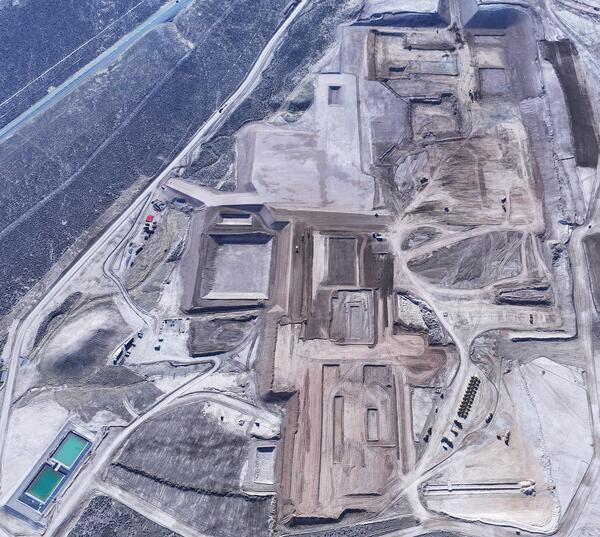
A bird’s eye view of the Thacker Pass lithium mine captured in late February 2025 reveals the contours of the process plant pad taking shape. Lithium Americas, the company that owns the mine, used Landsat data to help determine its potential impact on sagebrush environments and groundwater.
USGS MRP Coloring Page Lepidolite
Detailed Description
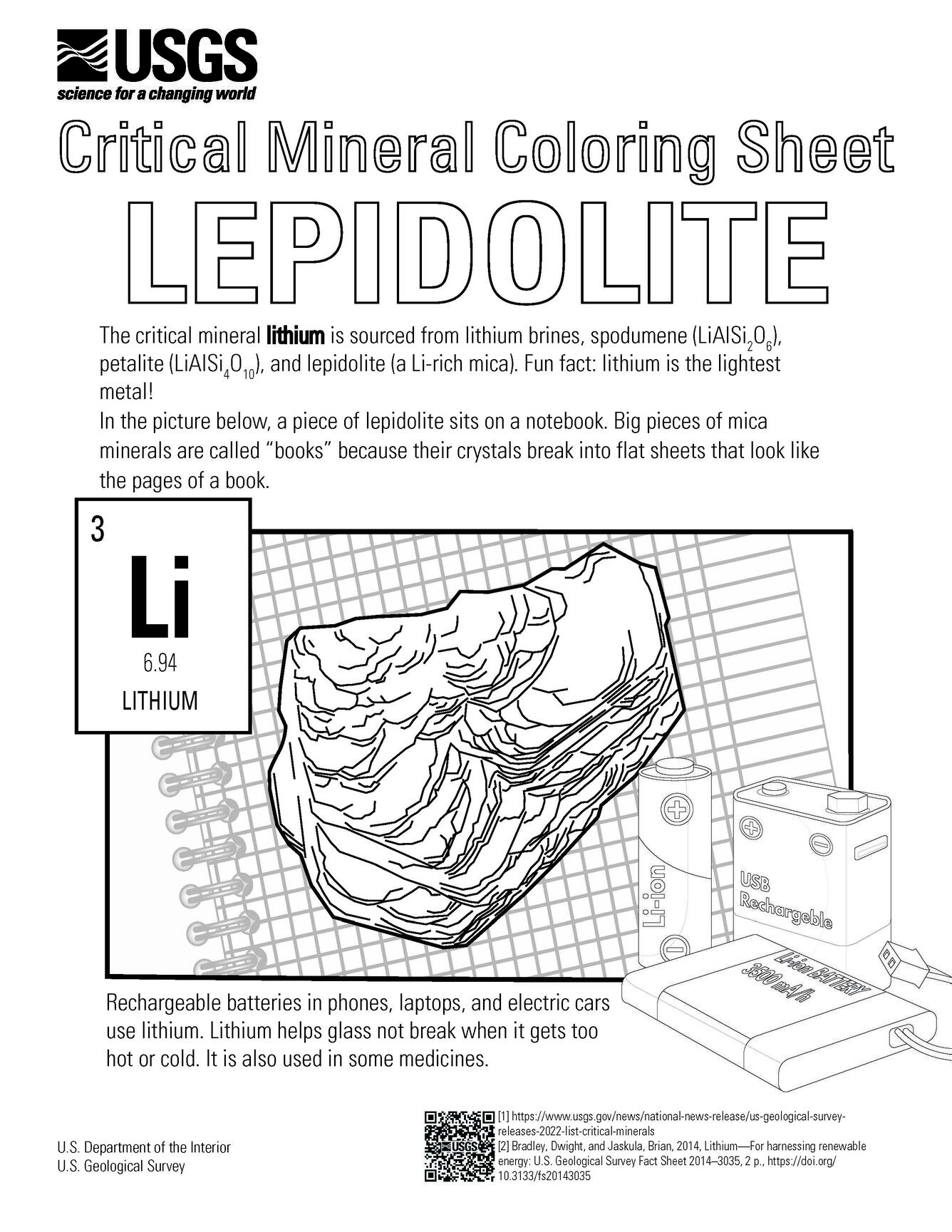
Critical Minerals Coloring Sheet: lepidolite
The critical mineral lithium is sourced from lithium brines, spodumene (LiAlSi2O6), petalite (LiAlSi4O10), and lepidolite (a Li-rich mica). Fun fact: lithium is the lightest metal!
In the picture, a piece of lepidolite sits on a notebook. Big pieces of mica minerals are called "books" because their crystals break into flat sheets that look like the pages of a book.
Sources/Usage
Public Domain.
Related
Thacker Pass Lithium Mining
A bird’s eye view of the Thacker Pass lithium mine captured in late February 2025 reveals the contours of the process plant pad taking shape. Lithium Americas, the company that owns the mine, used Landsat data to help determine its potential impact on sagebrush environments and groundwater.

Spodumene
Mineral origin: Hallman Beam Mine, Cherryville, NC
Primary mineral commodity: Lithium
Uses: batteries for cell phones, laptops, and electric and hybrid vehicles
Mineral origin: Hallman Beam Mine, Cherryville, NC
Primary mineral commodity: Lithium
Uses: batteries for cell phones, laptops, and electric and hybrid vehicles

Lithium Mining in Salar de Atacama, Chile
The Salar de Atacama in Chile is a large, dry salt flat surrounded by mountain ranges and is one of the driest places on Earth. Parts of the Atacama Desert have gone without rain for as long as people have been keeping track, but water rich in dissolved salts lies beneath this flat surface. The Salar is particularly rich in lithium salts.
The Salar de Atacama in Chile is a large, dry salt flat surrounded by mountain ranges and is one of the driest places on Earth. Parts of the Atacama Desert have gone without rain for as long as people have been keeping track, but water rich in dissolved salts lies beneath this flat surface. The Salar is particularly rich in lithium salts.
Related
Thacker Pass Lithium Mining
A bird’s eye view of the Thacker Pass lithium mine captured in late February 2025 reveals the contours of the process plant pad taking shape. Lithium Americas, the company that owns the mine, used Landsat data to help determine its potential impact on sagebrush environments and groundwater.
A bird’s eye view of the Thacker Pass lithium mine captured in late February 2025 reveals the contours of the process plant pad taking shape. Lithium Americas, the company that owns the mine, used Landsat data to help determine its potential impact on sagebrush environments and groundwater.
Spodumene
Mineral origin: Hallman Beam Mine, Cherryville, NC
Primary mineral commodity: Lithium
Uses: batteries for cell phones, laptops, and electric and hybrid vehicles
Mineral origin: Hallman Beam Mine, Cherryville, NC
Primary mineral commodity: Lithium
Uses: batteries for cell phones, laptops, and electric and hybrid vehicles
Lithium Mining in Salar de Atacama, Chile
The Salar de Atacama in Chile is a large, dry salt flat surrounded by mountain ranges and is one of the driest places on Earth. Parts of the Atacama Desert have gone without rain for as long as people have been keeping track, but water rich in dissolved salts lies beneath this flat surface. The Salar is particularly rich in lithium salts.
The Salar de Atacama in Chile is a large, dry salt flat surrounded by mountain ranges and is one of the driest places on Earth. Parts of the Atacama Desert have gone without rain for as long as people have been keeping track, but water rich in dissolved salts lies beneath this flat surface. The Salar is particularly rich in lithium salts.