USGS MRP Critical Mineral Word Scramble Puzzle: Tantalum
USGS MRP Critical Mineral Word Scramble Puzzle: TantalumUSGS Mineral Resources Program Critical Mineral Word Scramble Puzzle: Tantalum


Official websites use .gov
A .gov website belongs to an official government organization in the United States.

Secure .gov websites use HTTPS
A lock () or https:// means you’ve safely connected to the .gov website. Share sensitive information only on official, secure websites.

Danielle Olinger is a geologist with the Geology, Geophysics, and Geochemistry Science Center.
Danielle is interested in igneous petrology and trace element geochemistry as it relates to understanding ore deposits. Her primary research focuses on characterizing the the formation of critical mineral deposits hosted in carbonatite-alkaline silicate complexes. Danielle is also researching the formation of lead-zinc deposits in the Colorado Mineral Belt. Danielle uses a variety of analytical methods including: optical petrography, fluid inclusion microthermometry, RAMAN spectroscopy, laser ablation ICP-MS, micro XRF, whole-rock geochemistry, in-situ isotopic analysis, and microbeam analysis (SEM, EPMA).
Danielle is also dedicated to educational outreach and leads a task developing educational products for K-12 audiences (and beyond) that effectively communicate how geosciences and mineral resources impact our everyday lives.


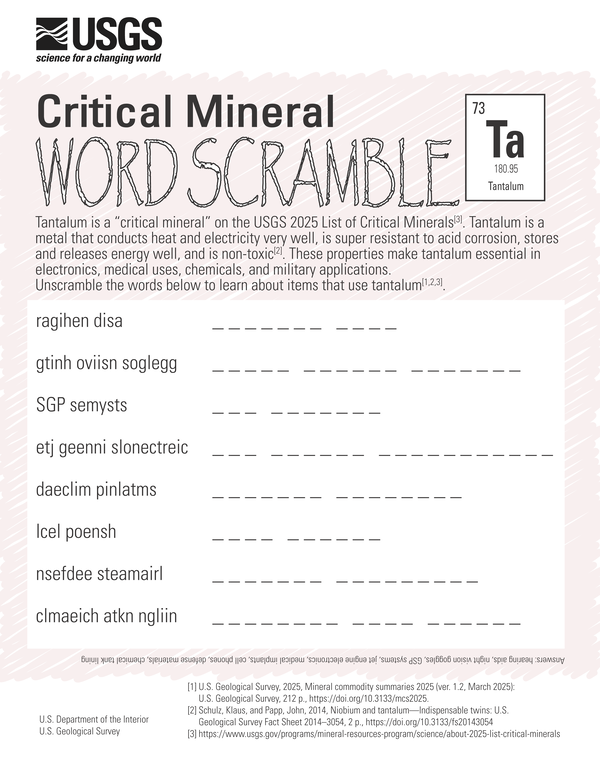
USGS Mineral Resources Program Critical Mineral Word Scramble Puzzle: Tantalum
USGS Mineral Resources Program Critical Mineral Word Scramble Puzzle: Tantalum
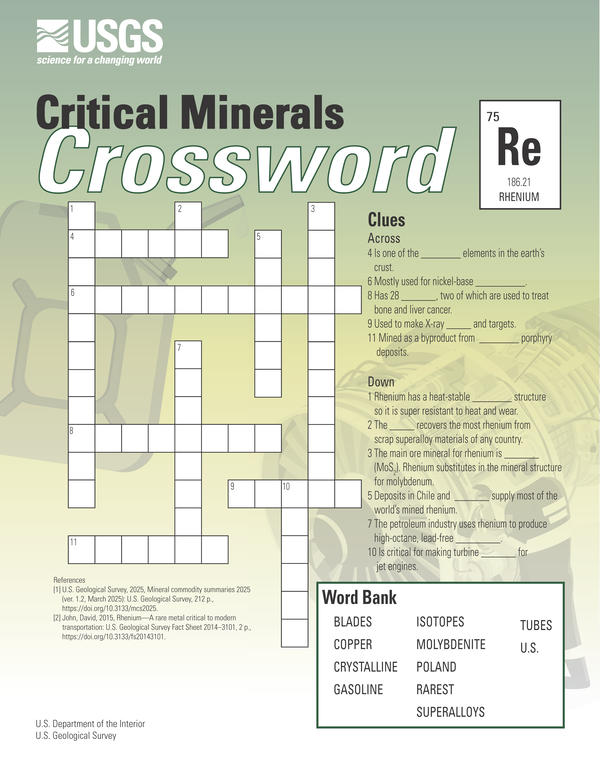
Critical Mineral Crossword Puzzle: Rhenium.
Rhenium is listed as "critical mineral". Learn about where we get rhenium and how we use it by solving the crossword puzzle clues!
More information
Critical Mineral Crossword Puzzle: Rhenium.
Rhenium is listed as "critical mineral". Learn about where we get rhenium and how we use it by solving the crossword puzzle clues!
More information
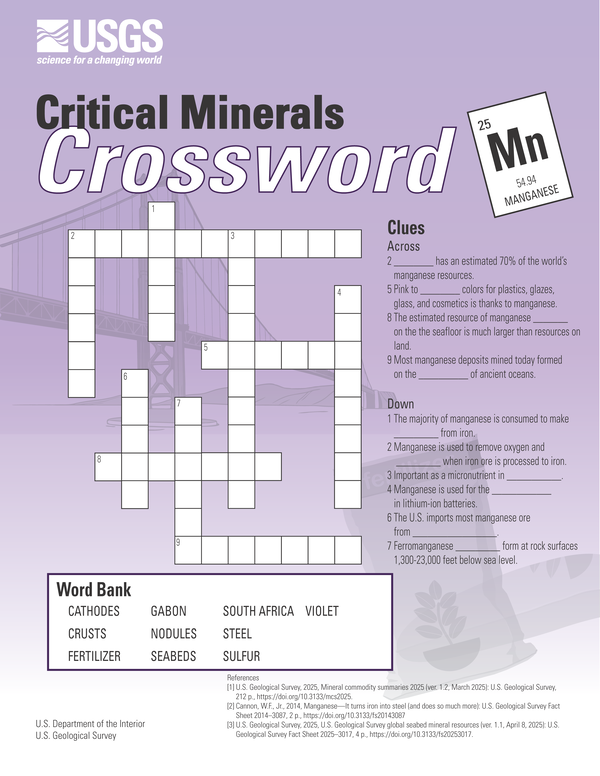
Critical Mineral Crossword Puzzle: Manganese
Manganese is listed as a "critical mineral". Learn about where we get manganese and how we use it by solving the crossword puzzle clues!
More information:
Critical Mineral Crossword Puzzle: Manganese
Manganese is listed as a "critical mineral". Learn about where we get manganese and how we use it by solving the crossword puzzle clues!
More information:
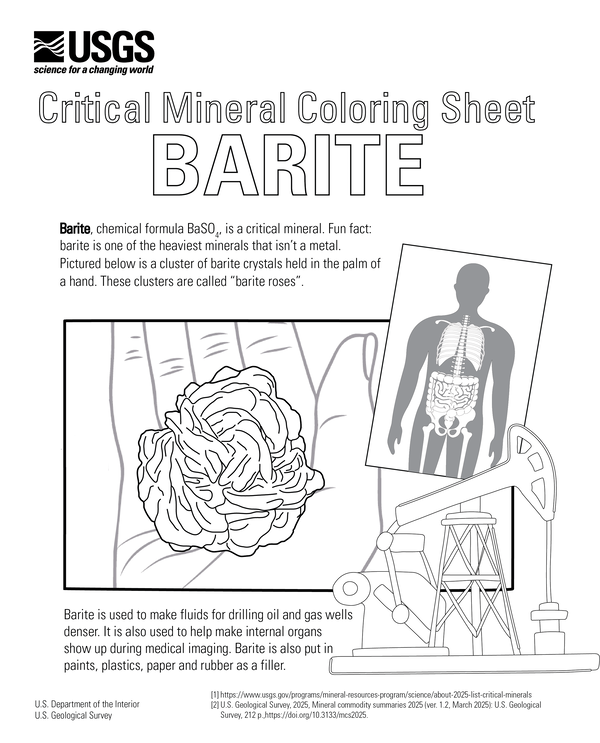
USGS Mineral Resources Program coloring page for the critical mineral barite.
Barite, chemical formula BaSO4, is a critical mineral. Fun fact: barite is one of the heaviest minerals that isn't a metal.
USGS Mineral Resources Program coloring page for the critical mineral barite.
Barite, chemical formula BaSO4, is a critical mineral. Fun fact: barite is one of the heaviest minerals that isn't a metal.
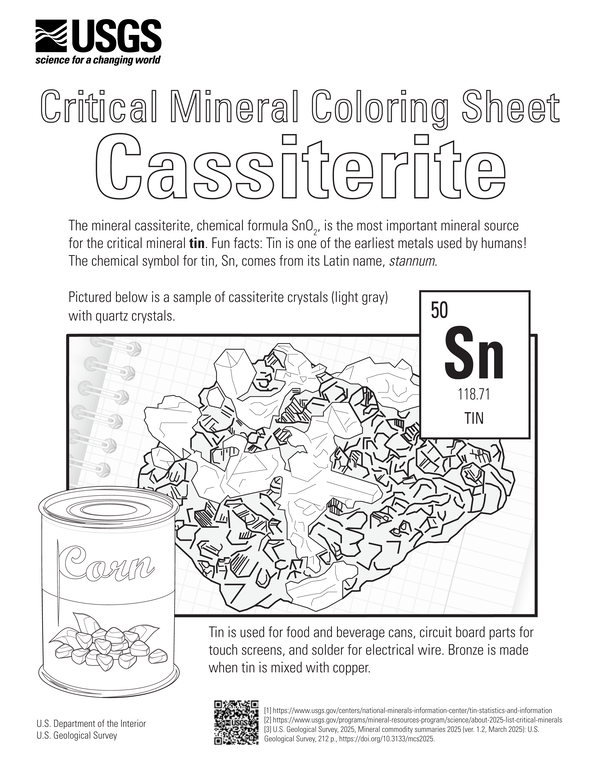
USGS Mineral Resources Program coloring page for cassiterite and the critical mineral tin.
The mineral cassiterite, chemical formula SnO2, is the most important mineral source for the critical mineral tin. Fun facts: tin is one of the earliest metals used by humans! The chemical symbol for tin, Sn, comes from its Latin name, stannum.
USGS Mineral Resources Program coloring page for cassiterite and the critical mineral tin.
The mineral cassiterite, chemical formula SnO2, is the most important mineral source for the critical mineral tin. Fun facts: tin is one of the earliest metals used by humans! The chemical symbol for tin, Sn, comes from its Latin name, stannum.
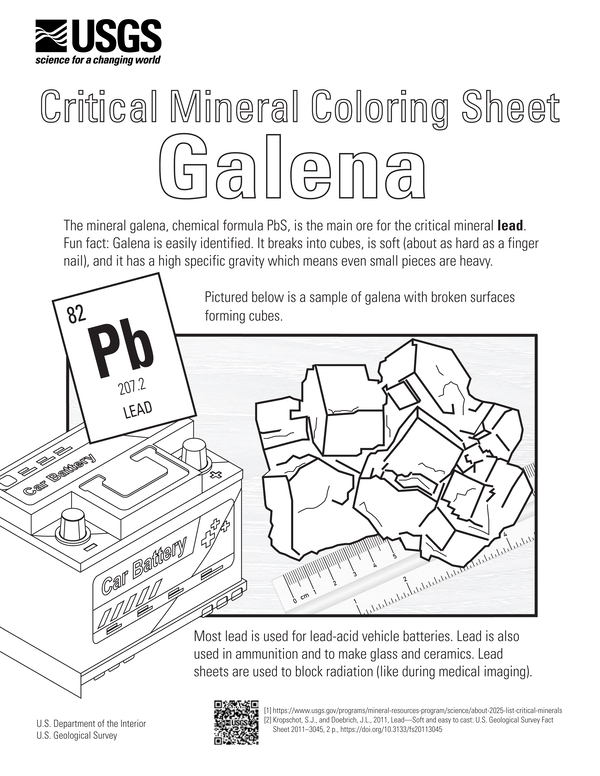
USGS Mineral Resources Program coloring page for the mineral galena and the critical mineral lead.
USGS Mineral Resources Program coloring page for the mineral galena and the critical mineral lead.
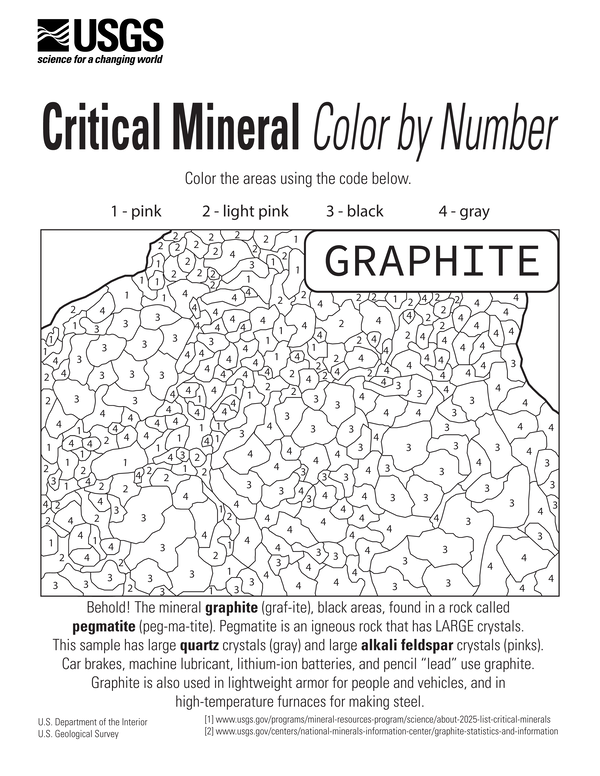
USGS Mineral Resources Program color by number for the critical mineral graphite.
USGS Mineral Resources Program color by number for the critical mineral graphite.
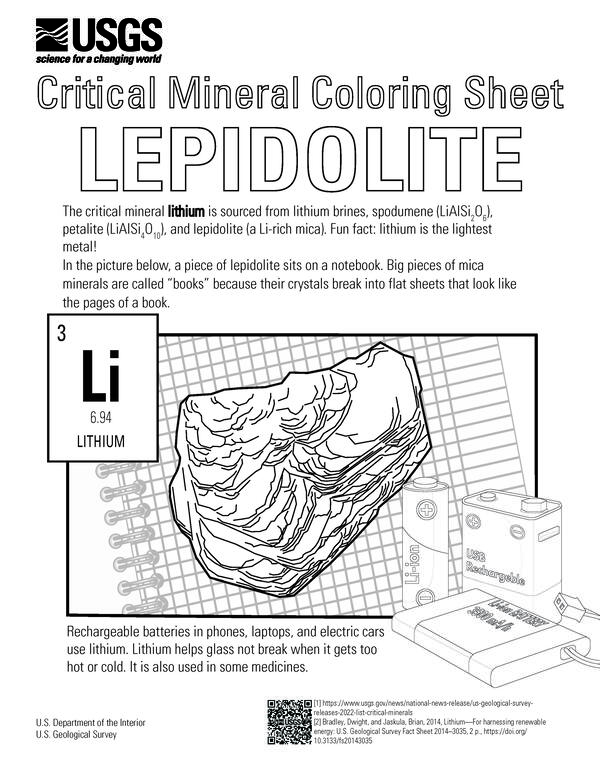
Critical Minerals Coloring Sheet: lepidolite
The critical mineral lithium is sourced from lithium brines, spodumene (LiAlSi2O6), petalite (LiAlSi4O10), and lepidolite (a Li-rich mica). Fun fact: lithium is the lightest metal!
Critical Minerals Coloring Sheet: lepidolite
The critical mineral lithium is sourced from lithium brines, spodumene (LiAlSi2O6), petalite (LiAlSi4O10), and lepidolite (a Li-rich mica). Fun fact: lithium is the lightest metal!
USGS Mineral Resources Program Critical Mineral Word Scramble Puzzle: Tantalum
USGS Mineral Resources Program Critical Mineral Word Scramble Puzzle: Tantalum
Critical Mineral Crossword Puzzle: Rhenium.
Rhenium is listed as "critical mineral". Learn about where we get rhenium and how we use it by solving the crossword puzzle clues!
More information
Critical Mineral Crossword Puzzle: Rhenium.
Rhenium is listed as "critical mineral". Learn about where we get rhenium and how we use it by solving the crossword puzzle clues!
More information
Critical Mineral Crossword Puzzle: Manganese
Manganese is listed as a "critical mineral". Learn about where we get manganese and how we use it by solving the crossword puzzle clues!
More information:
Critical Mineral Crossword Puzzle: Manganese
Manganese is listed as a "critical mineral". Learn about where we get manganese and how we use it by solving the crossword puzzle clues!
More information:
USGS Mineral Resources Program coloring page for the critical mineral barite.
Barite, chemical formula BaSO4, is a critical mineral. Fun fact: barite is one of the heaviest minerals that isn't a metal.
USGS Mineral Resources Program coloring page for the critical mineral barite.
Barite, chemical formula BaSO4, is a critical mineral. Fun fact: barite is one of the heaviest minerals that isn't a metal.
USGS Mineral Resources Program coloring page for cassiterite and the critical mineral tin.
The mineral cassiterite, chemical formula SnO2, is the most important mineral source for the critical mineral tin. Fun facts: tin is one of the earliest metals used by humans! The chemical symbol for tin, Sn, comes from its Latin name, stannum.
USGS Mineral Resources Program coloring page for cassiterite and the critical mineral tin.
The mineral cassiterite, chemical formula SnO2, is the most important mineral source for the critical mineral tin. Fun facts: tin is one of the earliest metals used by humans! The chemical symbol for tin, Sn, comes from its Latin name, stannum.
USGS Mineral Resources Program coloring page for the mineral galena and the critical mineral lead.
USGS Mineral Resources Program coloring page for the mineral galena and the critical mineral lead.
USGS Mineral Resources Program color by number for the critical mineral graphite.
USGS Mineral Resources Program color by number for the critical mineral graphite.
Critical Minerals Coloring Sheet: lepidolite
The critical mineral lithium is sourced from lithium brines, spodumene (LiAlSi2O6), petalite (LiAlSi4O10), and lepidolite (a Li-rich mica). Fun fact: lithium is the lightest metal!
Critical Minerals Coloring Sheet: lepidolite
The critical mineral lithium is sourced from lithium brines, spodumene (LiAlSi2O6), petalite (LiAlSi4O10), and lepidolite (a Li-rich mica). Fun fact: lithium is the lightest metal!
*Disclaimer: Listing outside positions with professional scientific organizations on this Staff Profile are for informational purposes only and do not constitute an endorsement of those professional scientific organizations or their activities by the USGS, Department of the Interior, or U.S. Government