



Volcano Watch — Water in Kīlauea, and its role in its eruptions
When most people think of erupting water, they probably have geysers, like Old Faithful Geyser in Yellowstone National Park, in mind. However, Kīlauea and its diverse style of eruptions are also significantly impacted by water. In fact, some of Kīlauea’s past explosive eruptions occurred when magma erupted through groundwater or through a lake in a summit crater.
Volcano Watch is a weekly article and activity update written by U.S. Geological Survey Hawaiian Volcano Observatory scientists and affiliates. Today's article is by USGS California Volcano Observatory research hydrologist Shaul Hurwitz.
Water (H2O) that originates from the atmosphere—including snow and rain—is called “meteoric water.” The large amounts of rain in and around Kīlauea seep into the ground (rather than flow in streams) because the shallow basaltic rocks of Kīlauea have very high permeability, meaning that a lot of water can flow through them. When the water is beneath the ground, it is called groundwater.
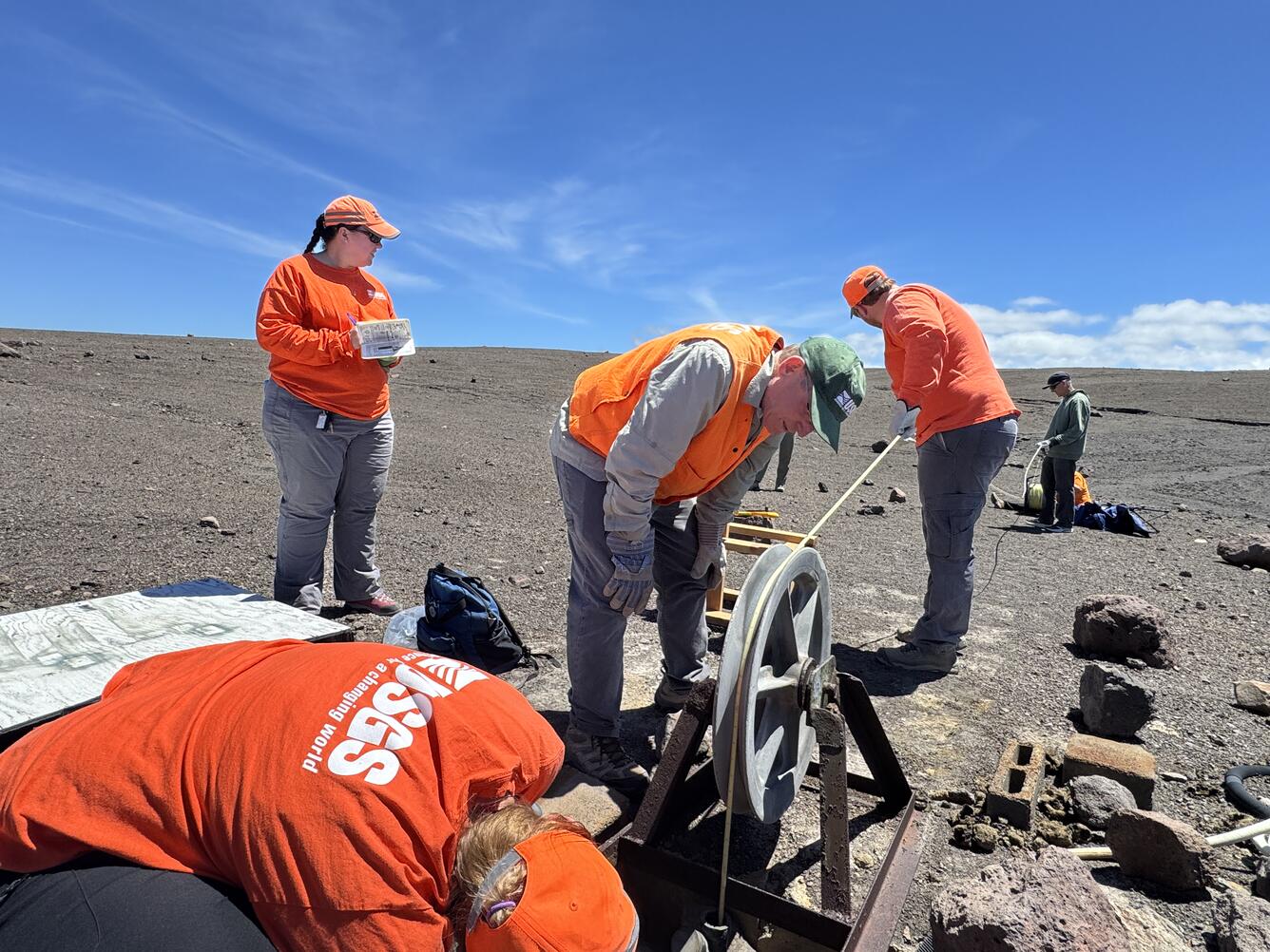
Measurements made for more than two decades in a deep well on Kīlauea’s summit have provided information on the depth of groundwater, and it is deep! Until the 2018 eruption, water level in the well varied between about 1600 and 1620 feet (488–494 meters) below the ground surface. After the 2018 eruption, water in the well dropped to about 1660–1670 feet (506–509 meters). This is about 2400 feet (740 meters) above sea level. Chemical analysis of water from the well has informed scientists how much gas emitted from the magma is absorbed by groundwater. Although the water in the well contains significant amounts of sulfur and chlorine that are from the magma, the water itself is predominantly meteoric.
Another, albeit short, glimpse into Kīlauea’s groundwater came from sampling a water lake that filled the
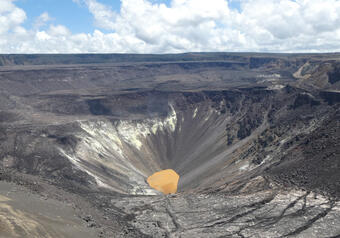
Kīlauea summit crater between July 2019 and December 2020. That lake was mostly filled by groundwater flowing from the surrounding rocks. To know what was in the water, HVO scientists collected samples using drones (or UAS, or Uncrewed Aircraft Systems). Chemical analysis of the water revealed that it was very saline (about twice the salinity of seawater) and contained a lot of sulfur. However, the sulfur in the lake was not derived from gas released by an underlying magma but from leaching of minerals containing sulfur (sulfate minerals). At that time (2019–2020), that inference suggested a small likelihood of an explosive phreatomagmatic eruption (an eruption that occurs when magma interacts with external water).
Although most of the water below ground is meteoric, small amounts of water are also dissolved in deep magma—similar to carbon dioxide (CO2) being dissolved in carbonated drinks. When the magma moves closer to the ground surface and the pressure on the magma decreases, water (and other gases) is released from the magma. The water released from the magma is either emitted to the air as a gas plume (with the other gases, such as sulfur dioxide), or it mixes with meteoric groundwater. The process is like opening a bottle of soda that causes the CO2 to be released from the liquid, form bubbles, and escape from the bottle.
Most measurements of gas emission in Kīlauea are focused on determining the amount of sulfur dioxide (SO2) but the most abundant gas in the plume is actually water (as steam). On average gas plumes in Kīlauea contain about 90% water. How do scientists know that? By measuring the concentrations of gas samples collected from high temperature fumaroles and from remote measurements with an instrument called Fourier Transform infrared spectrometer (FTIR) that can measure the relative abundance of some gases, including those of SO2, CO2, hydrogen chloride (HCl), and water.
Water is a key ingredient in all volcanoes. At Kīlauea, water has a significant impact on the explosivity of the eruptions, on the texture of erupted rocks, and on the amounts and compositions of gases emitted. Kīlauea’s continuous evolution is controlled by many factors and water is one of the most significant.
For further reading: Groundwater Dynamics at Kīlauea Volcano and Vicinity, Hawaiʻi. In U.S. Geological Survey Professional Paper 1867.
Volcano Activity Updates
Kīlauea has been erupting episodically within the summit caldera since December 23, 2024. Its USGS Volcano Alert level is WATCH.
Episode 30 of the Kīlauea summit eruption in Halemaʻumaʻu crater occurred on August 6. Summit region inflation since the end of episode 30, along with low-level tremor, suggests that another episode could occur within the next week. Sulfur dioxide emission rates are elevated in the summit region during active eruption episodes. No unusual activity has been noted along Kīlauea’s East Rift Zone or Southwest Rift Zone.
Mauna Loa is not erupting. Its USGS Volcano Alert Level is at NORMAL.
No earthquakes were reported felt in the Hawaiian Islands during the past week.
HVO continues to closely monitor Kīlauea and Mauna Loa.
Please visit HVO’s website for past Volcano Watch articles, Kīlauea and Mauna Loa updates, volcano photos, maps, recent earthquake information, and more. Email questions to askHVO@usgs.gov.