



Hunting for Sasquatch (events) at Biscuit Basin in Yellowstone
Sasquatch is a mythical creature with scant evidence to support its existence. Likewise, eruptions from Black Diamond Pool since last July were almost mythical, with few sightings and ambiguous evidence. Until May 31, 2025, that is…
Yellowstone Caldera Chronicles is a weekly column written by scientists and collaborators of the Yellowstone Volcano Observatory. This week's contribution is from Mara H. Reed, Samantha R. Hilburn, and Margery B. Price, physical science technicians in the Geology Program at Yellowstone National Park.
Since May 14, 2025, Yellowstone Volcano Observatory (YVO) scientists have remotely monitored activity in Biscuit Basin using a webcam installed next to Black Diamond Pool. Biscuit Basin remains closed to the public after a dramatic hydrothermal explosion on July 23, 2024 sent mud, rocks, and water at least 400 feet (120 meters) into the air. While this event was the largest known to occur at Biscuit Basin, Black Diamond Pool has a long history of eruptions and probably even formed due to a hydrothermal explosion sometime between 1902 and 1912.
YVO scientists suspected that explosive eruptions continued at Black Diamond after July 23, 2024. New sediment and rock debris appeared regularly over the months that followed the initial explosion. Monitoring equipment also indicated that something was going on, but only two eruptions were witnessed by people (on November 5, 2024, and January 3, 2025). The events toppled small seismometers, buried temperature sensors in mud, and in one case washed a temperature sensor down into the Firehole River. Based on the temperature record from several sensors, at least eight events occurred between January and April 2025, but scientists could not determine the size or duration of eruptions from available data. Due to their mysterious nature, scientists started to call the events “Sasquatch” eruptions, referencing a creature from North American folklore (also called Bigfoot).
The webcam was installed in hopes of finally catching an event on video. The camera sends images to a public website every 15 minutes and records video on site that can be downloaded later if warranted. At first light on May 21, images from the camera indicated loose sediment chunks on the pool and an increase in turbidity from the previous night—possibly the aftermath of an overnight eruption. Then, on the evening of May 31, several people, including citizen scientist Craig Munson, Jr., observed newly displaced rocks and wet ground in the 8:45 p.m. webcam image that had not been present in the 8:30 p.m. image. YVO scientists remotely downloaded video footage from the webcam, which revealed a four-second-long eruption of water, steam, and sediment to 20–30 feet (6–9 meters) high at 8:39 p.m.
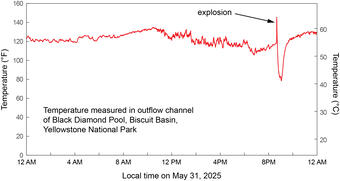
At last, a Sasquatch sighting! One of the temperature sensors previously installed in a runoff channel of Black Diamond Pool also recorded a strong signal from the event. Temperature increased from approximately 125.2 °F (51.8 °C) to 146.5 °F (63.6 °C) and back down to 125.4 °F (51.9 °C) over the span of about four minutes. The temperature then dropped before returning to normal over the course of an hour as the pool recovered from the eruption.
The May 31 event was not the only eruption captured by the new camera. Similar eruptions occurred on June 12, July 3, and July 14, 2025. Combined with temperature and infrasound sensor records, webcam footage provides an additional source of data to further constrain the size and duration of eruptions.
Hydrothermal explosions or eruptions, like the “Sasquatch” events observed at Black Diamond Pool, are caused by pressure changes resulting from the transition of liquid water to steam. These explosions are not triggered directly by magma or magmatic gases interacting with shallow groundwater; rather, when water boils in a confined space, expanding steam bubbles build enough pressure to eventually overcome the strength of sealed rock, causing an explosion. The July 23, 2024, explosion at Black Diamond Pool clearly changed the shallow hot water and steam plumbing system of the feature, so that now it seems to favor small eruptions every few days to weeks.
Hazards associated with hydrothermal events cannot be understated. The July 2024 event at Biscuit Basin expelled boulders large enough to smash through boardwalks as visitors ran for safety. Fortunately, no one was injured, but the damage to boardwalks and ongoing “Sasquatch” eruptions mean that the basin remains closed for safety. But data from the camera and other monitoring instruments—including a seismic/infrasound/GPS/weather station that was installed in late July—should help scientists to better understand what is happening within and beneath Black Diamond Pool. This information is critical for park management decisions about public safety.
You can be the next citizen scientist who reports a rare “Sasquatch” sighting! Watch out for the next eruption on the Biscuit Basin webcam and alert a YVO team member (yvowebteam@usgs.gov) if you see anything suspicious...