



Ecology and Distribution of the Endangered Hawaiian Hoary Bat
The Hawaiian Hoary Bat (Lasiurus semotus) is the only extant land mammal native to the Hawaiian archipelago. It is listed as endangered due to apparent population declines, and a lack of knowledge concerning its distribution, abundance, and habitat needs. Agencies and landowners in Hawai‘i seek to assist in the creation of sustainable uses for managed lands while also protecting bat populations and facilitating species recovery. In order to meet these goals and develop appropriate policy for land use practices and bat recovery, detailed information on the bat’s distribution, abundance, population genetics, food habitats, and habitat are being gathered by USGS/PIERC.
Overview:

The Hawaiian Hoary Bat (Lasiurus semotus) is the only extant land mammal native to the Hawaiian archipelago. It is listed as endangered due to apparent population declines, and a lack of knowledge concerning its distribution, abundance, and habitat needs (USFWS 1998). Recent work indicates that the bat may be more widely distributed than previously believed, undergo altitudinal migrations, and uses both native and non-native habitats, and may display seasonal variation in activity and habitat use patterns (Menard 2001). This endangered species is present in many landscapes that include lands used for silvaculture, agriculture, grazing, and residential areas, and may therefore be affected by land use activities and modifications. Agencies and landowners in Hawai‘i seek to assist in the creation of sustainable uses for managed lands while also protecting bat populations and facilitating species recovery. In order to meet these goals and develop appropriate policy for land use practices and bat recovery, USGS/PIERC gathers detailed information on the bat’s distribution, abundance, population genetics, food habitats, and habitat. Information generated is used in making management decisions by the U.S. Fish and Wildlife Service and by Hawai‘i Department of Lands and Natural Resources.
Highlights and Key Findings:
Distribution and seasonal altitudinal migration in which much of the Hawaiian hoary bat population moves from summer-autumn lowland sites where pregnancy, lactation, and fledging occur to highland refugia above 5000 feet where over-wintering appears to occur was documented. Seasonal movement patterns are very consistent over multiple years. Radio-tracking data show that individual bats range over large areas and diverse habitat types and are capable of making one-way movements of up to 12 miles per night. Individuals marked and recaptured from 1 to 4 years between radio-tag monitoring events habitually use the same foraging and roosting areas over this span of time, thus showing strong site fidelity. Acoustic monitoring from 5 years of data collection on the Island of Hawai‘i shows consistent patterns of bat occupancy within sites by season and across annual cycles. Acoustic monitoring at several sites on Maui, Kaua‘i, and O‘ahu documented patterns of site use.
Products from this work can be found in the Publications tab.
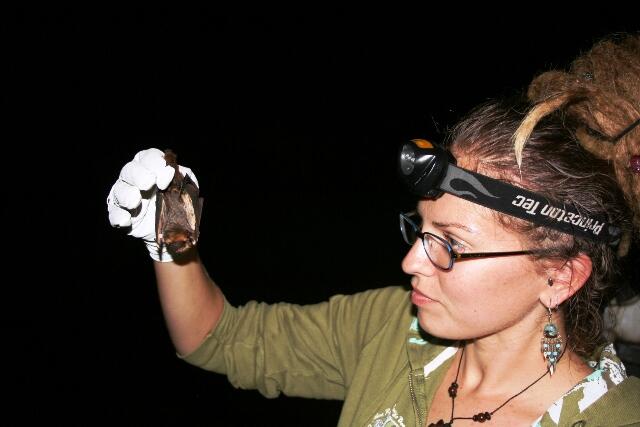
The Hawaiian Hoary Bat (Lasiurus semotus) is the only extant land mammal native to the Hawaiian archipelago. It is listed as endangered due to apparent population declines, and a lack of knowledge concerning its distribution, abundance, and habitat needs. Agencies and landowners in Hawai‘i seek to assist in the creation of sustainable uses for managed lands while also protecting bat populations and facilitating species recovery. In order to meet these goals and develop appropriate policy for land use practices and bat recovery, detailed information on the bat’s distribution, abundance, population genetics, food habitats, and habitat are being gathered by USGS/PIERC.
Overview:
The Hawaiian Hoary Bat (Lasiurus semotus) is the only extant land mammal native to the Hawaiian archipelago. It is listed as endangered due to apparent population declines, and a lack of knowledge concerning its distribution, abundance, and habitat needs (USFWS 1998). Recent work indicates that the bat may be more widely distributed than previously believed, undergo altitudinal migrations, and uses both native and non-native habitats, and may display seasonal variation in activity and habitat use patterns (Menard 2001). This endangered species is present in many landscapes that include lands used for silvaculture, agriculture, grazing, and residential areas, and may therefore be affected by land use activities and modifications. Agencies and landowners in Hawai‘i seek to assist in the creation of sustainable uses for managed lands while also protecting bat populations and facilitating species recovery. In order to meet these goals and develop appropriate policy for land use practices and bat recovery, USGS/PIERC gathers detailed information on the bat’s distribution, abundance, population genetics, food habitats, and habitat. Information generated is used in making management decisions by the U.S. Fish and Wildlife Service and by Hawai‘i Department of Lands and Natural Resources.
Highlights and Key Findings:
Distribution and seasonal altitudinal migration in which much of the Hawaiian hoary bat population moves from summer-autumn lowland sites where pregnancy, lactation, and fledging occur to highland refugia above 5000 feet where over-wintering appears to occur was documented. Seasonal movement patterns are very consistent over multiple years. Radio-tracking data show that individual bats range over large areas and diverse habitat types and are capable of making one-way movements of up to 12 miles per night. Individuals marked and recaptured from 1 to 4 years between radio-tag monitoring events habitually use the same foraging and roosting areas over this span of time, thus showing strong site fidelity. Acoustic monitoring from 5 years of data collection on the Island of Hawai‘i shows consistent patterns of bat occupancy within sites by season and across annual cycles. Acoustic monitoring at several sites on Maui, Kaua‘i, and O‘ahu documented patterns of site use.
Products from this work can be found in the Publications tab.