



A photo of the McCloud arm looking upstream from one of the telemetry deployment sites.
Caitlin L Stockwell
Caitlin Stockwell is a Fish Biologist with USGS Western Fisheries Research Center’s Columbia River Research Lab. She has wide background in salmon behavior using acoustic telemetry, from studies performed in Europe and Canada on Atlantic salmon to more recent work on salmonids in the Pacific Northwest. Her current work focuses on reintroduction efforts above hydroelectric dams.
Caitlin’s research interests focus on using acoustic telemetry to understand fish movement and behavior in a variety of habitats. Much of her previous work, before coming to work at USGS, involved using acoustic telemetry to study 3-dimensional movement of salmon and infer behavior and therefore welfare of farmed Atlantic salmon in Canada and Europe. She has worked with many international collaborators focusing on better utilizing big data for studying interactions between fish and their environment. Current research focuses on fish passage and survival above high-head dams using acoustic telemetry. Present work involves winter-run Chinook salmon reintroduction above Shasta Dam. Much of her work involves working with diverse groups of partners ranging from federal and state agencies to tribal partners.
Science and Products

Shasta Reservoir McCloud Arm
A photo of the McCloud arm looking upstream from one of the telemetry deployment sites.
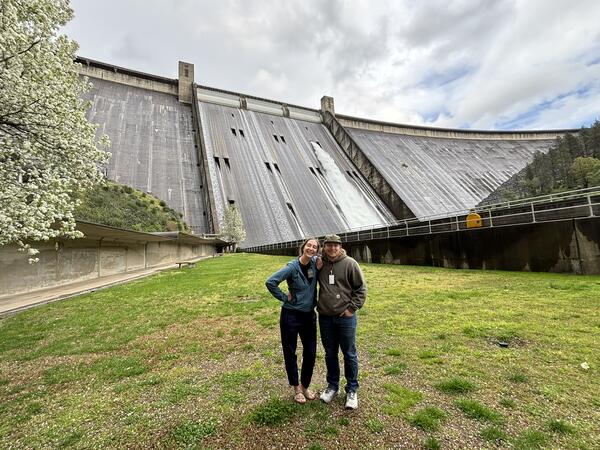
Shasta Dam
This is Shasta Dam in California. Mitchell Morse and Caitlin Stockwell drove down to Redding, CA to wrap up the Shasta Reservoir fish telemetry project. They worked with California Department of Fish and Wildlife partners to remove 16 submersible acoustic telemetry receivers within the reservoir, and 5 receivers installed on Shasta Dam.
This is Shasta Dam in California. Mitchell Morse and Caitlin Stockwell drove down to Redding, CA to wrap up the Shasta Reservoir fish telemetry project. They worked with California Department of Fish and Wildlife partners to remove 16 submersible acoustic telemetry receivers within the reservoir, and 5 receivers installed on Shasta Dam.

Telemetry Receivers on Shasta Reservoir, CA
Mitchell Morse and Caitlin Stockwell drove down to Redding, CA to wrap up the Shasta Reservoir fish telemetry project. They worked with California Department of Fish and Wildlife partners to remove 16 submersible acoustic telemetry receivers within the reservoir, and 5 receivers installed on Shasta Dam.
Mitchell Morse and Caitlin Stockwell drove down to Redding, CA to wrap up the Shasta Reservoir fish telemetry project. They worked with California Department of Fish and Wildlife partners to remove 16 submersible acoustic telemetry receivers within the reservoir, and 5 receivers installed on Shasta Dam.
Science and Products
Shasta Reservoir McCloud Arm
A photo of the McCloud arm looking upstream from one of the telemetry deployment sites.
A photo of the McCloud arm looking upstream from one of the telemetry deployment sites.
Shasta Dam
This is Shasta Dam in California. Mitchell Morse and Caitlin Stockwell drove down to Redding, CA to wrap up the Shasta Reservoir fish telemetry project. They worked with California Department of Fish and Wildlife partners to remove 16 submersible acoustic telemetry receivers within the reservoir, and 5 receivers installed on Shasta Dam.
This is Shasta Dam in California. Mitchell Morse and Caitlin Stockwell drove down to Redding, CA to wrap up the Shasta Reservoir fish telemetry project. They worked with California Department of Fish and Wildlife partners to remove 16 submersible acoustic telemetry receivers within the reservoir, and 5 receivers installed on Shasta Dam.
Telemetry Receivers on Shasta Reservoir, CA
Mitchell Morse and Caitlin Stockwell drove down to Redding, CA to wrap up the Shasta Reservoir fish telemetry project. They worked with California Department of Fish and Wildlife partners to remove 16 submersible acoustic telemetry receivers within the reservoir, and 5 receivers installed on Shasta Dam.
Mitchell Morse and Caitlin Stockwell drove down to Redding, CA to wrap up the Shasta Reservoir fish telemetry project. They worked with California Department of Fish and Wildlife partners to remove 16 submersible acoustic telemetry receivers within the reservoir, and 5 receivers installed on Shasta Dam.