



MacGillivray’s Warbler First Confirmed State Record for Maryland
The USGS Bird Banding Lab’s fall migration station at Patuxent Research Refuge captured a new species record for the state of Maryland in September 2026.
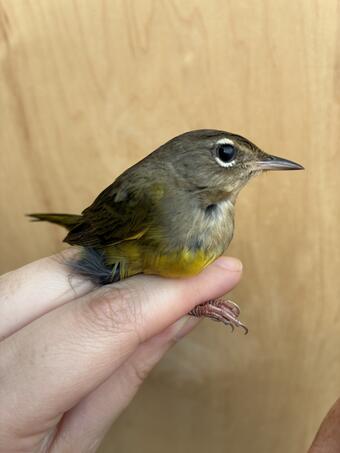
Fall migration is quite an important and difficult time for songbirds, let alone first year songbirds. They must precisely navigate to their pre-programmed wintering grounds without ever having traveled there before. All the while, they need to make multiple stops between nightly migration flights to build sufficient fat stores for the next leg. Every so often, some individuals lose their way during this treacherous journey and end up in completely unexpected places! This was the case for one individual captured by the USGS Bird Banding Lab Migration Station team on September 2.
This individual initially stood out because it had a bright yellow body, light gray/brown hood, and white around its eyes; a description that gets banders very excited (think Mourning Warbler/Connecticut Warbler). However, it was also sporting a set of intense and broad white eye-arcs, short undertail feathers, and a lack of yellow in the throat.
“The first thing that I noticed was those huge, white eye-arcs!" biologist Matt Rogosky excitedly recalled while extracting this bird from the mist net.
Back at the banding station, it received a USGS federal metal band with a unique 9-digit number, the age and sex were determined, and important morphometric measurements were taken. Originally the team assumed that this individual must be an odd-looking Mourning Warbler since they are the much more expected eastern migrant during the early portion of the migration season. However, in conjunction with visual field marks, in-hand measurements, review of published literature (Pyle 2020; Pyle and Henderson 1990) and much discussion with experts, it was concluded that the bird in question was a MacGillivray’s Warbler!
MacGillivray’s Warblers breed exclusively in western North America from southern Alaska through the western Rocky Mountains and south to central Arizona. Migrating through these areas, it winters in western Central America (Pitocchelli, 2020). Occasional vagrant records have occurred east of the Mississippi River with most states having at least one accepted record of MacGillivray’s Warbler. One of the states without an accepted record was Maryland. In Maryland’s history of bird records, there has been only one unconfirmed record of a MacGillivray’s Warbler back in 1964 (MD/DCRC 2024).
This 2026 capture changes history; becoming the first documented and photographed record of the species in the state!
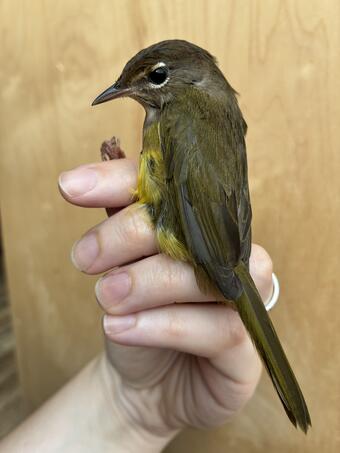
Key information that led to this ID:
- Eye-arcs thick, bright white and abruptly cut off. First fall Mourning Warblers can have eye rings as well, but they are yellowish, thin, and complete or nearly complete; not as thick and bright white as in this individual.
- Hood distinct gray/brown without any yellow washed in and clear separation with bright yellow lower breast. First fall Mourning Warblers would have indistinct grayish hood mixing with yellow breast.
- Throat white without yellow. First fall Mourning Warblers would have yellow throat and blended with light grayish hood.
- Tail long (52mm) with short undertail coverts. Tail length in range for both species. However, it was in the higher range for Mourning Warbler (43-53) and the lower range for MacGillivray’s Warbler (47-63).
- Measurement “Wing (flat)-tail” was 5 mm. This fell completely in MacGillivray’s Warbler range of 2-13mm vs the Mourning Warbler’s range of 9-18mm.
Citations
Maryland/District of Columbia Records Committee. (2024, October 2). *MD/DCRC Database: Abridged Version*. Baltimore, MD: Maryland Ornithological Society. Retrieved from https://mdbirds.org/mddcrc/pdf/mddatabase.pdf.
Pyle, P. (2022). Identification Guide to North American Birds: Part I (2nd ed.) (S. N. G. Howell & D. F. DeSante, Collab.). Slate Creek Press. ISBN 978 0 96189405 4.
Pyle, P., & Henderson, P. (1990, October). On separating female and immature Oporornis warblers in fall. Birding, 22(5), 222–225.
Pitocchelli, Jay. (2020). MacGillivray’s Warbler, version 1.0 In Birds of the World (Editor(s)). Cornell Lab of Ornithology, Ithaca, NY, USA.