



Notes From The Field: Wintering Rosy-Finches
"Notes from the Field” are contributed articles that highlight current banding projects and the continued importance of bird banding. This article focuses on a long-term Rosy-Finch monitoring project in New Mexico.
“Notes From the Field” news articles highlight the continued importance of bird banding. This article was contributed by Steven Cox of Rio Grande Bird Research, Inc. and Whitney Watson of New Mexico State University. Steven Cox has been working in biology for close to 45 years and has led a team of devoted volunteers with Rio Grande Bird Research, Inc. for over 40 years.
Today, banding allows scientists to track birds’ behavior, migration, lifespans, populations, diseases and levels of environmental contaminants. Information gathered through the North American Bird Banding Program helps inform management and conservation decisions of game and non-game species, such as protecting or restoring habitat, setting hunting regulations and determining plans for human development. The North American Bird Banding Program depends on a network of over 10,000 permitted bird banders working in the United States, Canada and Trust Territories. Each year these banders help us add up to 1.2 million new banding records to our century-long dataset.
What is your bird banding/marking project?
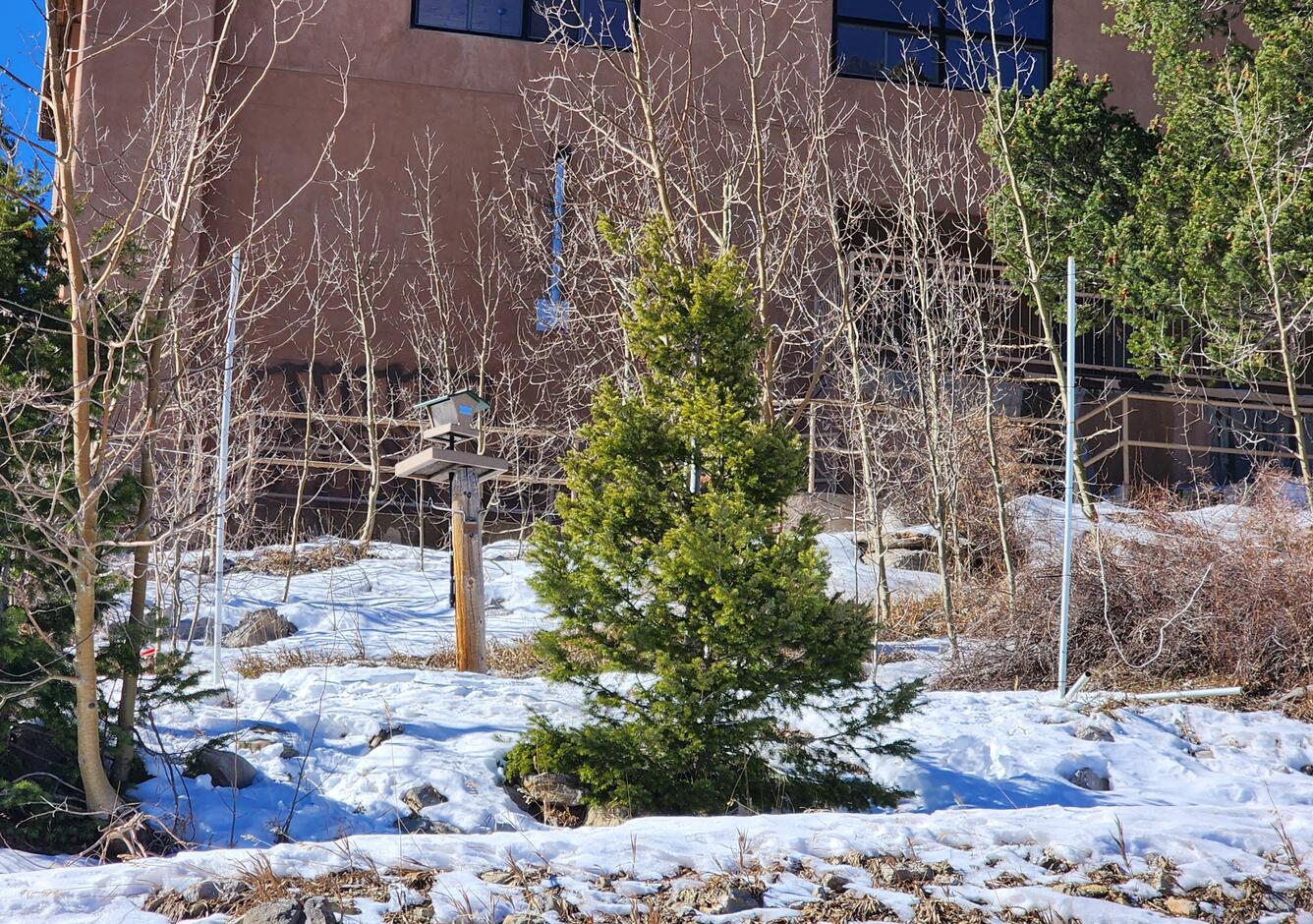
Our project involves banding the three North American species of Rosy-Finch, the Brown-capped Rosy-Finch (Leucosticte australis), the Black Rosy-Finch (L. atrata), and the Gray-crowned Rosy-Finch (L. tephrocotis) during the winter at the Sandia Crest, the highest point in the Sandia Mountains of New Mexico. All three species of Rosy-Finch regularly migrate to this site for the winter and it’s also the southernmost point where any of the three species can be seen.
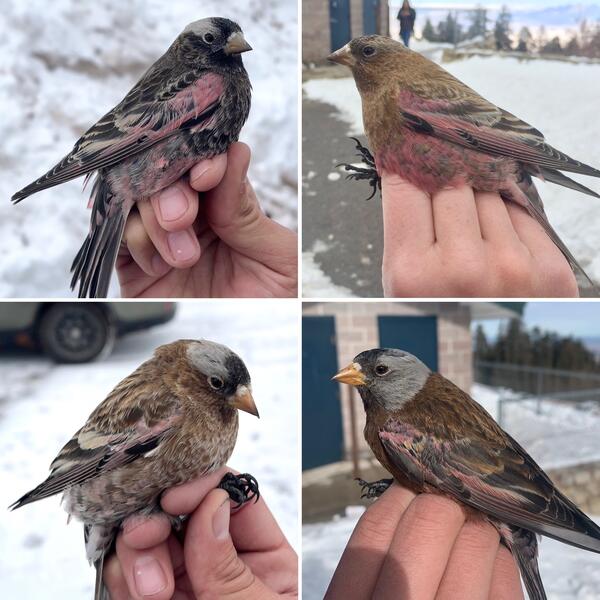
Banding has occurred at our site at the Sandia Crest since early 2004, approximately once per week during the winter months, roughly November through April. Other species like Cassin’s Finches, Dark-eyed Juncos, and Black-capped Chickadees are also regularly captured and marked during banding sessions.
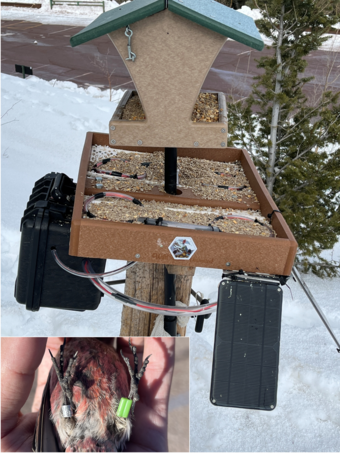
We have an artificial feeder set up at the site and capture Rosy-Finches in a set of mist nets surrounding the feeder. We mark Rosy-Finches with aluminum USGS leg bands, collect tail feather samples, record information on age and sex, and collect morphometric measurements like mass, tail length, and wing chord length.
In the last couple of years, we have also marked Rosy-Finches with radio frequency ID (RFID) tags in addition to their USGS ID leg bands to test the ability of a RFID reader set up at the artificial feeder to collect more robust mark-recapture data without the need for physical recapture of birds in mist nets. RFID tags carry a unique ID that is transmitted to a memory card when birds land on the feeder within range of the specialized antenna.
Why is your study species particularly interesting? Why do you think projects like yours are so important?
Rosy-Finches are unique in that they are adapted to living at high elevations and high latitudes and are able to endure harsh conditions like extreme cold and low oxygen levels. They are difficult to observe because the areas they inhabit are typically quite remote. At the same time, studying them is important as they are particularly vulnerable to environmental change because high elevation and high latitude regions are warming at a rapid pace.
How/why was this project started? What question(s) are you trying to answer through your research?
Initially, Rio Grande Bird Research, Inc. wanted to investigate the winter site fidelity of the Brown-capped, Black, and Gray-crowned Rosy-Finch. Since the first banding season of winter 2003–2004, the project has expanded and we are now trying to answer questions relating to demographic trends and migratory connectivity of the three Rosy-Finch species. More recently, Whitney Watson, a PhD candidate in the New Mexico Cooperative Fish and Wildlife Research Unit at New Mexico State University, began using project banding data for her dissertation work. Specifically, she is using the mark-recapture data generated from the banding to estimate annual survival in the three species to better understand survival patterns and trends through time and the factors that may affect survival.
Whitney is also using the tail feathers collected in this study to determine breeding origins of the Rosy-Finches captured at this wintering site using a technique called stable isotope analysis. Feathers (and all animal tissues) contain a unique hydrogen isotope signature, and because this signature varies naturally in groundwater with elevation and latitude, a hydrogen isotope signature from a feather can be linked to the geographic region where the feather was grown. Ultimately, stable isotope analysis will help us understand how breeding and wintering populations in these species are connected to one another, as well as how factors affecting a population during one part of the annual cycle may carry over to another.
We have also been trying to determine whether the RFID tagging/detection method is a worthwhile addition to banding projects like ours. There are added costs in terms of purchasing additional equipment (such as RFID leg bands and RFID readers) and in the time and effort spent conducting RFID reader maintenance. However, the method has the potential to generate much more fine-scale data on reoccurrence of tagged birds, allowing for more precise vital rate estimation and increased ability to answer questions about daily activity patterns and seasonal arrival and departure timing.
What have you found so far? Any surprises? Major accomplishments?
The longevity of this study is an accomplishment in itself, as long-term datasets like this are rare and particularly valuable for answering questions about change over time in vulnerable species such as Rosy-Finches.
One surprising finding of this project is that, while number of individuals of each species captured at our site has fluctuated greatly over the years, the Black Rosy-Finches have continued to show up at the Sandia Crest wintering site in the highest numbers relative to the other two species in recent winters, despite their breeding grounds being geographically farther from New Mexico than those of the Brown-capped Rosy-Finch.
We have also found out through preliminary stable isotope breeding origin analysis that individuals of each species appear to be originating from breeding/molting grounds across multiple different parts of their breeding ranges rather than a single region within each species, which points to intermixing of distinct breeding populations on wintering grounds.
When it comes to our analysis of RFID data, we found that reencounter data collected via RFID were able to generate more reliable estimates of survival than mist-net-only mark-recapture data given a limited study duration.
More details on preliminary project findings.
What are the next short- and long-term steps for your research project?
Whitney is currently working on finishing her analysis looking at the impacts of climate variables on annual survival in the three Rosy-Finch species based on the winter banding data from the Sandia Crest. She plans to publish the results of the study in the coming months.
Who is involved in your project?
The long-term banding study is led by Steven Cox of Rio Grande Bird Research Inc. and a team of dedicated volunteers. The more recent effort analyzing the banding data and feather samples is led by Whitney Watson of New Mexico State University and Abby Lawson of the USGS New Mexico Cooperative Fish and Wildlife Research Unit, in collaboration with the U.S. Fish and Wildlife Service Division of Migratory Bird Management, the New Mexico Department of Wildlife (formerly Department of Game and Fish), and New Mexico State University.
Where can I get more information about your project?
Some additional information on banding activities can be found on:
- Rio Grande Bird Research, Inc. Facebook page
New Mexico Department of Wildlife (formerly Department of Fish and Game) final grant report
Any use of trade, firm, or product names is for descriptive purposes only and does not imply endorsement by the U.S. Government.
All banding, marking, and sampling are conducted under a federally authorized Bird Banding Permit issued by the USGS BBL.
The “Notes From the Field” series highlights current banding projects and the continued importance of bird banding and the Bird Banding Lab. Want to see your project featured in a future “Notes From the Field” article? Email Kyra Harvey kharvey@usgs.gov for submission details.