



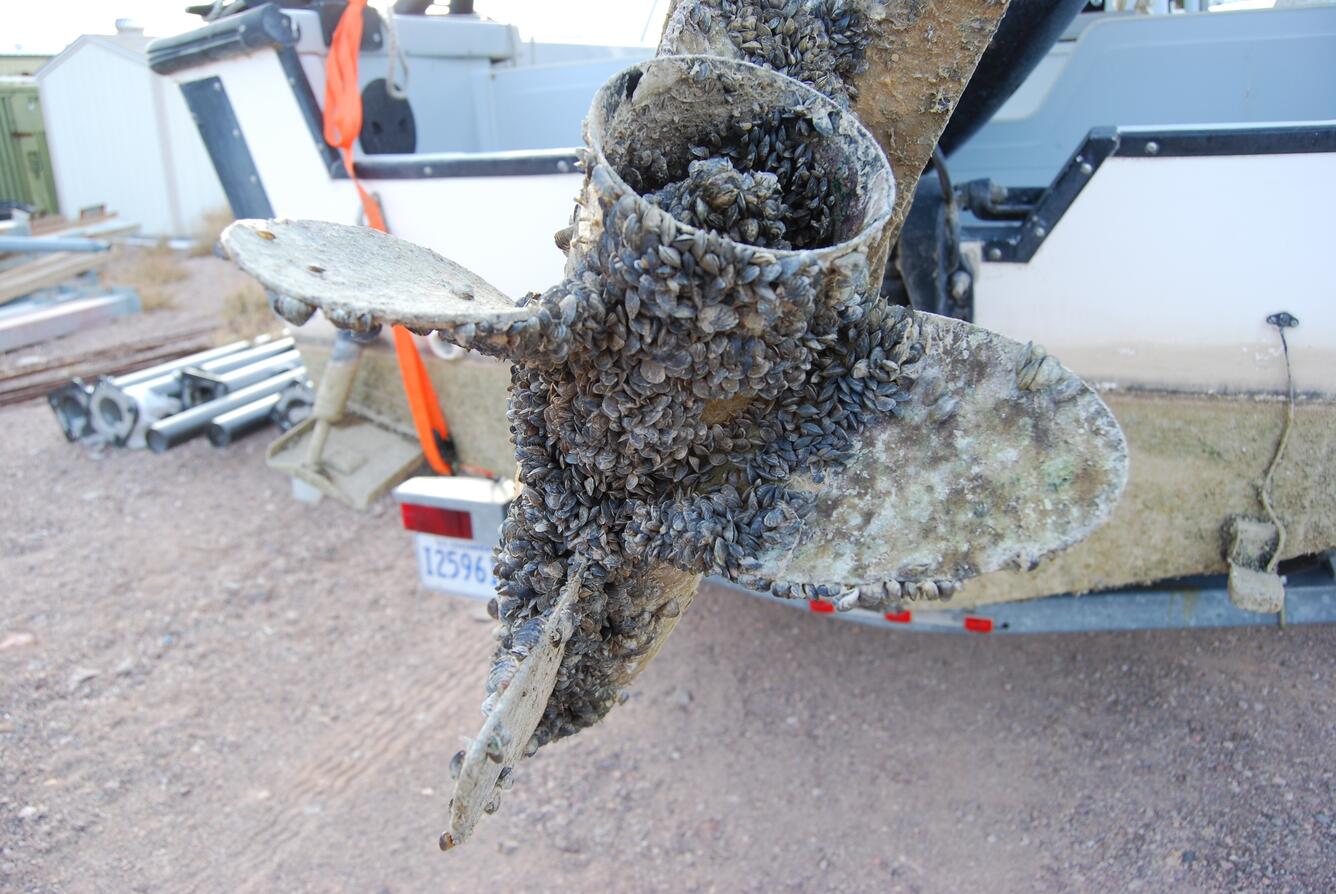
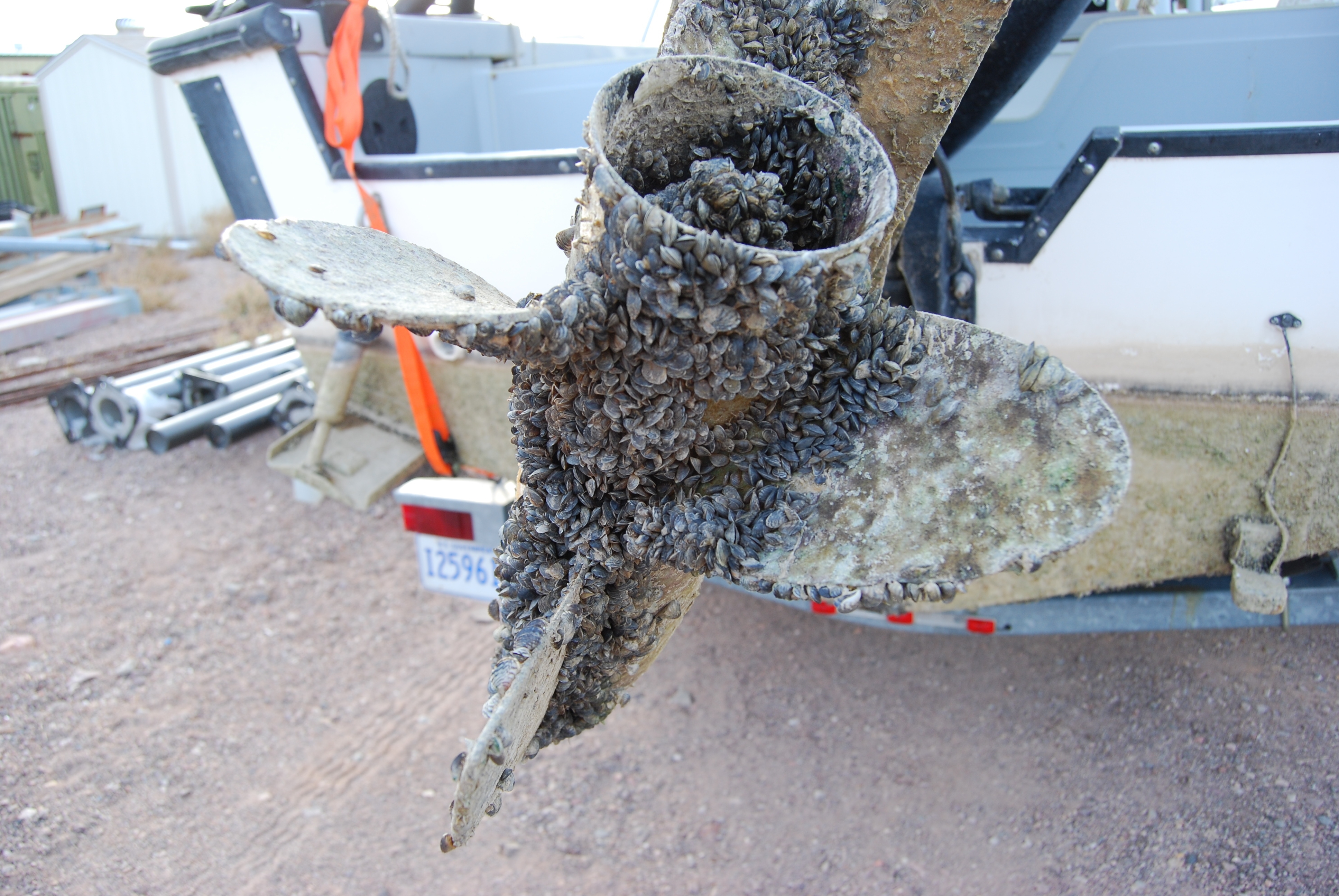
Boat with Invasive Mussel Infestation


Detailed Description
This is an image of a boat propeller with an invasive mussel infestation.
Sources/Usage
Public Domain.
Taken by the Washington Department of Fish and Wildlife
Related
Fate and effects to the benthic community of a copper treatment to eradicate invasive mussels in a large western river, USA Fate and effects to the benthic community of a copper treatment to eradicate invasive mussels in a large western river, USA
Copper-based chemical treatments are commonly used to eradicate invasive mussels in small ponds and lakes, but their use in large rivers has been limited. In 2023, in response to a detection of invasive quagga mussels, a 10-km reach of the Snake River (Idaho, USA), was treated with an unprecedented 19,300 kg of chelated copper molluscicide to a target concentration of 1,000 µg/L for 10...
Authors
Austin K. Baldwin, Erin Murray, Lauren M. Zinsser, Tyler King, Scott D. Ducar, India Southern, Theresa Thom, Christopher A. Mebane
Limited co-existence of native unionids and invasive dreissenid mussels more than 30 Y post dreissenid invasion in a large river system Limited co-existence of native unionids and invasive dreissenid mussels more than 30 Y post dreissenid invasion in a large river system
There are serious concerns for native freshwater mussel survival (Bivalvia: Unionidae) in the Laurentian Great Lakes region after populations were seemingly pushed to the brink of extirpation following the introduction of dreissenid mussels (Dreissena polymorpha and D. rostriformis bugensis) in the mid-1980s. The Detroit River was the first major river system in North America to be...
Authors
S. Keretz, D. Woolnough, Edward F. Roseman, T.J. Morris, A. Elgin, D.T. Zanatta
Relative importance of phosphorus, invasive mussels and climate for patterns in chlorophyll a and primary production in Lakes Michigan and Huron Relative importance of phosphorus, invasive mussels and climate for patterns in chlorophyll a and primary production in Lakes Michigan and Huron
1. Lakes Michigan and Huron, which are undergoing oligotrophication after reduction of phosphorus loading, invasion by dreissenid mussels and variation in climate, provide an opportunity to conduct large-scale evaluation of the relative importance of these changes for lake productivity. We used remote sensing, field data and an information-theoretic approach to identify factors that...
Authors
David M. Warner, Barry M. Lesht
Invasive zebra mussels (Driessena polymorpha) and Asian clams (Corbicula fluminea) survive gut passage of migratory fish species: implications for dispersal Invasive zebra mussels (Driessena polymorpha) and Asian clams (Corbicula fluminea) survive gut passage of migratory fish species: implications for dispersal
The introduction and spread of invasive species is of great concern to natural resource managers in the United States. To effectively control the spread of these species, managers must be aware of the multitude of dispersal methods used by the organisms. We investigated the potential for survival through the gut of a migrating fish (blue catfish, Ictalurus furcatus) as a dispersal...
Authors
Michael R. Gatlin, Daniel E. Shoup, James M. Long
Procedures for conducting underwater searches for invasive mussels (Dreissena sp.) Procedures for conducting underwater searches for invasive mussels (Dreissena sp.)
Zebra mussels (Dreissena polymorpha) were first detected in the Great Lakes in 1988. They were likely transported as larvae or young adults inside the ballast tanks of large ocean-going ships originating from Europe. Since their introduction, they have spread throughout the Eastern, Midwestern, and Southern United States. In 2007, Quagga mussels (Dreissena rostriformis bugensis) were...
Authors
Noah Adams
Related
Fate and effects to the benthic community of a copper treatment to eradicate invasive mussels in a large western river, USA Fate and effects to the benthic community of a copper treatment to eradicate invasive mussels in a large western river, USA
Copper-based chemical treatments are commonly used to eradicate invasive mussels in small ponds and lakes, but their use in large rivers has been limited. In 2023, in response to a detection of invasive quagga mussels, a 10-km reach of the Snake River (Idaho, USA), was treated with an unprecedented 19,300 kg of chelated copper molluscicide to a target concentration of 1,000 µg/L for 10...
Authors
Austin K. Baldwin, Erin Murray, Lauren M. Zinsser, Tyler King, Scott D. Ducar, India Southern, Theresa Thom, Christopher A. Mebane
Limited co-existence of native unionids and invasive dreissenid mussels more than 30 Y post dreissenid invasion in a large river system Limited co-existence of native unionids and invasive dreissenid mussels more than 30 Y post dreissenid invasion in a large river system
There are serious concerns for native freshwater mussel survival (Bivalvia: Unionidae) in the Laurentian Great Lakes region after populations were seemingly pushed to the brink of extirpation following the introduction of dreissenid mussels (Dreissena polymorpha and D. rostriformis bugensis) in the mid-1980s. The Detroit River was the first major river system in North America to be...
Authors
S. Keretz, D. Woolnough, Edward F. Roseman, T.J. Morris, A. Elgin, D.T. Zanatta
Relative importance of phosphorus, invasive mussels and climate for patterns in chlorophyll a and primary production in Lakes Michigan and Huron Relative importance of phosphorus, invasive mussels and climate for patterns in chlorophyll a and primary production in Lakes Michigan and Huron
1. Lakes Michigan and Huron, which are undergoing oligotrophication after reduction of phosphorus loading, invasion by dreissenid mussels and variation in climate, provide an opportunity to conduct large-scale evaluation of the relative importance of these changes for lake productivity. We used remote sensing, field data and an information-theoretic approach to identify factors that...
Authors
David M. Warner, Barry M. Lesht
Invasive zebra mussels (Driessena polymorpha) and Asian clams (Corbicula fluminea) survive gut passage of migratory fish species: implications for dispersal Invasive zebra mussels (Driessena polymorpha) and Asian clams (Corbicula fluminea) survive gut passage of migratory fish species: implications for dispersal
The introduction and spread of invasive species is of great concern to natural resource managers in the United States. To effectively control the spread of these species, managers must be aware of the multitude of dispersal methods used by the organisms. We investigated the potential for survival through the gut of a migrating fish (blue catfish, Ictalurus furcatus) as a dispersal...
Authors
Michael R. Gatlin, Daniel E. Shoup, James M. Long
Procedures for conducting underwater searches for invasive mussels (Dreissena sp.) Procedures for conducting underwater searches for invasive mussels (Dreissena sp.)
Zebra mussels (Dreissena polymorpha) were first detected in the Great Lakes in 1988. They were likely transported as larvae or young adults inside the ballast tanks of large ocean-going ships originating from Europe. Since their introduction, they have spread throughout the Eastern, Midwestern, and Southern United States. In 2007, Quagga mussels (Dreissena rostriformis bugensis) were...
Authors
Noah Adams