



Scientist Holding a Telemetry Receiver for Tracking Fish


Detailed Description
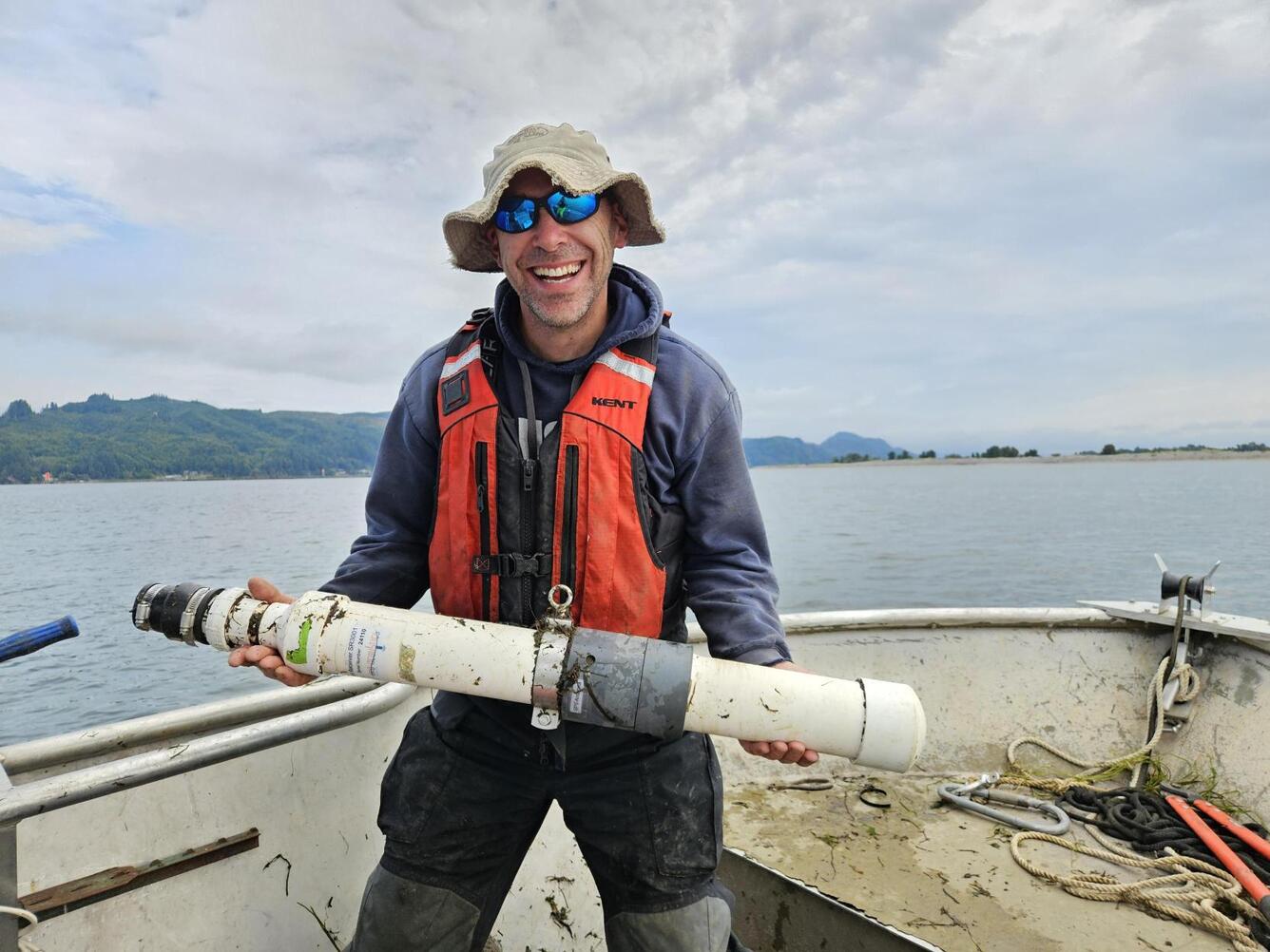
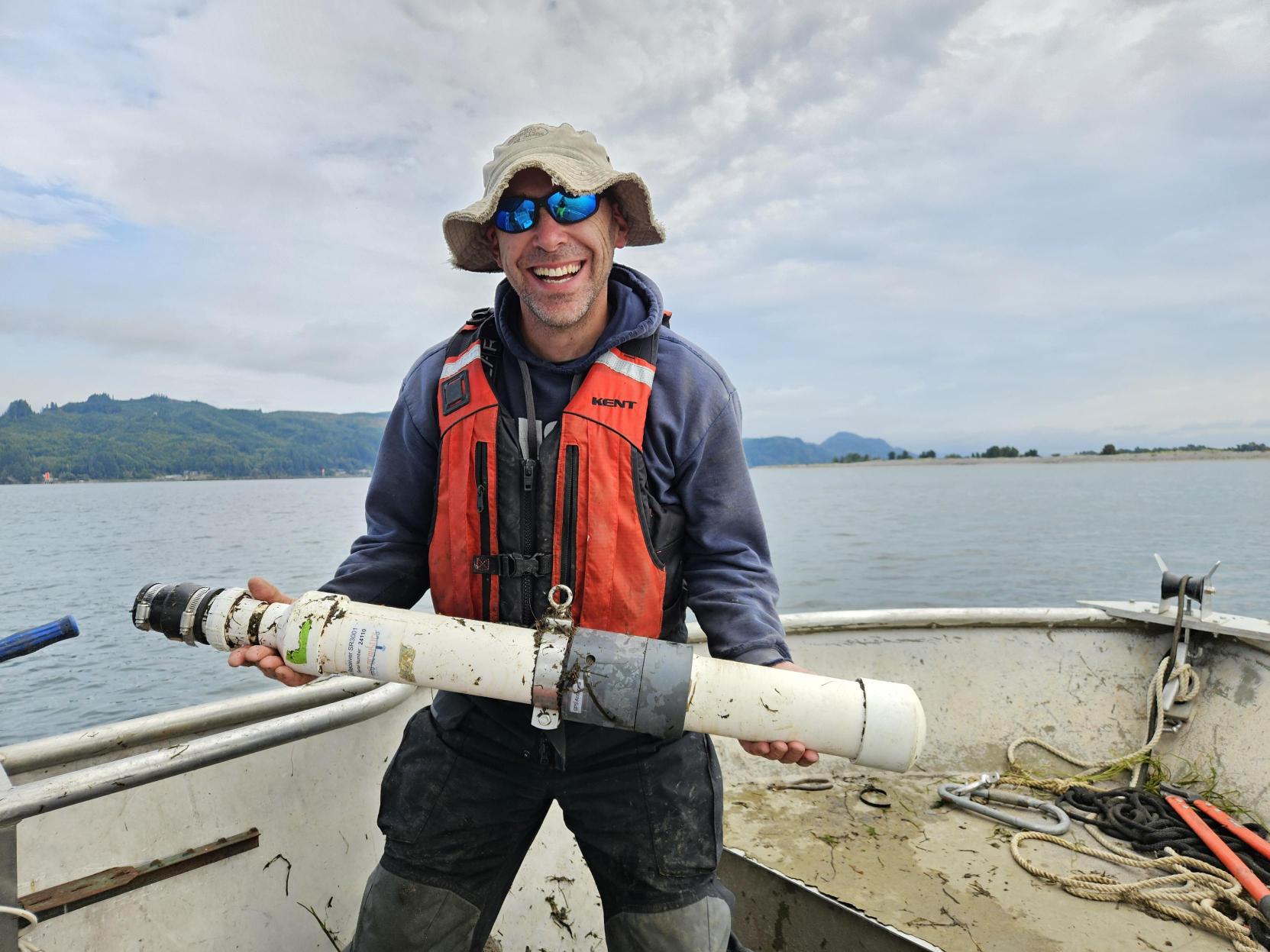
Ryan Tomka retrieves an acoustic telemetry receiver from the lower Columbia River estuary. During the 2025 field season, researchers deployed acoustic telemetry equipment to track yearling Chinook salmon as they moved through both restored estuarine wetlands and the main Columbia River channel. The study aims to estimate how many fish enter these restored areas and how long they stay—critical information for evaluating the success of habitat restoration projects.
Sources/Usage
Public Domain.
Related
Movements of juvenile Pacific Lamprey (Entosphenus tridentatus) in the Yakima and Columbia Rivers, Washington, 2018—A pilot study using acoustic telemetry Movements of juvenile Pacific Lamprey (Entosphenus tridentatus) in the Yakima and Columbia Rivers, Washington, 2018—A pilot study using acoustic telemetry
Telemetry has been an invaluable tool to improve our understanding of adult Pacific Lamprey (Entosphenus tridentatus) movements and to guide management approaches to protect and restore this species of concern. Juvenile and larval lamprey, however, are much smaller than adults, and have not been monitored with telemetry because available transmitters have traditionally been too large...
Authors
Theresa L. Liedtke, Ralph T. Lampman, Z. Daniel Deng, Tyler E. Beals, Michael S. Porter, Amy C. Hansen, Tobias J. Kock, Ryan G. Tomka, Patrick Monk
Use of acoustic telemetry to evaluate survival and behavior of juvenile salmonids at hydroelectric dams: A case study from Rocky Reach Dam, Columbia River, USA: Chapter 8.1 Use of acoustic telemetry to evaluate survival and behavior of juvenile salmonids at hydroelectric dams: A case study from Rocky Reach Dam, Columbia River, USA: Chapter 8.1
Telemetry provides a powerful and flexible tool for studying fish and other aquatic animals, and its use has become increasingly commonplace. However, telemetry is gear intensive and typically requires more specialized knowledge and training than many other field techniques. As with other scientific methods, collecting good data is dependent on an understanding of the underlying...
Authors
Tracy W. Steigl, Christopher M. Holbrook
Use of electromyogram telemetry to assess swimming activity of adult spring Chinook salmon migrating past a Columbia River dam Use of electromyogram telemetry to assess swimming activity of adult spring Chinook salmon migrating past a Columbia River dam
Electromyogram (EMG) radiotelemetry was used to estimate the swim speeds of spring Chinook salmon Oncorhynchus tshawytscha migrating upstream past a Columbia River dam. Electrodes from EMG transmitters were surgically implanted in the red muscle of fish captured at Bonneville Dam, and output from the tags was calibrated to defined swim speeds for each fish in a tunnel respirometer. The...
Authors
R.S. Brown, D.R. Geist, M.G. Mesa
Survival estimates of migrant juvenile salmonids in the Columbia River through John Day Dam using radio-telemetry, 2003 Survival estimates of migrant juvenile salmonids in the Columbia River through John Day Dam using radio-telemetry, 2003
Abstract not available
Authors
T.D. Counihan, G.S. Holmberg, C. E. Walker, J.M. Hardiman
Survival estimates of migrant juvenile salmonids in the Columbia River from John Day Dam through Bonneville Dam using radio-telemetry. Annual report 2000 Survival estimates of migrant juvenile salmonids in the Columbia River from John Day Dam through Bonneville Dam using radio-telemetry. Annual report 2000
Abstract not available
Authors
T.D. Counihan, J.H. Petersen
Description and performance of an automated radio telemetry system to monitor the movement and distribution of northern squawfish at Columbia River dams. Annual report 1993 Description and performance of an automated radio telemetry system to monitor the movement and distribution of northern squawfish at Columbia River dams. Annual report 1993
No abstract available
Authors
R.S. Shively, M.B. Sheer, G.S. Holmberg
Integration of radio telemetry and hydraulic model data for siting and operating juvenile bypass systems on the Columbia River to reduce predation Integration of radio telemetry and hydraulic model data for siting and operating juvenile bypass systems on the Columbia River to reduce predation
No abstract available
Authors
R.S. Shively, T.P. Poe, R. Peters
Related
Movements of juvenile Pacific Lamprey (Entosphenus tridentatus) in the Yakima and Columbia Rivers, Washington, 2018—A pilot study using acoustic telemetry Movements of juvenile Pacific Lamprey (Entosphenus tridentatus) in the Yakima and Columbia Rivers, Washington, 2018—A pilot study using acoustic telemetry
Telemetry has been an invaluable tool to improve our understanding of adult Pacific Lamprey (Entosphenus tridentatus) movements and to guide management approaches to protect and restore this species of concern. Juvenile and larval lamprey, however, are much smaller than adults, and have not been monitored with telemetry because available transmitters have traditionally been too large...
Authors
Theresa L. Liedtke, Ralph T. Lampman, Z. Daniel Deng, Tyler E. Beals, Michael S. Porter, Amy C. Hansen, Tobias J. Kock, Ryan G. Tomka, Patrick Monk
Use of acoustic telemetry to evaluate survival and behavior of juvenile salmonids at hydroelectric dams: A case study from Rocky Reach Dam, Columbia River, USA: Chapter 8.1 Use of acoustic telemetry to evaluate survival and behavior of juvenile salmonids at hydroelectric dams: A case study from Rocky Reach Dam, Columbia River, USA: Chapter 8.1
Telemetry provides a powerful and flexible tool for studying fish and other aquatic animals, and its use has become increasingly commonplace. However, telemetry is gear intensive and typically requires more specialized knowledge and training than many other field techniques. As with other scientific methods, collecting good data is dependent on an understanding of the underlying...
Authors
Tracy W. Steigl, Christopher M. Holbrook
Use of electromyogram telemetry to assess swimming activity of adult spring Chinook salmon migrating past a Columbia River dam Use of electromyogram telemetry to assess swimming activity of adult spring Chinook salmon migrating past a Columbia River dam
Electromyogram (EMG) radiotelemetry was used to estimate the swim speeds of spring Chinook salmon Oncorhynchus tshawytscha migrating upstream past a Columbia River dam. Electrodes from EMG transmitters were surgically implanted in the red muscle of fish captured at Bonneville Dam, and output from the tags was calibrated to defined swim speeds for each fish in a tunnel respirometer. The...
Authors
R.S. Brown, D.R. Geist, M.G. Mesa
Survival estimates of migrant juvenile salmonids in the Columbia River through John Day Dam using radio-telemetry, 2003 Survival estimates of migrant juvenile salmonids in the Columbia River through John Day Dam using radio-telemetry, 2003
Abstract not available
Authors
T.D. Counihan, G.S. Holmberg, C. E. Walker, J.M. Hardiman
Survival estimates of migrant juvenile salmonids in the Columbia River from John Day Dam through Bonneville Dam using radio-telemetry. Annual report 2000 Survival estimates of migrant juvenile salmonids in the Columbia River from John Day Dam through Bonneville Dam using radio-telemetry. Annual report 2000
Abstract not available
Authors
T.D. Counihan, J.H. Petersen
Description and performance of an automated radio telemetry system to monitor the movement and distribution of northern squawfish at Columbia River dams. Annual report 1993 Description and performance of an automated radio telemetry system to monitor the movement and distribution of northern squawfish at Columbia River dams. Annual report 1993
No abstract available
Authors
R.S. Shively, M.B. Sheer, G.S. Holmberg
Integration of radio telemetry and hydraulic model data for siting and operating juvenile bypass systems on the Columbia River to reduce predation Integration of radio telemetry and hydraulic model data for siting and operating juvenile bypass systems on the Columbia River to reduce predation
No abstract available
Authors
R.S. Shively, T.P. Poe, R. Peters