An official website of the United States government
Here's how you know
Official websites use .gov
A .gov website belongs to an official government organization in the United States.
Secure .gov websites use HTTPS
A lock () or https:// means you’ve safely connected to the .gov website. Share sensitive information only on official, secure websites.
A steady stream of lava exiting the episode 61g lava tube pours into the ocean at the Kamokuna ocean entry. The interaction between the lava and ocean water causes explosive reactions, throwing bits of lava (seen in the photo at the base of the lava stream).
Since the delta collapse on December 31, 2016 there has not been any evidence of the lava delta rebuilding. The fume trace of the 61g tube system on the coastal plain is visible up slope from the ocean entry. The cove in the sea cliff (at center) is where the ~4 acre portion of old sea cliff collapsed into the ocean after the delta fell in. The new public lava viewing area and rope line is in the lower right, and the emergency access road is just inland from the coast.
This video clip shows the lava stream - about 1-2 m or yards wide - pouring out of the tube into the Pacific Ocean, triggering pulsating explosions that are throwing bits of lava onto the top of the sea cliff.
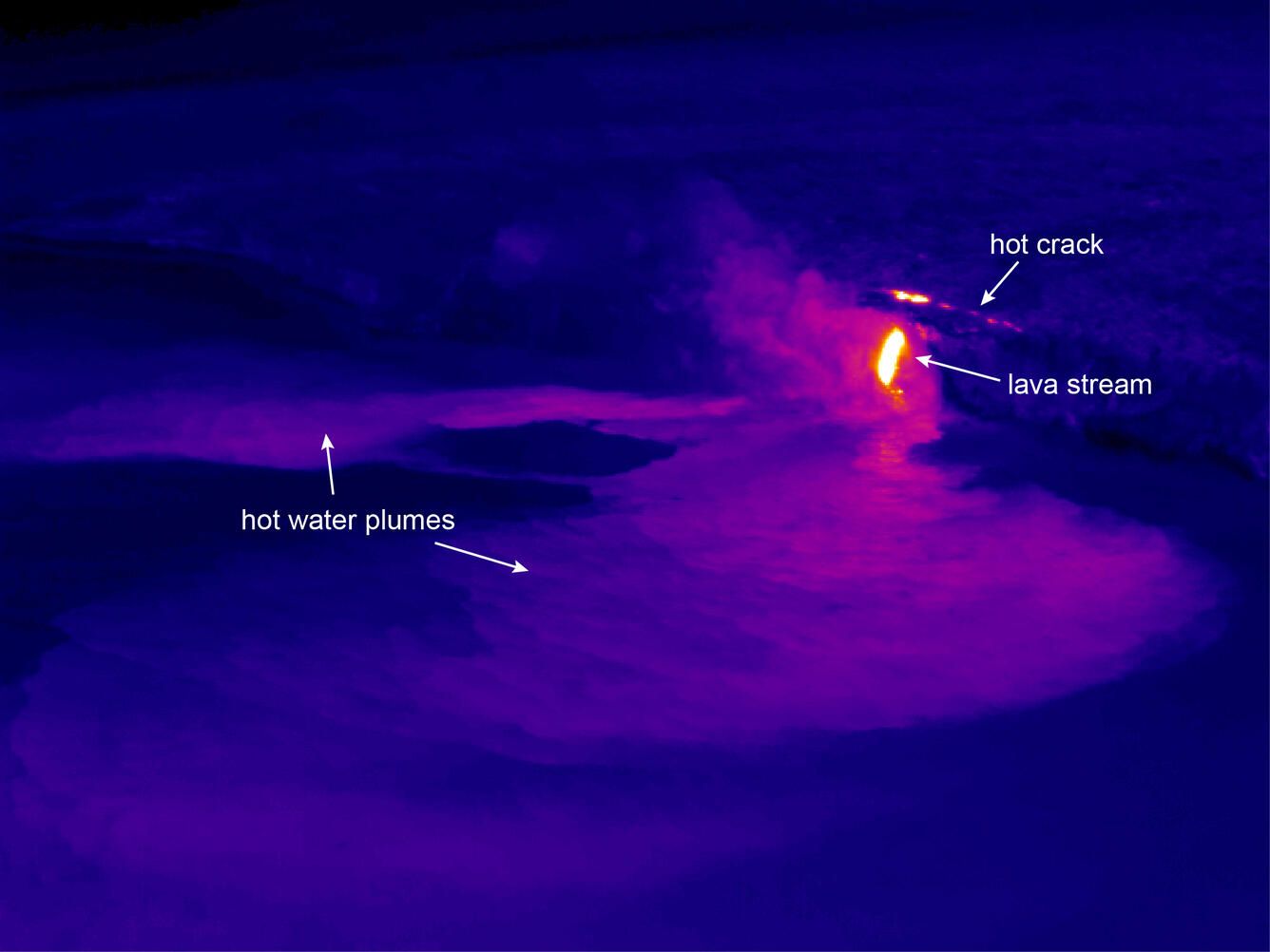
This thermal image shows the Kamokuna ocean entry. Two plumes of hot (scalding) water branch out from the entry point. The lava stream itself is the very hot feature right of center. Just above the lava stream, about 10 meters (yards) behind the sea cliff, is a narrow line of high temperatures that appears to be a hot crack. This hot crack suggests that the sea cliff around the entry point is unstable and has the potential to collapse.