



What have volcanoes got in their veins? In some places, tuffisite!
Many of us are used to seeing elongated “veins” in the rocks around us - streaks of minerals that precipitated over time to fill fractures in the surrounding rock. However, in some volcanic settings, a completely different type of vein can be found, called a “tuffisite”.
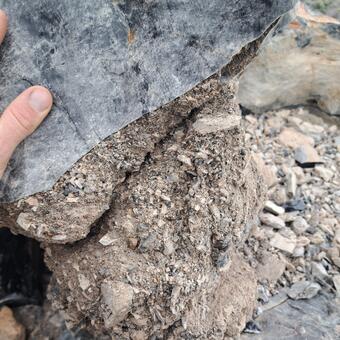
These veins give scientists important clues about the dynamics of volcanic eruptions. Tuffisite veins form during eruptions, when a mix of hot volcanic gas and rock fragments are forced through fractures in cooled lava. The fractures can form either in the rock around a volcanic vent, or directly within lava domes and flows. Tuffisite veins can be as small as a fraction of an inch or as big as multiple feet wide, while the rock fragments that fill them can range from tiny ash particles up to large boulders.
Multiple volcanic settings in California host tuffisites. One example is Panum Crater, which erupted about 700 years ago at the north end of the Mono Craters chain. This photo shows a tuffisite vein, containing ash and small angular rock fragments (or tephra), which cuts through the black obsidian found on the Panum lava dome. While lava dome formation is a mostly effusive process where lava flows slowly from a vent, tuffisites like this one preserve evidence of how violent tephra venting can occur alongside gentler lava dome effusion.