



Photo & Video Chronology – August 29, 2025 – Kīlauea summit observations and monitoring site maintenance
By Hawaiian Volcano Observatory
August 29, 2025
USGS Hawaiian Volcano Observatory Scientists visited the V1cam livestream camera site on the morning of August 29 for some maintenance work.
Media
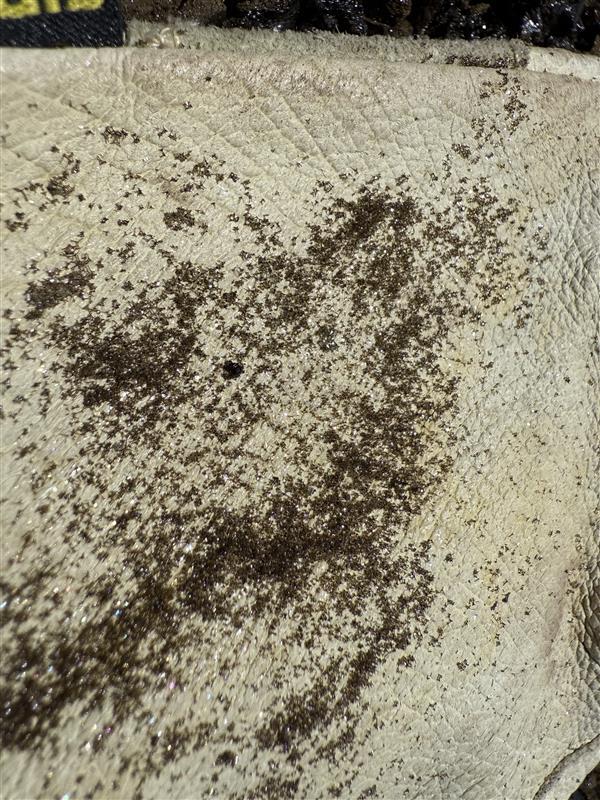
A close-up view of tiny volcanic glass fragments on a leather glove. These particles are abundant around the western rim of Kīlauea summit caldera, an area that is closed to the public due to hazardous conditions. Volcanic glass fragments can cause irritation to eyes, lungs, and skin, and exposure should be avoided. USGS scientists working in the closed area, with permission from Hawai‘i Volcanoes National Park, wear special personal protective equipment to minimize their exposure to these particles. USGS photo by L. DeSmither on August 29, 2025.
Sources/Usage: Public Domain. View Media Details
Media
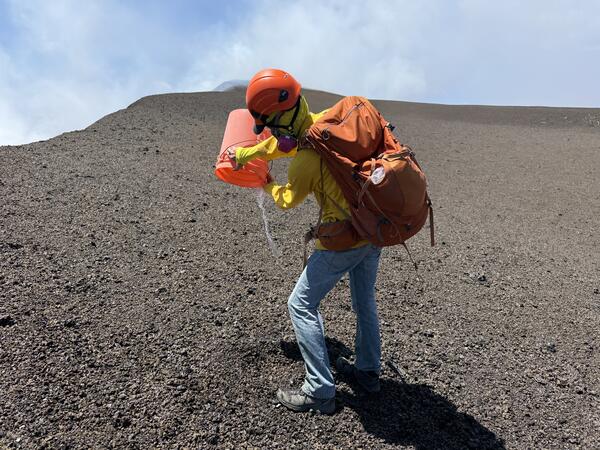
A USGS Hawaiian Volcano Observatory scientist empties water and volcanic glass particles from a tephra collection bucket on the western rim of Halema‘uma‘u. The buckets are used to collect tephra from the eruption episodes for geochemical analyses. Strong winds around the crater rim can resuspend older tephra, pele’s hair, and volcanic glass, which fall back into the buckets. Scientists empty the buckets between eruptive episodes to try and make sure there’s no contamination of materials from older episodes. USGS photo by L. DeSmither on August 29, 2025.
Sources/Usage: Public Domain. View Media Details
Media
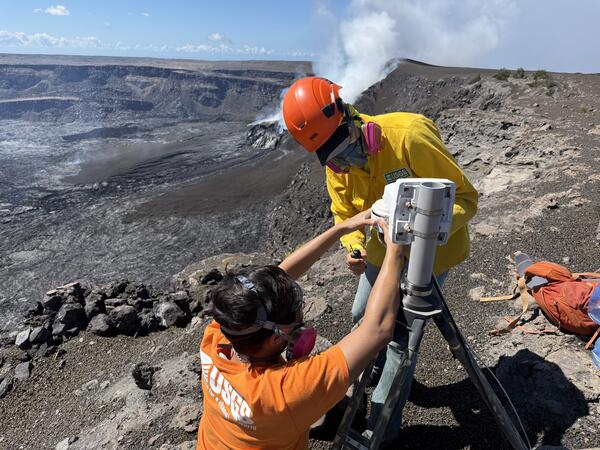
USGS Hawaiian Volcano Observatory Scientists visited the V1cam livestream camera site on the morning of August 29 for some maintenance work. Despite their distance from the volcanic gas plume from the north and south vents, seen behind them, crews wear respiratory and eye protection to minimize their exposure to tiny wind-blown volcanic glass particles that are abundant in the air and on the ground within the closed area around Kīlauea summit. These particles can cause irritation to the eyes and lungs and should be avoided. USGS photo by L. DeSmither.
Sources/Usage: Public Domain. View Media Details
Media
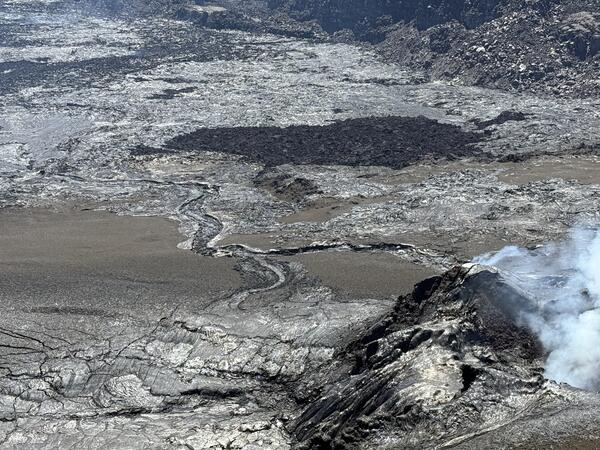
The ongoing Kīlauea summit eruption within Halema‘uma‘u crater remains paused following the end of episode 31 on August 23. Intermittent glow is visible from the north vent (lower right) in nighttime views. Small lava channels are visible near the center of this telephoto image cutting through the tephra blanket on the western crater floor. USGS photo taken on August 29, 2025, by L. DeSmither.
Sources/Usage: Public Domain. View Media Details
Media
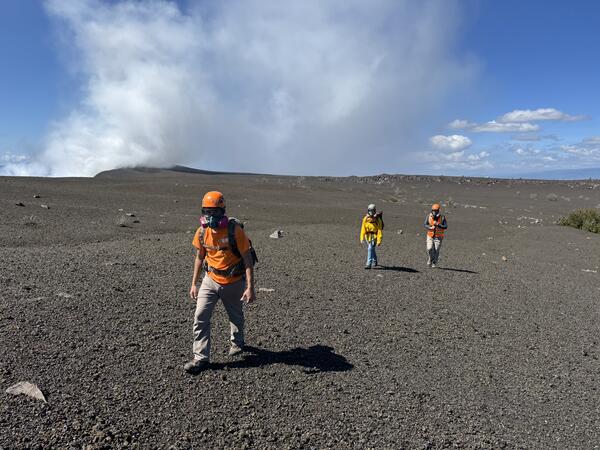
USGS Hawaiian Volcano Observatory Scientists hike to the northwest rim of Kaluapele (Kīlauea summit caldera) for maintenance at the V1cam livestream camera. The crew wears special personal protective equipment (PPE) to protect their eyes and lungs from exposure to tiny volcanic glass particles. Walking on the tephra, which blankets the western rim of the caldera, crushes the delicate glass fragments and sends tiny glass particles into the air, which are irritating to the lungs and eyes. This highlights one of the many hazards around the west rim of the caldera and why the area is closed to the public. USGS photo by M. Patrick taken on August 29, 2025.
Sources/Usage: Public Domain. View Media Details
Media
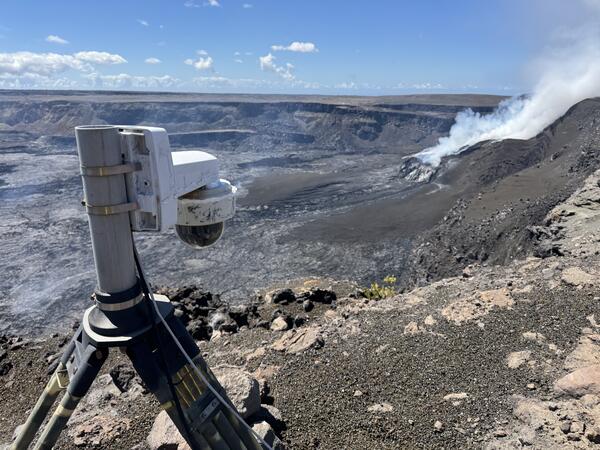
On the morning of August 29, 2025, USGS Hawaiian Volcano Observatory scientists visited the V1cam livestream camera (left) on the northwest rim of Kaluapele (Kīlauea summit caldera) for some site maintenance. The camera provides critical views of the ongoing Kīlauea summit eruption, particularly of the north vent, used for volcano monitoring. USGS photo by M. Patrick.
Sources/Usage: Public Domain. View Media Details
New Eruption Maps
Media
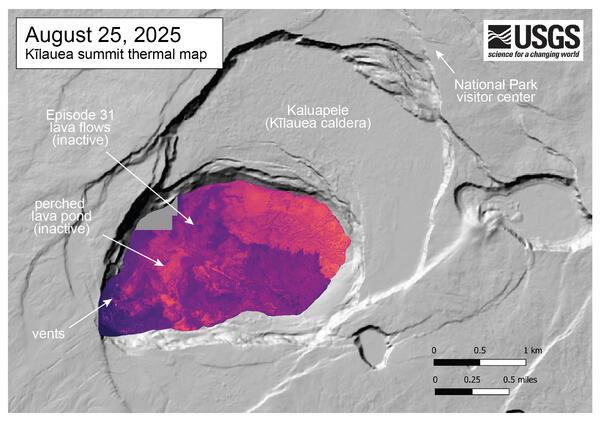
This thermal map of Kīlauea's summit caldera was made from airborne thermal images collected on August 25, just a few days after episode 31 lava fountaining covered the crater floor in new lava flows. These flows remain warm in the thermal imagery, particularly in the eastern crater where flows slightly expanded the margin of new flows on the crater floor. Two tiny ooze-outs of recent lava show as white (hot) in the thermal map, and represent a small amount of residual lava squeezed out from the surface.
Sources/Usage: Public Domain. View Media Details
Media
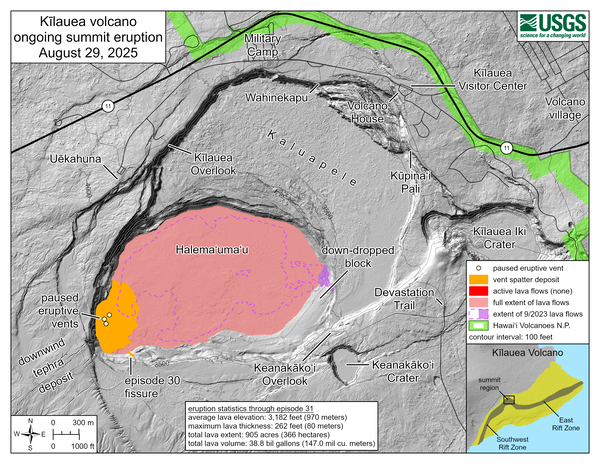
This reference map depicts the Kīlauea summit eruption within Halema‘uma‘u crater that began on December 23, 2024. As of this posting on August 29, 2025, the eruption has had thirty-one episodes, with the most recent one occurring on August 22 and 23. Most of the map data included here were collected during a Hawaiian Volcano Observatory helicopter overflight on August 25, so the provided statistics are reflective of the entire eruption to this point.
Sources/Usage: Public Domain. View Media Details