



Volcano Watch — Ancient volcanoes are critical to our modern world, and our future
If you’ve read “Volcano Watch” articles before, you can probably list several reasons that scientists study volcanoes. However, there is another reason to study volcanoes that may surprise you: critical mineral resources of economic importance.
Volcano Watch is a weekly article and activity update written by U.S. Geological Survey Hawaiian Volcano Observatory scientists and affiliates.
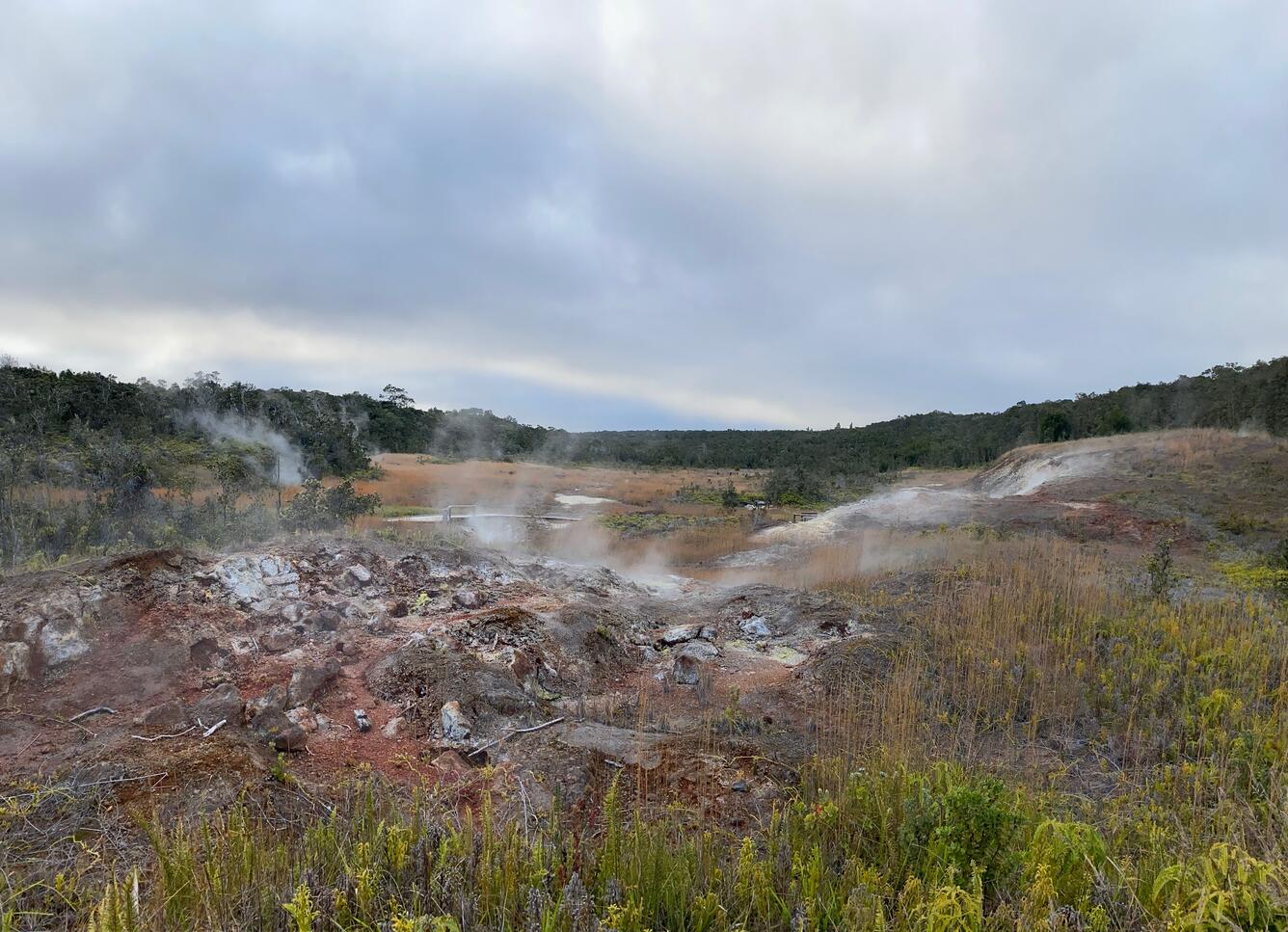
Volcanoes act as windows into the deep Earth. They help us understand the formation of our planet and others like it in the solar system. Living on or near an active volcano can be both beneficial, due to their rich soils and tourism appeal, but they also pose hazards to the communities around them. For this reason, we need to understand what drives volcanic eruptions and monitor volcanoes to keep communities safe.
Long after magma has stopped rising through the crust and the last eruption at a volcano has ceased, another process takes places in volcanic systems deep underground. Fluids begin to percolate through the system—they flow through the old magma reservoirs, the dykes and sills, buried lava flows and hydrothermal systems—transporting elements and chemically altering the surrounding rocks. Unlike the geologically short and violent lives of volcanoes, the formation of mineral systems is a slow, quiet process that can take millions of years.
According to the Energy Act of 2020, “critical minerals” are those minerals, elements, substances, or materials designated as critical because they serve an essential function for energy technology and have a high risk of supply chain disruption. The list of critical minerals includes elements like lithium, nickel, magnesium, platinum, iridium, and rare earth elements, among others. These elements have become important for our everyday lives, and are used in everything from solar panels, batteries, vehicles, power plants, medical devices, to smartphones.
More than half of the world’s critical mineral resources formed in ancient volcanic systems. When exploring for mineral resources, your location within the volcanic system will determine the type of ore bodies you’d expect to find.
For instance, deep in the volcanic system, minerals like chromium, titanium, vanadium, and platinum-group elements are found in layered intrusive rocks that were once bodies of magma that never made it to the surface.
The most abundant source of rare earth elements are strange magmas called carbonatites that are found at the edges of ancient continents and in ancient rift systems within continents. In other volcanic systems, like submarine volcanoes, magmatic-hydrothermal systems yield minerals like copper, lead, zinc, and gold.
The richest mineral deposits are often found in the oldest volcanic rocks. They’ve been weathered down, eroded, and buried, while fluids have moved through continuously altering the rocks themselves. You probably wouldn’t recognize them as old volcanic systems without a geology degree—and even then, it’s hard!
As geologists, we use observations of our modern world to help us understand the formations of the past. Studying recent and active volcanic systems—where they form, how they’re shaped inside, what magmas they produce, and how they interact with the surrounding environment—allows us to better understand and explore for these ancient, mineral-bearing systems that power the modern and future world. So, next time you visit a national park with volcanoes like Kīlauea or Yellowstone, imagine you are hiking on what could be a future ore deposit millions of years from now.
Volcano Activity Updates
Kīlauea has been erupting episodically within the summit caldera since December 23, 2024. Its USGS Volcano Alert level is WATCH.
Episode 29 of the Kīlauea summit eruption in Halemaʻumaʻu crater occurred on July 20, with approximately 13 hours of fountaining from predominantly the north vent. Summit region inflation since the end of episode 29, along with persistent tremor, suggests that another episode is possible and could start July 31 or later. Sulfur dioxide emission rates are elevated in the summit region during active eruption episodes. No unusual activity has been noted along Kīlauea’s East Rift Zone or Southwest Rift Zone.
Mauna Loa is not erupting. Its USGS Volcano Alert Level is at NORMAL.
One earthquake was reported felt in the Hawaiian Islands during the past week: a M3.1 earthquake 1 km (0 mi) S of Kealakekua at 9 km (5 mi) depth on July 21 at 9:07 p.m. HST.
HVO continues to closely monitor Kīlauea and Mauna Loa.
Please visit HVO’s website for past Volcano Watch articles, Kīlauea and Mauna Loa updates, volcano photos, maps, recent earthquake information, and more. Email questions to askHVO@usgs.gov.