



The spectacular springs of Black Sand Basin
Black Sand Basin, a sub-basin of Upper Geyser Basin, is home to impressive hot springs, frequently active geysers, and fascinating history.
Yellowstone Caldera Chronicles is a weekly column written by scientists and collaborators of the Yellowstone Volcano Observatory. This week's contribution is from Michael Poland, geophysicist with the U.S. Geological Survey and Scientist-in-Charge of the Yellowstone Volcano Observatory.
Yellowstone National Park’s Upper Geyser Basin is home to some of the most spectacular geysers in the park, including Old Faithful, Grand, Giant, Castle, and Riverside Geysers. But in the areas that host the most impressive geysers there are few large hot springs. For those, you need to explore a sub-basin of the region: Black Sand Basin!
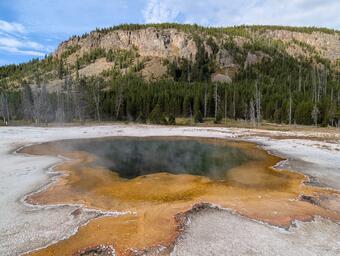
Black Sand Basin, which is located just west of the Old Faithful area along the southern side of the main highway, has gone by many names over the years. In 1878, the name “Emerald Group” was given to the area after one of the springs. In the 1880s, “Black Sand Basin” began to appear on maps but was intended to apply to a single spring—today’s Black Sand Pool (one of the well-known thumping hot springs of Yellowstone). The late 1800s also saw the name “Sun Light Basin” applied to the group of springs and small geysers. It was only in 1927 that all of this confusion was put to rest and the name “Black Sand Basin” was made official.
The “black sand” referenced in the name is from obsidian fragments in the sandy material that makes up much of the surface of the area. That obsidian comes from a rhyolite lava flow—specifically the Summit Lake flow—that makes up the steep cliffs just west of Upper Geyser Basin.
There are several large hot springs in Black Sand Basin. Emerald Pool once was the best-known feature in the area due to its deep green color, but the temperature of the spring has decreased over time leading to the water becoming brownish in appearance. Nearby Green Spring has occasionally discharged water into Iron Spring Creek, which passes through the basin. The water was so hot and voluminous that it killed fish in the creek!
Rainbow Pool and Sunset Lake are the two largest hot springs in Black Sand Basin. Both are ringed by bacteria of varying colors, providing the reason behind the springs’ names. In the 1880s, geologist Arnold Hague noted that Sunset Lake was second only to Grand Prismatic Spring in terms of its colorful appearance.

One of the most inconspicuous pools in Black Sand Basin also has one of the most fascinating histories. Handkerchief Pool was an early tourist attraction because visitors would drop handkerchiefs into the water. The linen would be sucked downward by convective action and then returned to the surface within a minute or two, all nice and clean. Hague noted that these conditions were similar to other pools in Yellowstone, but “in other localities the work is not done so systematically and wearing apparel is usually injured.” Some guides took to calling the pool the “Devil’s Laundry.”
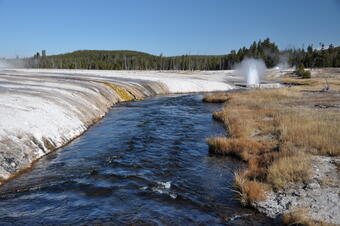
Of course, handkerchiefs were not the only things thrown into Handkerchief Pool. A 1929 cleaning of the pool turned up a broken bottle, part of a spark plug, hair pins, nails, a horseshoe, and \$1.98 in coins, in addition to a dozen or so handkerchiefs and other human and natural debris. This material caused the spring to go dormant, and it wasn’t until a log was removed by park naturalist George Marler in 1950 that water began to circulate once more.
Several small geysers also can be found in the basin. Spouter Geyser is adjacent to the parking lot and is frequently in action, often for hours at a time. Cliff Geyser is the tallest geyser in Black Sand Basin and erupts to 20 feet (6 meters) or more every few minutes. A boardwalk overlook is right across Iron Spring Creek from the geyser, making for an impressive and close-up view of the activity.
Although it does not receive the attention of other areas in Upper Geyser Basin, Black Sand Basin is worth a visit. The most impressive hot springs in the region can be found there, and one can get up close and personal with several small but frequently active geysers.
Acknowledgement: Some of the information from this article was taken from T. Scott Bryan’s The Geysers of Yellowstone, Lee H. Whittlesey’s Yellowstone Place Names, and the unpublished Geology of Yellowstone National Park by Arnold Hague.