



Yellowstone’s newest hydrothermal monitoring station and “renewed” camera
In early September, monitoring capabilities in Yellowstone received a significant boost with the renewal of the Yellowstone Lake camera and the installation of a new monitoring station at Geyser Hill, near Old Faithful.
Yellowstone Caldera Chronicles is a weekly column written by scientists and collaborators of the Yellowstone Volcano Observatory. This week's contribution is from Michael Poland, geophysicist with the U.S. Geological Survey and Scientist-in-Charge of the Yellowstone Volcano Observatory, and Jamie Farrell, associate research professor with the University of Utah Seismograph Stations and Chief Seismologist of the Yellowstone Volcano Observatory.
In 2022, the Yellowstone Volcano Observatory introduced a 10-year plan for monitoring volcanic, seismic, and hydrothermal activity in the Yellowstone National Park area. A key aspect of that plan was to specifically monitor hydrothermal systems by placing geophysical sensors in geyser basins. In so doing, it would be possible to better detect hazardous hydrothermal changes, like steam explosions.
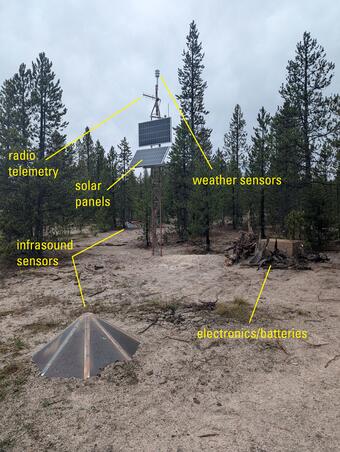
The first such station was established in September 2023 at Norris Geyser Basin. The site included a GPS antenna to track ground movement, a broadband seismometer to detect even the smallest seismic tremor, weather instrumentation, and an infrasound array to measure low-frequency acoustic signals. On April 15, 2024, the seismic and infrasound sensors picked up an explosion that occurred on Porcelain Terrace in Norris Geyser Basin. No one was nearby to witness the explosion, so the event would have gone unnoticed had it not been for the monitoring station. In fact, that was the first hydrothermal explosion ever recorded by geophysical monitoring in Yellowstone National Park!
Of course, the 2024 Norris Geyser Basin explosion was quickly overshadowed by the July 23, 2024, hydrothermal explosion at Biscuit Basin—an event that drove home the hazardous nature of the boiling water system at Yellowstone. Fortunately, no one was injured, but Biscuit Basin has been closed to visitors ever since.
Yellowstone Volcano Observatory scientists installed another hydrothermal monitoring station, with a camera along with GPS, seismic, meteorological, and infrasound sensors, at Biscuit Basin in summer 2025, and the station has recorded numerous signals associated with eruptions from Black Diamond Pool (source of the 2024 explosion) as well as a new explosion just north of Black Diamond Pool in June 2026.
The latest site in the growing hydrothermal monitoring network in Yellowstone National Park came online in early September 2026 near Geyser Hill, not far from Old Faithful Geyser in Upper Geyser Basin. The site, which is designated “YGH” and was installed by a team of University of Utah, Yellowstone National Park, and USGS scientists and staff, includes weather, seismic, and infrasound sensors, and it has already shown that it can detect a variety of signals. For example, the seismic sensor clearly records the “thumping” behavior of Doublet Pool. Past changes in the thumping interval there have accompanied anomalous hydrothermal activity, like the 2018 eruption of Ear Spring and the 2023 unrest on Geyser Hill, so monitoring the thumping could be an important way of forecasting future changes.
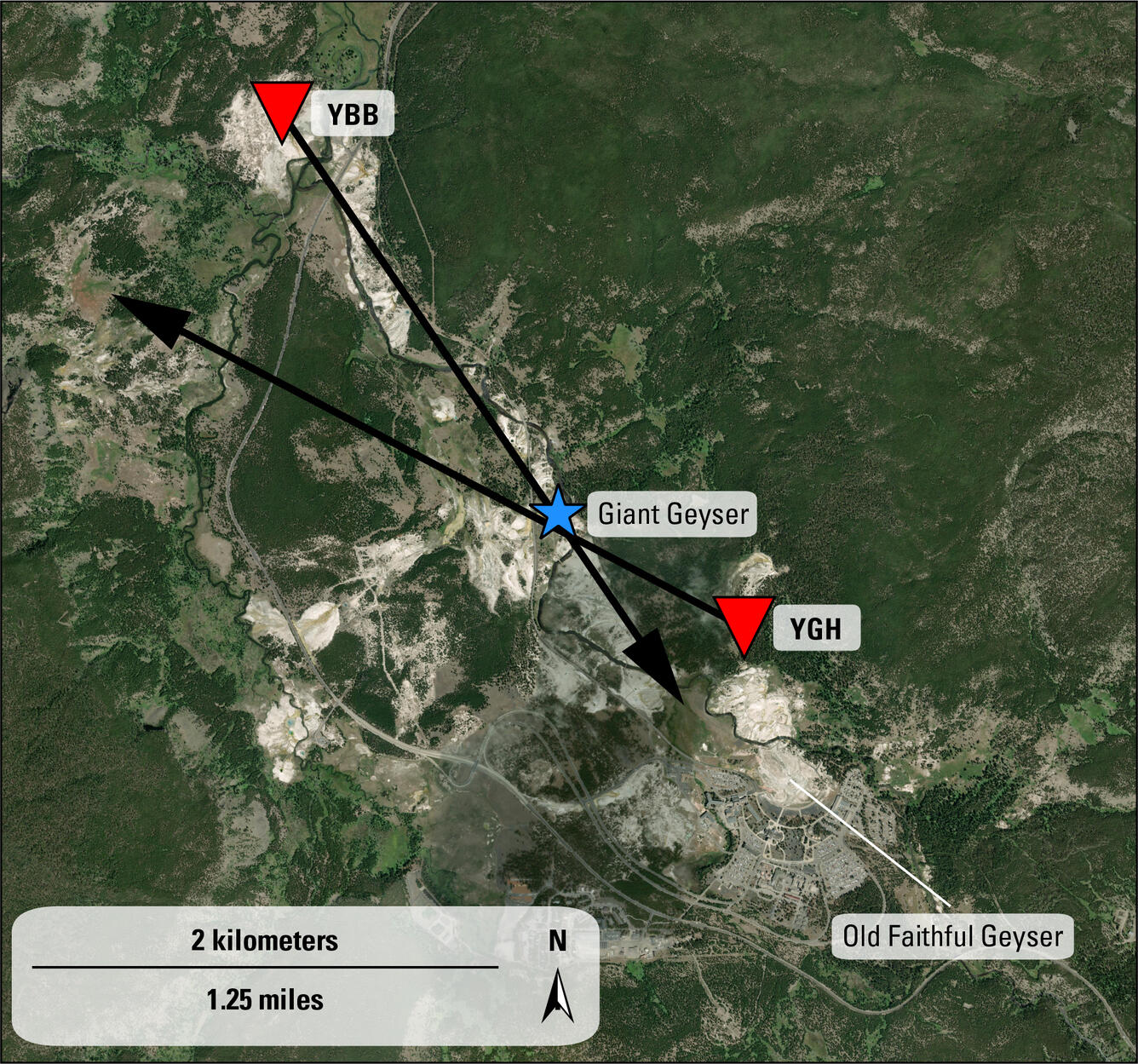
The infrasound sensors at the new station also clearly record a variety of geyser eruptions, including those from Old Faithful Geyser, Grand Geyser, and even Giant Geyser, which sprang to life in summer 2026 after a period of dormancy. Giant Geyser eruptions are also recorded by the infrasound array at Biscuit Basin and, based on the directionality of the sound, it is possible to use the data from the two locations to pinpoint the source. This provides a proof-of-concept about how multiple infrasound monitoring stations together can be used to triangulate the sources of any anomalous acoustic signals.
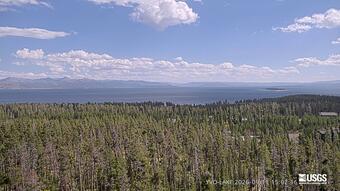
In addition to the YGH station, a new camera was also installed in the area of Lake Village in early September. Or, more accurately, reinstalled. The Lake camera was first set up in 2017 on a cell tower, and it provided a view of Yellowstone Lake and Stevenson Island until it malfunctioned in 2024. Efforts to replace the camera were stymied by bad weather and an active osprey nest in the tower, but engineers from the University of Utah were able to ascend the tower and install a new camera in early September. The camera view is updated every 15 minutes and can be seen at https://www.usgs.gov/media/webcams/webcam-yellowstone-lake.
The new monitoring station and renewed camera will be instrumental (so to speak!) for tracking hydrothermal activity in Yellowstone’s Upper Geyser Basin and assessing conditions in the area of Yellowstone Lake. All datasets are accessible via the station map on the Yellowstone Volcano Observatory website so you can follow along. Happy hydrothermal monitoring!