



Yellowstone’s phantom, sometimes mythical, Howard Eaton Trail
The Howard Eaton Trail, once spanning 157 miles, was the longest hiking and equestrian trail in Yellowstone National Park for nearly 50 years. Today, the remnants of that trail cover roughly a sixth of its former length.
Yellowstone Caldera Chronicles is a weekly column written by scientists and collaborators of the Yellowstone Volcano Observatory. This week's contribution is from Stanley Mordensky, geologist with the U.S. Geological Survey.
Visitors to Yellowstone National Park might have come across trails named for Howard Eaton. But these trails can be found in several widely separated areas of the park. What is the history of this trail, and who was Howard Eaton?
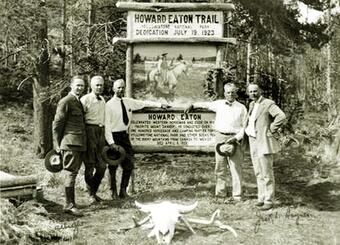
The Howard Eaton Trail was named after the first US dude rancher, Howard Eaton, who was born on February 8, 1851, in Pittsburgh, Pennsylvania, and began traveling west by 1868. In 1879, Eaton established the first dude ranch, then called Custer Trail Ranch, in Medora, North Dakota, and he was eventually joined by his brothers, Willis and Alden, who helped run the recreation site. In 1904, the Eaton brothers relocated their ranch to Wolf, Wyoming.
Howard Eaton’s first trip into Yellowstone National Park was in 1884. As with many, it left an indelible impression upon him. By 1898, he was leading annual two-week guided tours in the park. By 1906, the guided trips through the park lasted up to 20 days and included 30 to 60 people with as many as 95 horses and 7 wagons. The routes varied depending on the weather, grass and water availability, the number of guests, and the proximity to other parties. He sold the experience as “roughing it with comfort”.
Eaton surrounded himself with prominent individuals of the time, like mystery writer Mary Roberts Rinehart (source of the phrase “the butler did it”), photographer Arthur Aloysius "Pete" Dailey, and, not least of all, Theodore Roosevelt. Consequently, Eaton rose in fame through various forms of media during a time shortly after the American frontier had closed. The wilderness was no longer seen as an inexhaustible and untamed force to be conquered, but instead as a valuable resource for recreation and inspiration to be protected.
Eaton died unexpectedly after an operation for appendicitis in 1922. He was remembered for his charm and dedication to conservation and protection of wildlife. Years later, a founder of the Boy Scouts of America, Dan Beard, described him as having "had a heart as big as an ox… Howard's heart was so big that he could not call a man down, even when he knew the man to be wrong; he was so kind-hearted, in truth that rather than prove that a man was wrong, he would help the fellow to think that he was right." (Boy's Life, September 1928)
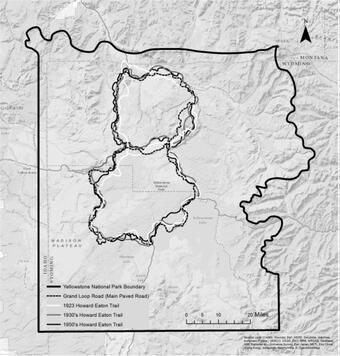
Despite the man living a larger-than-life persona, many are surprised to learn that Howard Eaton was not personally involved in designing the trail that held his name. Shortly after Eaton’s death, Yellowstone Park Superintendent Horace Albright began planning a trail to honor Eaton with help from Alice Morris, a New York socialite who fell in love with Yellowstone and had been mapping out trails in the park since 1917. The hastily assembled Howard Eaton Trail, composed of existing trails, bridle paths, and abandoned roads, opened in 1923.
The 1920s-era Howard Eaton Trail largely followed the Grand Loop Road, which had been mostly constructed for stagecoach and wagon traffic by 1905 and authorized for vehicle traffic in August 1915. The trail was subject to rapid deterioration and was reconstructed, often further from the road, in the 1930s by the Civilian Conservation Corps. The newer, more robust trail had improvements, like grades better suited for horses. By the late 1950s, the trail had undergone yet a another round of renovation, after which it frequently intersected the main road.
For nearly five decades, the National Park Service maintained these various incarnations of the Howard Eaton Trail for foot and equestrian travel. However, in 1970 budget constraints forced the Park Service to abandon large sections of the trail, and some of the newly disembodied sections were given new names. The life cycle of the Howard Eaton trail in many respects reflects the changing nature of how visitors interact with Yellowstone National Park. Rapid construction in 1923 was meant to separate foot and equestrian visitors from the ever-increasing automobile traffic along the road. Then, after the surge in automobile ownership following World War II, the need for a separate pedestrian path around the park was no longer critical. In the present day, only three sections of trail remain and still retain the moniker of the Howard Eaton Trail: near Golden Gate (4 miles), Old Faithful (9 miles), and Fishing Bridge (14 miles).
Sources:
DeJarnett , D. 2017. Cowboy Tales on the Eaton Trail in Yellowstone. Pronghorn Press. ISBN No. 978-1-941052-23-5
Meyer, J. 2017. Yellowstone’s Howard Eaton Trail. Western Historical Quarterly 48 (2). https://www.jstor.org/stable/26782820.