



How to catch a vector: Mosquito monitoring for avian malaria control
Study site landscape
Typical forest in Upper Waiākea Forest Reserve, Island of Hawai'i, features 'ōhi'a trees and uluhe ferns
Mosquito egg raft
Southern house mosquito, Culex quinquefasciatus, egg raft as seen under a digital microscope
USGS researchers are combatting avian malaria by improving the trapping and tracking of mosquitoes in endangered Hawaiian bird habitats.
Avian malaria is the main driver of population declines of endangered Hawaiian honeycreepers, a group of endemic and culturally important birds. Introduced southern house mosquitoes (Culex quinquefasciatus) host the parasite that causes avian malaria (Plasmodium relictum) and has led to rapid declines and extinction events in honeycreeper populations. To combat the spread of the disease to these imperiled species, USGS partners are releasing non-compatible male mosquitoes that mate with resident females and produce sterile eggs on Maui and Kauaʻi. Male mosquitoes do not feed on blood, only nectar, so they don’t spread disease. This method is intended as a birth control measure, suppressing mosquito populations and reducing disease risk among native birds. Researchers then trap mosquitoes in target areas to record their changing numbers and evaluate the success of the intervention.
What is the issue?
Researchers want to know if this program is reducing mosquito populations. Effective mosquito trapping provides important information about the size and reductions of these populations. Current traps and trap placement optimized for other introduced mosquito species may not effectively attract southern house mosquitoes, so scientists are testing new methods to attract this species even when populations are low.
What is our approach?
Objectives:
- Increase efficacy of traps for southern house mosquitoes
- Assess passive traps to collect eggs from females
- Implement a statistical approach to estimate small populations
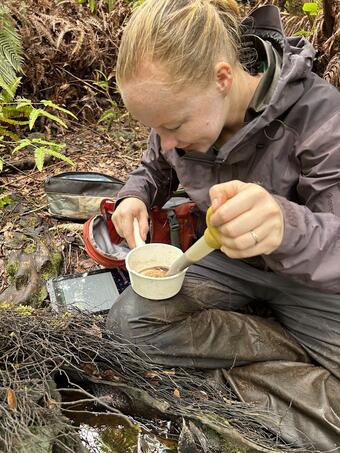
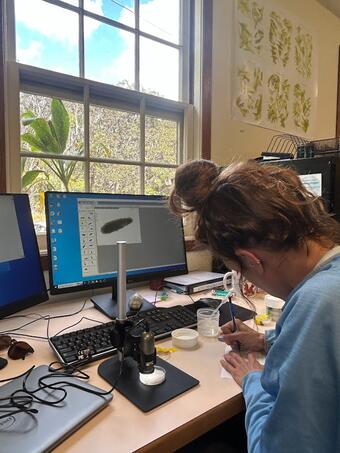
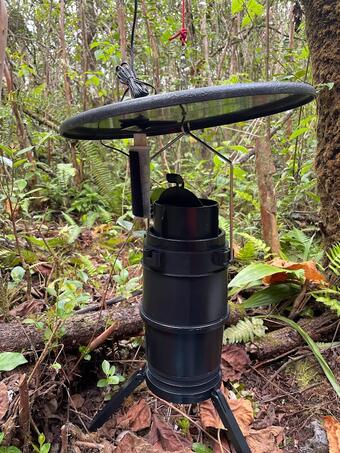
Research on the Island of Hawai‘i incorporates variations in locations and trap and lure types for attracting adult mosquitoes. Stationary traps test different lures (CO2 [carbon dioxide] or “smelly”) and sites (in trees or on the ground) for the preferences of females and males. For passive traps that entice females to lay eggs, a complementary field study assesses the fecundity of female mosquitoes. The southern house mosquito lays its eggs in one connected group called an egg raft. Egg rafts are collected, counted, and allowed to hatch resulting in robust techniques for sampling oviposition (egg-laying) and estimating hatch rates in mosquitoes within these wet, mid-elevation habitats.
In addition to these field studies, streamlined data and statistical processes provide a progress check across the Hawaiian Islands. New technologies for field data entry are being explored for greater efficiency, followed by standard USGS practices of quality control and data releases for public availability. In addition, resource managers receive data visualizations and clearly documented analyses that can be applied to tracking mosquito suppression on other islands.
What is the benefit?
The success of these studies and mosquito interventions aim to support healthy populations of endangered honeycreepers and other native birds throughout the Hawaiian Islands. These techniques benefit and expand efforts to control the mosquito vectors of avian malaria in Hawaii and other tropical locations.
USGS researchers are combatting avian malaria by improving the trapping and tracking of mosquitoes in endangered Hawaiian bird habitats.
Avian malaria is the main driver of population declines of endangered Hawaiian honeycreepers, a group of endemic and culturally important birds. Introduced southern house mosquitoes (Culex quinquefasciatus) host the parasite that causes avian malaria (Plasmodium relictum) and has led to rapid declines and extinction events in honeycreeper populations. To combat the spread of the disease to these imperiled species, USGS partners are releasing non-compatible male mosquitoes that mate with resident females and produce sterile eggs on Maui and Kauaʻi. Male mosquitoes do not feed on blood, only nectar, so they don’t spread disease. This method is intended as a birth control measure, suppressing mosquito populations and reducing disease risk among native birds. Researchers then trap mosquitoes in target areas to record their changing numbers and evaluate the success of the intervention.
What is the issue?
Researchers want to know if this program is reducing mosquito populations. Effective mosquito trapping provides important information about the size and reductions of these populations. Current traps and trap placement optimized for other introduced mosquito species may not effectively attract southern house mosquitoes, so scientists are testing new methods to attract this species even when populations are low.
What is our approach?
Objectives:
- Increase efficacy of traps for southern house mosquitoes
- Assess passive traps to collect eggs from females
- Implement a statistical approach to estimate small populations
Research on the Island of Hawai‘i incorporates variations in locations and trap and lure types for attracting adult mosquitoes. Stationary traps test different lures (CO2 [carbon dioxide] or “smelly”) and sites (in trees or on the ground) for the preferences of females and males. For passive traps that entice females to lay eggs, a complementary field study assesses the fecundity of female mosquitoes. The southern house mosquito lays its eggs in one connected group called an egg raft. Egg rafts are collected, counted, and allowed to hatch resulting in robust techniques for sampling oviposition (egg-laying) and estimating hatch rates in mosquitoes within these wet, mid-elevation habitats.
In addition to these field studies, streamlined data and statistical processes provide a progress check across the Hawaiian Islands. New technologies for field data entry are being explored for greater efficiency, followed by standard USGS practices of quality control and data releases for public availability. In addition, resource managers receive data visualizations and clearly documented analyses that can be applied to tracking mosquito suppression on other islands.
What is the benefit?
The success of these studies and mosquito interventions aim to support healthy populations of endangered honeycreepers and other native birds throughout the Hawaiian Islands. These techniques benefit and expand efforts to control the mosquito vectors of avian malaria in Hawaii and other tropical locations.