



New Data Visualizations Dive into Inland Fisheries as Food Sources
Three new data visualizations highlighting recreational inland fisheries harvest have been added to the USGS Earth is in Flux science visualization gallery. The interactive visuals showcase the nutritional contribution, economic value, and climate vulnerability of inland recreational fish consumption by country and taxa.
While often viewed as a leisure pastime, inland recreational fishing provides meaningful contributions to local economies, cultures, and, especially, food systems. Depending on the species, eating fish caught recreationally may also be vulnerable to changes in climate. Research from the National and Midwest CASCs highlights how this kind of freshwater fishing plays an overlooked role in feeding communities around the globe.
CASC scientists combined their expertise with the USGS Vizlab team, a group of designers, data scientists, and science communicators from the USGS Water Resources Mission Area, to release the ‘Recreational Inland Fisheries as Food’ data visualizations. This collection of visualizations is a new addition to the USGS Earth is in Flux science visualization gallery, a shared initiative to creatively communicate key findings of USGS land change science. Through three interactive data visualizations, users can explore the nutritional contribution, economic value, and climate vulnerability of inland recreational consumption by country in an accessible and engaging format.
Inland Recreational Fish Consumption: Users can examine consumable harvest (edible portions of a given fish) for the five fish families with the largest recreational edible harvest, as well as the countries that consume them.
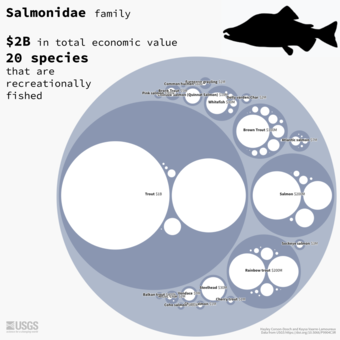
Total Consumptive Use Value of Recreationally Harvested Fishes: Users can view the economic value of fish that people catch and consume through recreational fishing. The nested circles show how this value is distributed between countries.
Climate Vulnerability of Recreational Fish Consumption by Country: Users can explore the global implications of inland recreational fishing as a food source by mapping the number of recreational fishers in each country, the amount of consumable fish harvested, and the average climate vulnerability score for each harvested species.
The findings illustrated through these interactive visualizations may be used to encourage more data exploration and help inform climate adaptation planning and management of these often underappreciated food sources.
These visualizations were developed using data from the National CASC project titled Estimating Global Inland Recreational Consumption to Adapt to Global Change.
Learn more about the research in the associated articles, “Inland recreational fisheries contribute nutritional benefits and economic value but are vulnerable to climate change” and “Global dataset of species-specific inland recreational fisheries harvest for consumption” published in the journal Nature.