



RADish Profiles: Jennifer (Nifer) Wilkening
Explore More RADish Profiles
Explore interviews with scientists and managers researching and implementing the resist-accept-direct (RAD) framework.
Jennifer (Nifer) Wilkening
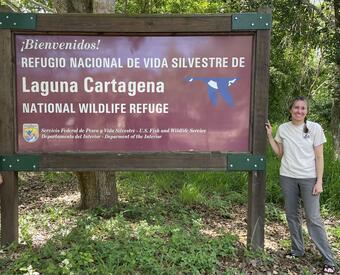
Research Ecologist, U.S. Fish and Wildlife Service National Wildlife Refuge System
Jennifer (Nifer) Wilkening is a Research Ecologist with the U.S. Fish and Wildlife Service National Wildlife Refuge System stationed in Fort Collins, Colorado. Nifer has worked in wildlife conservation and natural resource management since 1999, and became involved with the Resist-Accept-Direct (RAD) framework in 2018. She has worked on wildlife conservation projects in Africa, Asia, South America, and numerous ecoregions throughout the western United States including the Rocky Mountains, Sierra Nevada, Cascades, Great Basin, Coastal Sagescrub, and the Mojave Desert. Nifer’s research has centered around climate change in desert and mountain ecosystems, with particular emphasis on the use of a habitat specialist species to identify, interpret and model climate change impacts. Her current role with the refuge system focuses on air and water resources, such as water quality and water quantity, with an emphasis on protecting wildlife and refuge habitats while supporting adaptation to global change. She is a member of the IUCN Climate Change Specialist Group, an author for the 5th National Climate Assessment, and an Associate Editor for PLOS Climate and the Journal of Wildlife Management.
Q: How did you first get involved with the RAD framework or decision-making around ecological transformation?
I've been working in the field of wildlife conservation since 1999 and have been actively involved with TWS (The Wildlife Society) since 2012. In 2018, I responded to an open call for participation in a workshop jointly organized by TWS and AFS (American Fisheries Society) that focused on responding to ecosystem transformation. At the time, I was a wildlife biologist with the U.S. Fish and Wildlife Service (USFWS) Ecological Services program, working primarily on threatened and endangered species and habitat conservation planning. So I initially approached RAD from a species and habitat level perspective due to my professional responsibilities, plus I was living in the Mojave Desert which is home to a lot of endemic species and habitat specialists.
My perspective has broadened since moving from Ecological Services to the National Wildlife Refuge System in 2020. My previous work with USFWS already required me to think about habitat and ecological context, but the questions were often framed around the needs of particular listed species. In the refuge system, I am more often considering ecological processes, multiple species, and multiple management objectives across larger landscapes. That broader context has influenced how I think about RAD and the range of decisions it can help wildlife refuge managers navigate.
Q: What are some of the biggest challenges you’ve seen managers face when choosing between resisting, accepting, or directing change?
One of the biggest challenges is the time scale. Refuge managers are already witnessing change on the landscape and often know more is coming, but are uncertain on when or how quickly changes may occur. So they frequently ask: “When is this change going to happen?” and then try to determine when they should begin implementing a Resist, Accept, or Direct strategy. The challenge is making decisions about when and how to act while there is still uncertainty about the timing and pace of change.
Additionally, there is an important spatial component. Many refuges are large and contain a diversity of habitats and ecological conditions, so managers have to determine where within a refuge a particular RAD action makes sense. This is one reason, I think, refuge managers do not need additional tools and studies, but instead more support for making decisions with the information they already have. Refuge managers are poised to take action; the challenge is determining when and where that action will be most effective.
Another challenge is reconciling local priorities with conservation at the system level. Refuge managers naturally focus on the refuge in front of them and the resources they are responsible for protecting. But the National Wildlife Refuge System is managed as a network, and sometimes the best outcome for the overall system may mean accepting loss in one unit so that resources can be directed toward maintaining or restoring something elsewhere. From a system perspective, that seems like a good choice, but it can be difficult for an individual refuge and the local community to accept the loss of a resource they have worked to protect. RAD allows for managers to think beyond what they can preserve at their individual refuge and consider where conservation investments can have the greatest benefit across the broader system.
Q: How important do you think cross-organizations partnerships are for RAD?
Cross-organizational partnerships are essential to conservation because ecological processes rarely align with administrative boundaries. Within the USFWS, working with partners is an explicit part of our conservation mission. We rely heavily on partnerships because no single organization has the authority, capacity, or information needed to manage entire ecosystems or address all aspects of species conservation. The opportunity to work alongside partners allows scientists to coordinate conservation efforts across different jurisdictions and at both the ecosystem and species levels. I think it is especially important with RAD because the decisions being made within a refuge can affect ecological conditions and management options elsewhere. Engaging partners can provide a broader understanding of what is happening across the landscape. It can also help managers consider how different actions may interact and what consequences they may have beyond their own jurisdiction.
Q: In one sentence (or as close as you can get), how would you explain RAD to someone outside of science?
RAD is a facilitation tool that helps practitioners evaluate different options and have clear-eyed conversations about the trade-offs involved in responding to ecosystem transformation.
Explore interviews with scientists and managers researching and implementing the resist-accept-direct (RAD) framework.
Jennifer (Nifer) Wilkening
Research Ecologist, U.S. Fish and Wildlife Service National Wildlife Refuge System
Jennifer (Nifer) Wilkening is a Research Ecologist with the U.S. Fish and Wildlife Service National Wildlife Refuge System stationed in Fort Collins, Colorado. Nifer has worked in wildlife conservation and natural resource management since 1999, and became involved with the Resist-Accept-Direct (RAD) framework in 2018. She has worked on wildlife conservation projects in Africa, Asia, South America, and numerous ecoregions throughout the western United States including the Rocky Mountains, Sierra Nevada, Cascades, Great Basin, Coastal Sagescrub, and the Mojave Desert. Nifer’s research has centered around climate change in desert and mountain ecosystems, with particular emphasis on the use of a habitat specialist species to identify, interpret and model climate change impacts. Her current role with the refuge system focuses on air and water resources, such as water quality and water quantity, with an emphasis on protecting wildlife and refuge habitats while supporting adaptation to global change. She is a member of the IUCN Climate Change Specialist Group, an author for the 5th National Climate Assessment, and an Associate Editor for PLOS Climate and the Journal of Wildlife Management.
Q: How did you first get involved with the RAD framework or decision-making around ecological transformation?
I've been working in the field of wildlife conservation since 1999 and have been actively involved with TWS (The Wildlife Society) since 2012. In 2018, I responded to an open call for participation in a workshop jointly organized by TWS and AFS (American Fisheries Society) that focused on responding to ecosystem transformation. At the time, I was a wildlife biologist with the U.S. Fish and Wildlife Service (USFWS) Ecological Services program, working primarily on threatened and endangered species and habitat conservation planning. So I initially approached RAD from a species and habitat level perspective due to my professional responsibilities, plus I was living in the Mojave Desert which is home to a lot of endemic species and habitat specialists.
My perspective has broadened since moving from Ecological Services to the National Wildlife Refuge System in 2020. My previous work with USFWS already required me to think about habitat and ecological context, but the questions were often framed around the needs of particular listed species. In the refuge system, I am more often considering ecological processes, multiple species, and multiple management objectives across larger landscapes. That broader context has influenced how I think about RAD and the range of decisions it can help wildlife refuge managers navigate.
Q: What are some of the biggest challenges you’ve seen managers face when choosing between resisting, accepting, or directing change?
One of the biggest challenges is the time scale. Refuge managers are already witnessing change on the landscape and often know more is coming, but are uncertain on when or how quickly changes may occur. So they frequently ask: “When is this change going to happen?” and then try to determine when they should begin implementing a Resist, Accept, or Direct strategy. The challenge is making decisions about when and how to act while there is still uncertainty about the timing and pace of change.
Additionally, there is an important spatial component. Many refuges are large and contain a diversity of habitats and ecological conditions, so managers have to determine where within a refuge a particular RAD action makes sense. This is one reason, I think, refuge managers do not need additional tools and studies, but instead more support for making decisions with the information they already have. Refuge managers are poised to take action; the challenge is determining when and where that action will be most effective.
Another challenge is reconciling local priorities with conservation at the system level. Refuge managers naturally focus on the refuge in front of them and the resources they are responsible for protecting. But the National Wildlife Refuge System is managed as a network, and sometimes the best outcome for the overall system may mean accepting loss in one unit so that resources can be directed toward maintaining or restoring something elsewhere. From a system perspective, that seems like a good choice, but it can be difficult for an individual refuge and the local community to accept the loss of a resource they have worked to protect. RAD allows for managers to think beyond what they can preserve at their individual refuge and consider where conservation investments can have the greatest benefit across the broader system.
Q: How important do you think cross-organizations partnerships are for RAD?
Cross-organizational partnerships are essential to conservation because ecological processes rarely align with administrative boundaries. Within the USFWS, working with partners is an explicit part of our conservation mission. We rely heavily on partnerships because no single organization has the authority, capacity, or information needed to manage entire ecosystems or address all aspects of species conservation. The opportunity to work alongside partners allows scientists to coordinate conservation efforts across different jurisdictions and at both the ecosystem and species levels. I think it is especially important with RAD because the decisions being made within a refuge can affect ecological conditions and management options elsewhere. Engaging partners can provide a broader understanding of what is happening across the landscape. It can also help managers consider how different actions may interact and what consequences they may have beyond their own jurisdiction.
Q: In one sentence (or as close as you can get), how would you explain RAD to someone outside of science?
RAD is a facilitation tool that helps practitioners evaluate different options and have clear-eyed conversations about the trade-offs involved in responding to ecosystem transformation.