



Explore More RADish Profiles
Explore interviews with scientists and managers researching and implementing the resist-accept-direct (RAD) framework.
Tony W. Ciaocco
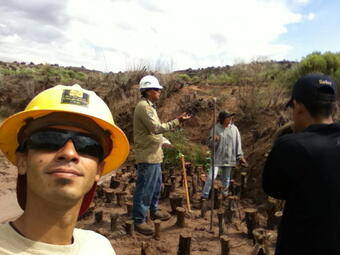
Mvskoke Ecologist and Ethnobiologist
Tony W. Ciocco "Chako" is a Mvskoke ecologist and ethnobiologist working at the intersection of wildlife management, ecological modeling, climate adaptation, and Indigenous Knowledge. His experience spans Tribal and federal natural resource programs, including work with the Bureau of Indian Affairs, the Navajo Nation Department of Fish and Wildlife, and the U.S. Geological Survey North Central Climate Adaptation Science Center (CASC). He has also worked with conservation focused nonprofits doing program development and hands-on restoration work with Conservation Legacy’s Ancestral Lands program. Tony is a Mvskoke language speaker and cultural practitioner, a Navajo Nation resident and in-law, and the recent founder of Epoch EthnoEcology, LLC, an ecological and ethnobiological consulting company focused on applied conservation, Indigenous Knowledge, and ecological research.
Q: How long have you been a RADish? (How did you first get involved with the RAD framework or decision-making around ecological transformation?
I first learned about RAD when I joined the USGS North Central CASC, and it immediately resonated with me because I had been debating many of the same issues with managers for years. I was especially interested in how RAD might intersect with Indigenous cultural frameworks for understanding and responding to ecological change. Conversations with some of the early RAD thinkers eventually contributed to a manuscript on Indigenous sociocultural responses to ecological transformation through a RAD lens which is awaiting publisher review. My main area is wildlife management, although I’ve also worked in rangeland management, habitat restoration, and of course climate adaptation. I first conceived RAD-like questions while doing Russian olive and tamarisk removal on the Navajo Nation, where nearly all funded management was effectively “resist” even when resistance sometimes seemed futile or counterproductive. RAD provides a way to articulate “accept” or “direct” as legitimate management choices rather than viewing management exclusively as a pass or fail effort to “resist”.
Q: How important do you think cross-organization partnerships are for RAD?
As a framework, RAD only becomes useful when organizations translate it into actual decisions and management. Ecological change crosses jurisdictions, as most public land management decisions and actions involve lots of stakeholders that differ in mandates, authorities, knowledge, impacts, and risk tolerance. Partnerships are therefore essential to applying RAD, as they expand the range of potential responses that can actually be considered and implemented.
Q: What are some examples of RAD work you’ve done?
I have limited formal experience as a RAD facilitator, but some experiences of mine include our NC CASC climate adaptation scenario planning project with Ute Mountain Ute and casual management pathway conceptualization discussions in my recent position at the Navajo Nation Fish and Wildlife Department. That latter experience may lead to formal grants and subsequent management activities, but sometimes just the open-ended dialogue is a powerful first step. It’s also deeply embedded in various projects that I’m pursuing via my recently founded LLC, Epoch EthnoEcology.
Q: How would you explain RAD in one sentence?
Because ecosystems are changing, and our understanding and ability to control them is limited, RAD helps us step outside ourselves and more objectively assess what is the best path forward, not just trying to force what we want.
Interview by Alani Arnold, George Mason University Fish and Wildlife Adaptation Intern.
Any use of trade, firm, or product names is for descriptive purposes only and does not imply endorsement by the US Government.
Explore interviews with scientists and managers researching and implementing the resist-accept-direct (RAD) framework.
Tony W. Ciaocco
Mvskoke Ecologist and Ethnobiologist
Tony W. Ciocco "Chako" is a Mvskoke ecologist and ethnobiologist working at the intersection of wildlife management, ecological modeling, climate adaptation, and Indigenous Knowledge. His experience spans Tribal and federal natural resource programs, including work with the Bureau of Indian Affairs, the Navajo Nation Department of Fish and Wildlife, and the U.S. Geological Survey North Central Climate Adaptation Science Center (CASC). He has also worked with conservation focused nonprofits doing program development and hands-on restoration work with Conservation Legacy’s Ancestral Lands program. Tony is a Mvskoke language speaker and cultural practitioner, a Navajo Nation resident and in-law, and the recent founder of Epoch EthnoEcology, LLC, an ecological and ethnobiological consulting company focused on applied conservation, Indigenous Knowledge, and ecological research.
Q: How long have you been a RADish? (How did you first get involved with the RAD framework or decision-making around ecological transformation?
I first learned about RAD when I joined the USGS North Central CASC, and it immediately resonated with me because I had been debating many of the same issues with managers for years. I was especially interested in how RAD might intersect with Indigenous cultural frameworks for understanding and responding to ecological change. Conversations with some of the early RAD thinkers eventually contributed to a manuscript on Indigenous sociocultural responses to ecological transformation through a RAD lens which is awaiting publisher review. My main area is wildlife management, although I’ve also worked in rangeland management, habitat restoration, and of course climate adaptation. I first conceived RAD-like questions while doing Russian olive and tamarisk removal on the Navajo Nation, where nearly all funded management was effectively “resist” even when resistance sometimes seemed futile or counterproductive. RAD provides a way to articulate “accept” or “direct” as legitimate management choices rather than viewing management exclusively as a pass or fail effort to “resist”.
Q: How important do you think cross-organization partnerships are for RAD?
As a framework, RAD only becomes useful when organizations translate it into actual decisions and management. Ecological change crosses jurisdictions, as most public land management decisions and actions involve lots of stakeholders that differ in mandates, authorities, knowledge, impacts, and risk tolerance. Partnerships are therefore essential to applying RAD, as they expand the range of potential responses that can actually be considered and implemented.
Q: What are some examples of RAD work you’ve done?
I have limited formal experience as a RAD facilitator, but some experiences of mine include our NC CASC climate adaptation scenario planning project with Ute Mountain Ute and casual management pathway conceptualization discussions in my recent position at the Navajo Nation Fish and Wildlife Department. That latter experience may lead to formal grants and subsequent management activities, but sometimes just the open-ended dialogue is a powerful first step. It’s also deeply embedded in various projects that I’m pursuing via my recently founded LLC, Epoch EthnoEcology.
Q: How would you explain RAD in one sentence?
Because ecosystems are changing, and our understanding and ability to control them is limited, RAD helps us step outside ourselves and more objectively assess what is the best path forward, not just trying to force what we want.
Interview by Alani Arnold, George Mason University Fish and Wildlife Adaptation Intern.
Any use of trade, firm, or product names is for descriptive purposes only and does not imply endorsement by the US Government.