
Oklahoma Cooperative Fish and Wildlife Research Unit
Active
By Cooperative Research Units
February 19, 2026
The Oklahoma Cooperative Fish and Wildlife Research Unit (est. 1948) is a partnership among the Oklahoma Department of Wildlife Conservation, Oklahoma State University, the U.S. Geological Survey, the U.S. Fish and Wildlife Service, and the Wildlife Management Institute.
Landscape associations and population genetics of a generalist carnivore at a range limit Landscape associations and population genetics of a generalist carnivore at a range limit
American black bear (Ursus americanus) sightings have increased in the Oklahoma Panhandle, an area outside of the species’ historical range, prompting an assessment of bears in the region. We used camera traps and an occupancy modeling framework to identify factors influencing bear detection and space-use patterns. We used noninvasive genetic sampling techniques to evaluate genetic...
Authors
Bailey A. Kleeberg, Robert Charles Lonsinger, Jennifer R. Adams, Lisette P. Waits, W. Sue Fairbanks
Summary of first daily ring formation in otoliths of freshwater fishes in the continental United States Summary of first daily ring formation in otoliths of freshwater fishes in the continental United States
Daily ring counts in young-of-the-year fishes are important for estimating important vital rates, such as growth, mortality, and timing of hatch. To accurately estimate some of these rates, the timing of the first daily ring must be estimated accurately. Variation in the timing of the first daily ring can be attributed to many factors, including biology of the species and experience of...
Authors
James M. Long, Richard A. Snow
Control of a dominant predator influences the occurrence of a mesocarnivore of conservation concern Control of a dominant predator influences the occurrence of a mesocarnivore of conservation concern
Context Interspecific interactions shape ecological communities, influence community dynamics, and drive co-evolution. Despite their ecological significance, predation and competition remain understudied in plains spotted skunks (Spilogale interrupta), a species of conservation concern. Clarifying how predator management influences their occurrence is crucial for effective conservation...
Authors
Kara M. White, Amanda E. Cheeseman, Joshua D. Stafford, Robert Charles Lonsinger
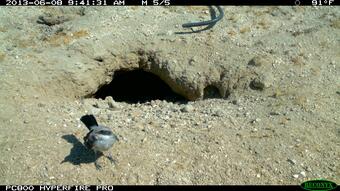
Factors influencing spatial and temporal patterns of Lanius ludovicianus (Loggerhead Shrike) occupancy at a grassland-sagebrush ecotone Factors influencing spatial and temporal patterns of Lanius ludovicianus (Loggerhead Shrike) occupancy at a grassland-sagebrush ecotone
Lanius ludovicianus (Loggerhead Shrike) is a predatory songbird that has experienced a severe population decline throughout its range since the 1940s, likely driven by a combination of factors, including habitat loss and fragmentation. Occupying larger territories compared to many other passerines, L. ludovicianus requires open habitat with interspersed trees and shrubs for nesting and...
Authors
Holly M. Todaro, Scott R. Loss, Robert Charles Lonsinger, Courtney J. Duchardt
The effect of turbidity on foraging by prerostrum juvenile Paddlefish The effect of turbidity on foraging by prerostrum juvenile Paddlefish
Objective A previous study evaluating restoration success of Paddlefish Polyodon spathula suggested that excessive turbidity in lakes and rivers may inhibit foraging by juveniles prior to the development of the rostrum. Although a Paddlefish's rostrum, which contains electroreceptors, helps the fish to locate zooplankton prey, the prerostrum stage lacks many of these electroreceptors...
Authors
Ethan Hood, James M. Long, Daniel E. Shoup, Casey A. Pennock, Andrew R. Dzialowski, Jason D. Schooley
The Oklahoma Cooperative Fish and Wildlife Research Unit (est. 1948) is a partnership among the Oklahoma Department of Wildlife Conservation, Oklahoma State University, the U.S. Geological Survey, the U.S. Fish and Wildlife Service, and the Wildlife Management Institute.
Landscape associations and population genetics of a generalist carnivore at a range limit Landscape associations and population genetics of a generalist carnivore at a range limit
American black bear (Ursus americanus) sightings have increased in the Oklahoma Panhandle, an area outside of the species’ historical range, prompting an assessment of bears in the region. We used camera traps and an occupancy modeling framework to identify factors influencing bear detection and space-use patterns. We used noninvasive genetic sampling techniques to evaluate genetic...
Authors
Bailey A. Kleeberg, Robert Charles Lonsinger, Jennifer R. Adams, Lisette P. Waits, W. Sue Fairbanks
Summary of first daily ring formation in otoliths of freshwater fishes in the continental United States Summary of first daily ring formation in otoliths of freshwater fishes in the continental United States
Daily ring counts in young-of-the-year fishes are important for estimating important vital rates, such as growth, mortality, and timing of hatch. To accurately estimate some of these rates, the timing of the first daily ring must be estimated accurately. Variation in the timing of the first daily ring can be attributed to many factors, including biology of the species and experience of...
Authors
James M. Long, Richard A. Snow
Control of a dominant predator influences the occurrence of a mesocarnivore of conservation concern Control of a dominant predator influences the occurrence of a mesocarnivore of conservation concern
Context Interspecific interactions shape ecological communities, influence community dynamics, and drive co-evolution. Despite their ecological significance, predation and competition remain understudied in plains spotted skunks (Spilogale interrupta), a species of conservation concern. Clarifying how predator management influences their occurrence is crucial for effective conservation...
Authors
Kara M. White, Amanda E. Cheeseman, Joshua D. Stafford, Robert Charles Lonsinger
Factors influencing spatial and temporal patterns of Lanius ludovicianus (Loggerhead Shrike) occupancy at a grassland-sagebrush ecotone Factors influencing spatial and temporal patterns of Lanius ludovicianus (Loggerhead Shrike) occupancy at a grassland-sagebrush ecotone
Lanius ludovicianus (Loggerhead Shrike) is a predatory songbird that has experienced a severe population decline throughout its range since the 1940s, likely driven by a combination of factors, including habitat loss and fragmentation. Occupying larger territories compared to many other passerines, L. ludovicianus requires open habitat with interspersed trees and shrubs for nesting and...
Authors
Holly M. Todaro, Scott R. Loss, Robert Charles Lonsinger, Courtney J. Duchardt
The effect of turbidity on foraging by prerostrum juvenile Paddlefish The effect of turbidity on foraging by prerostrum juvenile Paddlefish
Objective A previous study evaluating restoration success of Paddlefish Polyodon spathula suggested that excessive turbidity in lakes and rivers may inhibit foraging by juveniles prior to the development of the rostrum. Although a Paddlefish's rostrum, which contains electroreceptors, helps the fish to locate zooplankton prey, the prerostrum stage lacks many of these electroreceptors...
Authors
Ethan Hood, James M. Long, Daniel E. Shoup, Casey A. Pennock, Andrew R. Dzialowski, Jason D. Schooley