



Minerals and Uses Activity
This is a hands-on activity to introduce students to minerals, critical minerals, and how we use them in our everyday lives. Students will work in teams to match mineral commodities to the ore/mineral they come from, and the everyday items that need them.
Needed Items
- 2025 List of Critical Minerals or the Periodic Table of Critical Minerals
- Laminated activity mats (size 11" by 17")
- Ore/Mineral fact cards (size 11" x 17")
- Fact cards are to help provide additional information on the mineral/ore samples to help guide them through pairing the ore/mineral samples with the mineral commodities.
- The printout can be used as is or each card may be cut out to be paired with the ore/mineral samples. If using the cutouts, laminating the cards is recommended.
- Example everyday items
- Instructors may use real samples of the example items or printed cutouts of the images provided (size 11" x 17"). If using the images provided, laminating the cutouts is recommended.
- See the Key section for everyday item to mineral commodity pairings.
- Example ore/mineral samples
- Instructors may use real ore/mineral samples or printed cutouts of the sample images provided (size 11" x 17"). If using the images provided, laminating the cutouts is recommended.
- See the Key section for everyday item to mineral commodity pairings.
Instructions
This activity is designed as a stationed activity where students work in teams to complete each station. Student teams will rotate from one station to another until teams have completed all stations.
- Set up the room with 4 stations. Each station should have one activity mat, the associated ore/mineral samples, and associated everyday items.
- Group the students into 4 teams. 4-5 students per team works best.
- Using the vocabulary list, 2025 List of Critical Minerals graphic and/or the Periodic Table of Critical Minerals graphic, introduce the class to the concepts of mineral resources in our daily lives and critical minerals.
- Have the teams work together to match the ore/mineral sample to the mineral commodity. Students should start by reading the ore/mineral fact cards and then make observations about the samples in order to match the samples to the mineral commodities. The mineral commodities with red borders are on the 2025 List of Critical Minerals.
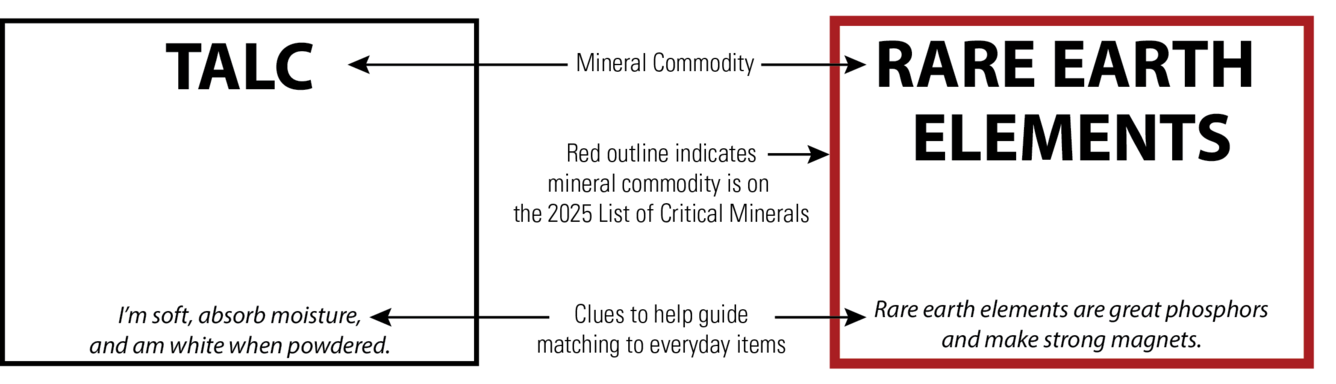
- Teams should then work to match the everyday items to the mineral commodity and ore/mineral samples using the clues provided on the activity mat.
- Once a team thinks they have everything correctly matched they should raise their hands to have the instructor check their answers.
- If there are incorrect pairings, remove them from the activity mat. Prompt the students to read the descriptions on the mat again and make specific observations to help correct the pairings.
- When all teams have finished matching the samples/everyday items at their station, have each team clear the samples/everyday items from the activity mat and move clockwise to the next station.
- Repeat until teams have visited all the stations.
- End the activity by asking the students “what ore/ore mineral surprised them the most and why?”, “what ore/ore mineral did they like the most and why?”, "are there any of the samples they saw today that they'd like to learn more about?", and “why do you think that we care about rocks and minerals?”
Vocabulary
- 2025 List of Critical Minerals: The U.S. Geological Survey (USGS) led the development of the 2025 List of Critical Minerals (Nassar and others, 2025; U.S. Geological Survey, 2025). The List contains 60 critical minerals which include 54 elements from the Periodic Table, graphite, barite, metallurgical coal, potash, phosphate rock, and fluorspar.
- CPUs: central processing units
- Critical Minerals: The Energy Act of 2020 defines critical minerals as minerals, elements, substances, or materials that: (1) are essential to the economic or national security of the United States; (2) the supply chain of which is vulnerable to disruptions and (3) serve an essential function in the manufacturing of a product the absence of which would have significant consequences for the economic or national security of the United States.
- Mineral: a naturally occurring, inorganic, solid with an orderly internal structure (atomic structure) and a controlled chemical composition (composition is controlled by the atomic structure).
- Mineral Commodities: minerals (or materials derived from minerals) that are bought and sold.
- Mineral Physical Properties: the atomic structure and chemical composition of a mineral control the physical properties. These properties are characteristics of a mineral that can be observed such as crystal form, how the mineral breaks, hardness, specific gravity, color, luster, streak, magnetism, odor, etc.
- Ore Deposit: a mineral occurrence of a sufficient size and concentration (grade) from which commodities can be profitably extracted (Cox and Singer, 1986).
- Phosphors: materials that release light when exposed to energy such as X-rays, ultra-violet rays, or electrons.
- Resource: A concentration of naturally occurring solid, liquid, or gaseous material in or on the Earth’s crust in such form and amount that economic extraction of a commodity from the concentration is currently or potentially feasible (U.S. Geological Survey, 2026).
Key
- The activity mats contain the list of ore/mineral samples that pair with the board. Instructors may use real samples or printed cutouts of the images provided. If using the images provided, laminated versions are recommended.
- Instructors may use real everyday items, models of everyday items (for example, a refrigerator for a doll house), or printed cutouts of the images provided. If using the images provided, laminated versions are recommended. Multiple everyday items for each mineral commodity are provided in the table below to provide instructors with options. The activity works best with one item per each mineral commodity. Other uses besides the ones listed below can be found at 2026 Mineral Commodities Summary | USGS.
| Activity Mat | Mineral Commodity | Ore/Mineral Sample | Everyday Item(s) (U.S. Geological Survey, 2026) |
|---|---|---|---|
| 1 | quartz sand | quartz sand | glass, fiber optics |
| 1 | talc | talc | deodorant, paper (makes it smooth) |
| 1 | niobium* | pyrochlore | jet engines, MRI magnets |
| 1 | rare earth elements* | bastnaesite | cellphone (phosphors for screens, magnets for vibration) |
| 1 | chromium* | chromite | stainless steel spoon |
| 2 | graphite* | graphite | pencil "lead", electric vehicle battery, car brakes |
| 2 | barite* | barite | gastrointestinal tract X-ray, oil/gas drilling fluid |
| 2 | phosphate rock* | phosphate rock | fertilizer |
| 2 | garnet | garnet | sandpaper |
| 2 | gypsum | gypsum | drywall |
| 3 | fluorspar* | fluorspar | refrigerator/freezer (refrigerants) |
| 3 | feldspar | feldspar | porcelain tiles |
| 3 | gold | gold | computer (CPUs, motherboard), jewelry |
| 3 | aluminum* | bauxite | aluminum can, aircraft parts |
| 3 | zinc* | sphalerite | sunscreen (zinc oxide), rubber |
| 4 | calcite | calcite | cement |
| 4 | copper* | chalcopyrite | electrical wire |
| 4 | nickel* | pentlandite | rechargeable battery, U.S. coins (not penny) |
| 4 | halite | halite | table salt |
| 4 | muscovite | muscovite | sparkly cosmetics, circuit board capacitors |
* Mineral commodities with an asterisk are on the 2025 List of Critical Minerals.
References Cited
Cox, D.P., and Singer, D.A., 1986, Mineral deposit models: U.S. Geological Survey Bulletin 1693, 398 p.
Nassar, N.T., Pineault, D., Allen, S.M., McCaffrey, D.M., Padilla, A.J., Brainard, J.L., Bayani, M., Shojaeddini, E., Ryter, J.W., Lincoln, S., and Alonso, E., 2025, Methodology and technical input for the 2025 U.S. List of Critical Minerals— Assessing the potential effects of mineral commodity supply chain disruptions on the U.S. economy: U.S. Geological Survey Open-File Report 2025–1047, 32 p., accessed May 12, 2026, at https://doi.org/10.3133/ofr20251047.
U.S. Geological Survey, 2025, Final 2025 List of Critical Minerals (90 FR 50494): U.S. Geological Survey, accessed May 12, 2026, at https://www.federalregister.gov/ documents/2025/11/07/2025-19813/final-2025-list-of-critical-minerals.
U.S. Geological Survey, 2026, Mineral commodity summaries 2026: U.S. Geological Survey, 222 p., accessed May 12, 2026, at https://doi.org/10.3133/mcs2026.