



Periodic Table of Critical Minerals & Their Uses Activity
Critical minerals are essential for our national security, economy, development of renewable energy, and infrastructure. In the activity below you will learn the definition of a critical mineral and discover what and how critical minerals are used in everyday items.
Media
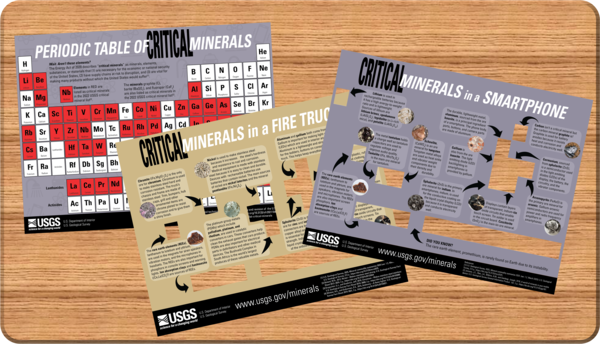
Sources/Usage: Public Domain. View Media Details
Instructions
Placemat Version
- Download the Periodic Table of Critical Minerals base layer. You can choose a low color or full color version.
- The base layer can be printed or used digitally.
- Download the everyday item overlay document(s) you would like to use for the activity.
- You can choose a low color or full color version for use digitally or for print.
- The digital documents have transparent sections that allow areas on the Periodic Table of Critical Minerals base layer to show through.
- For print versions of the everyday item overlay document(s):
- Cut out the areas along the dashed lines.
- Place the everyday item overlay document(s) onto the Periodic Table of Critical Minerals base layer to learn about some of the critical minerals used to make that item!
Poster Version
- The poster versions merge the information from the Periodic Table of Critical Minerals base layer placemat and the everyday item overlay(s).
- Print the poster on a large scale printer. Poster size works well as 44" wide by 34" tall.
Vocabulary
- Chemical elements: Chemical substances distinguished by atomic number.
- Critical minerals: A non-fuel mineral or mineral material essential to the economic and national security of the US, the supply chain of which is vulnerable to disruption, and that serves an essential function in the manufacturing of a product, the absence of which would have significant consequences for our economy or our national security.
- Mineral: a naturally occurring, inorganic, solid with specific atomic structure and controlled chemical composition.
- Mineral deposits: Deposits in which particular minerals are concentrated, typically noticed and studied if the minerals have economic value.
- Mineral resources: Natural occurrences of useful inorganic elements or compounds.
- Periodic table: an organization of chemical elements based on atomic number and other atomic properties.
- Phosphor: a substance that emits light when excited by radiation.
- Trace and minor elements: an element that occurs in lower amounts in a mineral and are NOT a main component for the chemical formula of the mineral. For example, the chemical formula for sphalerite is ZnS. Indium (In) can substitute for the zinc (Zn) in sphalerite. This is why, even though the chemical formula for sphalerite doesn't have In, the mineral sphalerite is actually the main In-bearing mineral (aka source for In).
Check back soon for more everyday item layers!