
U.S. flag

An official website of the United States government

Indigenous People

Filter Total Items: 3
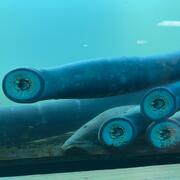
Linkages among pre-contact people, lamprey, and landscapes in the Willamette Valley

The U.S. Geological Survey and Portland State University are working with the Confederated Tribes of Grand Ronde and other partners to link past lamprey harvest locations with hydrogeomorphic conditions as landscape processes and shifting rivers have changed since the pre-contact archaeological period. This research provides a deeper historical context for lamprey conservation and restoration.
Linkages among pre-contact people, lamprey, and landscapes in the Willamette Valley

Linkages among pre-contact people, lamprey, and landscapes in the Willamette Valley

The U.S. Geological Survey and Portland State University are working with the Confederated Tribes of Grand Ronde and other partners to link past lamprey harvest locations with hydrogeomorphic conditions as landscape processes and shifting rivers have changed since the pre-contact archaeological period. This research provides a deeper historical context for lamprey conservation and restoration.
Learn More

Partnering with Indigenous Communities in the Pacific Islands

For millennia, Indigenous Pacific Islanders have stewarded natural resources to sustain their communities, traditional ways of life, and cultural identities. This close relationship with the natural world puts these communities at the forefront of climate change impacts. Drawing upon a strong history of adaptation and innovation, Indigenous communities are key collaborators on adaptation work...
Partnering with Indigenous Communities in the Pacific Islands

Partnering with Indigenous Communities in the Pacific Islands

For millennia, Indigenous Pacific Islanders have stewarded natural resources to sustain their communities, traditional ways of life, and cultural identities. This close relationship with the natural world puts these communities at the forefront of climate change impacts. Drawing upon a strong history of adaptation and innovation, Indigenous communities are key collaborators on adaptation work...
Learn More

Malo‘o ka lani, wela ka honua (When the sky is dry, the earth is parched): Investigating the Cultural Dimensions of Indigenous Local Knowledge Responses to Changing Climate Conditions

Hawai‘i’s isolation, paired with limited water resources, make the archipelago sensitive to reductions in water availability. Drought can take different forms, varying across Island geographies with respect to frequency, intensity, duration, and extent. A drought event can exert hydrological, agricultural, ecological, and socio-economic impacts – and these impacts have been growing over...
Malo‘o ka lani, wela ka honua (When the sky is dry, the earth is parched): Investigating the Cultural Dimensions of Indigenous Local Knowledge Responses to Changing Climate Conditions

Malo‘o ka lani, wela ka honua (When the sky is dry, the earth is parched): Investigating the Cultural Dimensions of Indigenous Local Knowledge Responses to Changing Climate Conditions

Hawai‘i’s isolation, paired with limited water resources, make the archipelago sensitive to reductions in water availability. Drought can take different forms, varying across Island geographies with respect to frequency, intensity, duration, and extent. A drought event can exert hydrological, agricultural, ecological, and socio-economic impacts – and these impacts have been growing over the past
Learn More
Was this page helpful?