Alex Gorr
Alex Gorr is a Research Physical Scientist in the Landslide Hazards Program.
Alex uses a combination of field, modeling, and remote sensing techniques to study postfire processes at a range of spatial scales. His current research aims to better understand the impacts of postfire debris-flow hazards in the western United States through statistical modeling and data collection.
Professional Experience
2024-Present: Research Physical Scientist (Mendenhall), USGS Geologic Hazards Science Center, Golden, CO
Education and Certifications
2019-2024: University of Arizona, Ph.D. Geosciences
2015 – 2019: University of South Carolina, B.S. Geological Sciences
Science and Products
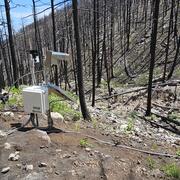
Elk Postfire Monitoring Station near Dayton, Wyoming
Wildfire can radically change a mountainous landscape such that even a modest rainstorm can produce deadly and destructive flash flooding and debris flows.
Inventory of 227 postfire debris-flow volumes for 34 fires in the western United States Inventory of 227 postfire debris-flow volumes for 34 fires in the western United States
Description This data release contains a dataset of 227 postfire debris-flow volumes compiled from 34 burn areas across six states in the western United States. Specifically, it includes debris-flow volumes collected from the following fires: Arizona: 2010 Schultz, 2011 Horseshoe 2, 2011 Monument, 2011 Wallow, 2017 Frye, 2019 Museum, 2019 Woodbury, 2020 Bush, 2021 Flag, 2021 Horton, 2021
Tadpole Fire Debris Flow and Wood Collector Measurements May 2021 Tadpole Fire Debris Flow and Wood Collector Measurements May 2021
This is a dataset of location and photo data for the debris flow deposits measured in the Tadpole Wildfire. The data were collected using the ArcGIS Collector application by multiple individuals. The original data are stored in a geodatabase here, and the geodatabase has the following fields: Latitude (decimal degrees), Longitude (decimal degrees), Elevation (meters), GlobalID (a unique...
Tadpole Fire Field Measurements following the 8 September 2020 Debris Flow, Gila National Forest, NM Tadpole Fire Field Measurements following the 8 September 2020 Debris Flow, Gila National Forest, NM
This data release contains data summarizing observations within and adjacent to the Tadpole Fire, which burned from 6 June to 4 July 2020 in the Gila National Forest, NM. This monitoring data were focused on debris flows triggered on 8 September 2020 in four drainage basins (TAD1, TAD2, TAD3, and TAD4). Rainfall data (1a_rain_geophones.csv) are provided in a comma-separated value (CSV)...
Characteristics of debris-flow-prone watersheds and debris-flow-triggering rainstorms following the Tadpole Fire, New Mexico, USA Characteristics of debris-flow-prone watersheds and debris-flow-triggering rainstorms following the Tadpole Fire, New Mexico, USA
Moderate- or high-severity fires promote increases in runoff and erosion, leading to a greater likelihood of extreme geomorphic responses, including debris flows. In the first several years following fire, the majority of debris flows initiate when runoff rapidly entrains sediment on steep slopes. From a hazard perspective, it is important to be able to anticipate when and where...
Authors
Luke A. McGuire, Francis K. Rengers, Ann Youberg, Alexander Gorr, Olivia J. Hoch, Rebecca Beers, Ryan Porter
The influence of large woody debris on post-wildfire debris flow sediment storage The influence of large woody debris on post-wildfire debris flow sediment storage
Debris flows transport large quantities of water and granular material, such as sediment and wood, and this mixture can have devastating impacts on life and infrastructure. The proportion of large woody debris (LWD) incorporated into debris flows can be enhanced in forested areas recently burned by wildfire, because wood recruitment into channels accelerates in burned forests. In this...
Authors
Francis K. Rengers, Luke A. McGuire, Katherine R. Barnhart, Ann Youberg, Daniel Cadol, Alexander Gorr, Olivia J. Hoch, Rebecca Beers, Jason W. Kean
A progressive flow-routing model for rapid assessment of debris-flow inundation A progressive flow-routing model for rapid assessment of debris-flow inundation
Debris flows pose a significant hazard to communities in mountainous areas, and there is a continued need for methods to delineate hazard zones associated with debris-flow inundation. In certain situations, such as scenarios following wildfire, where there could be an abrupt increase in the likelihood and size of debris flows that necessitates a rapid hazard assessment, the computational...
Authors
Alexander Gorr, Luke A. McGuire, Ann Youberg, Francis K. Rengers
Science and Products
Elk Postfire Monitoring Station near Dayton, Wyoming
Wildfire can radically change a mountainous landscape such that even a modest rainstorm can produce deadly and destructive flash flooding and debris flows.
Inventory of 227 postfire debris-flow volumes for 34 fires in the western United States Inventory of 227 postfire debris-flow volumes for 34 fires in the western United States
Description This data release contains a dataset of 227 postfire debris-flow volumes compiled from 34 burn areas across six states in the western United States. Specifically, it includes debris-flow volumes collected from the following fires: Arizona: 2010 Schultz, 2011 Horseshoe 2, 2011 Monument, 2011 Wallow, 2017 Frye, 2019 Museum, 2019 Woodbury, 2020 Bush, 2021 Flag, 2021 Horton, 2021
Tadpole Fire Debris Flow and Wood Collector Measurements May 2021 Tadpole Fire Debris Flow and Wood Collector Measurements May 2021
This is a dataset of location and photo data for the debris flow deposits measured in the Tadpole Wildfire. The data were collected using the ArcGIS Collector application by multiple individuals. The original data are stored in a geodatabase here, and the geodatabase has the following fields: Latitude (decimal degrees), Longitude (decimal degrees), Elevation (meters), GlobalID (a unique...
Tadpole Fire Field Measurements following the 8 September 2020 Debris Flow, Gila National Forest, NM Tadpole Fire Field Measurements following the 8 September 2020 Debris Flow, Gila National Forest, NM
This data release contains data summarizing observations within and adjacent to the Tadpole Fire, which burned from 6 June to 4 July 2020 in the Gila National Forest, NM. This monitoring data were focused on debris flows triggered on 8 September 2020 in four drainage basins (TAD1, TAD2, TAD3, and TAD4). Rainfall data (1a_rain_geophones.csv) are provided in a comma-separated value (CSV)...
Characteristics of debris-flow-prone watersheds and debris-flow-triggering rainstorms following the Tadpole Fire, New Mexico, USA Characteristics of debris-flow-prone watersheds and debris-flow-triggering rainstorms following the Tadpole Fire, New Mexico, USA
Moderate- or high-severity fires promote increases in runoff and erosion, leading to a greater likelihood of extreme geomorphic responses, including debris flows. In the first several years following fire, the majority of debris flows initiate when runoff rapidly entrains sediment on steep slopes. From a hazard perspective, it is important to be able to anticipate when and where...
Authors
Luke A. McGuire, Francis K. Rengers, Ann Youberg, Alexander Gorr, Olivia J. Hoch, Rebecca Beers, Ryan Porter
The influence of large woody debris on post-wildfire debris flow sediment storage The influence of large woody debris on post-wildfire debris flow sediment storage
Debris flows transport large quantities of water and granular material, such as sediment and wood, and this mixture can have devastating impacts on life and infrastructure. The proportion of large woody debris (LWD) incorporated into debris flows can be enhanced in forested areas recently burned by wildfire, because wood recruitment into channels accelerates in burned forests. In this...
Authors
Francis K. Rengers, Luke A. McGuire, Katherine R. Barnhart, Ann Youberg, Daniel Cadol, Alexander Gorr, Olivia J. Hoch, Rebecca Beers, Jason W. Kean
A progressive flow-routing model for rapid assessment of debris-flow inundation A progressive flow-routing model for rapid assessment of debris-flow inundation
Debris flows pose a significant hazard to communities in mountainous areas, and there is a continued need for methods to delineate hazard zones associated with debris-flow inundation. In certain situations, such as scenarios following wildfire, where there could be an abrupt increase in the likelihood and size of debris flows that necessitates a rapid hazard assessment, the computational...
Authors
Alexander Gorr, Luke A. McGuire, Ann Youberg, Francis K. Rengers