



In order to survey walrus herds, USGS surveys sites used by walruses from a remote field camp. Here you see the small boat used by USGS to access the field camp. In the foreground are polar bear tracks found along the shore near the USGS boat.
Anthony Fischbach
Applying wildlife biology tools, including satellite imagery interpretation and telemetry, to address Pacific walrus conservation problems.
Science and Products

Walrus Research
The USGS Alaska Science Center conducts long-term research on the Pacific walrus to provide scientific information to Department of Interior management agencies and Alaska Native co-management partners. In addition, the USGS Pacific walrus research program collaborates with the U.S. Fish and Wildlife Service (USFWS) and the State of Alaska’s Department of Fish and Game and Alaska Native co...

Tracking Data for Pacific Walrus (Odobenus rosmarus divergens)
Available here are tracking data of Pacific walrus, a marine mammal that ranges between the Alaska Peninsula, up through the Bering and Chukchi seas, and over to Russia. These data were collected from animals marked in the northern Bering and Chuckchi sea to understand seasonal movement patterns, use of coastal haulouts in northwestern Alaska, and determine estimates of abundance in autumn.

ASC Walrus Thematic Data Releases
ASC Walrus Thematic Data Releases. USGS publishes data and software to support Pacific walrus research and management. This page offers a location to find data and software products thematically organized under the headings of “satellite imagery” and “aerial imagery.”

Q&A: New Drone-Based Method Helps Monitor Walrus Health
Innovative drone technology provides critical insights into the body condition and health of Pacific walruses in a changing Arctic.
Q&A: Estimates of Abundance for Pacific Walrus
The Pacific walrus ranges across the Bering and Chukchi seas during the year. This wide geographic distribution makes it difficult to estimate Pacific walrus population abundance. However, recent technological advances in genetics and drone imagery have generated precise regional and range-wide abundance estimates.
Filter Total Items: 39
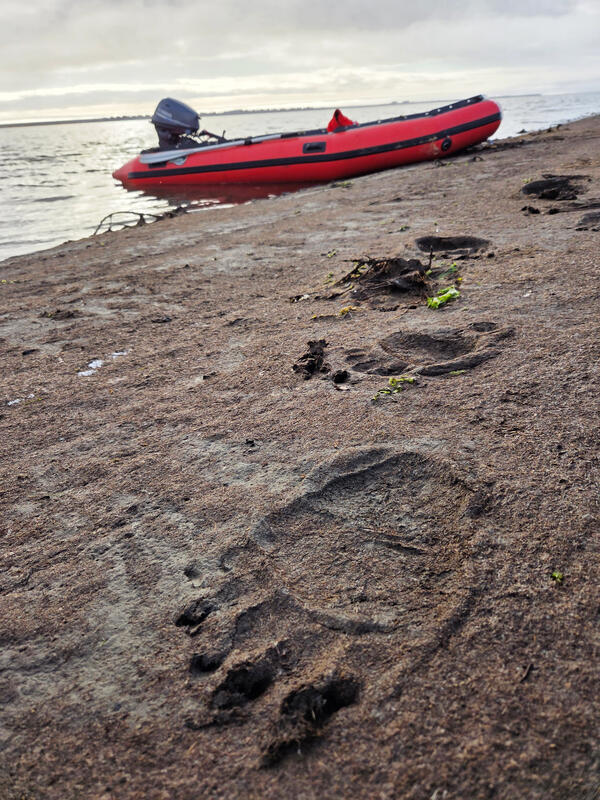
Polar bear tracks near a walrus haulout
In order to survey walrus herds, USGS surveys sites used by walruses from a remote field camp. Here you see the small boat used by USGS to access the field camp. In the foreground are polar bear tracks found along the shore near the USGS boat.
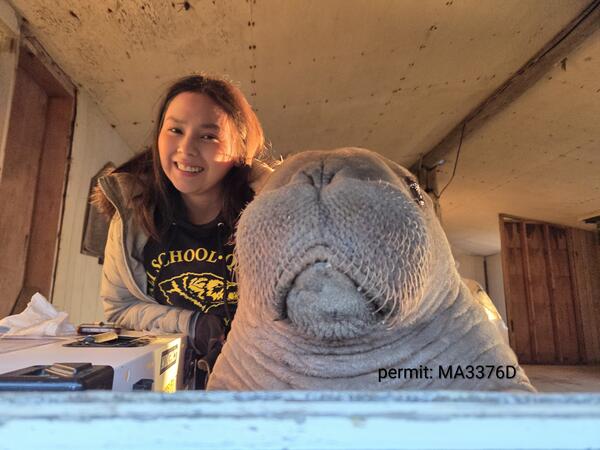
Caring for an orphaned walrus calf encountered during USGS surveys
Caring for an orphaned walrus calf encountered during USGS surveysIḷisaġvik College intern Violett Annisket attends to an orphan walrus calf encountered during USGS surveys. USGS is developing methods to detect and count walrus carcasses found onshore after herds return to the waters.
Permit: MA3376D
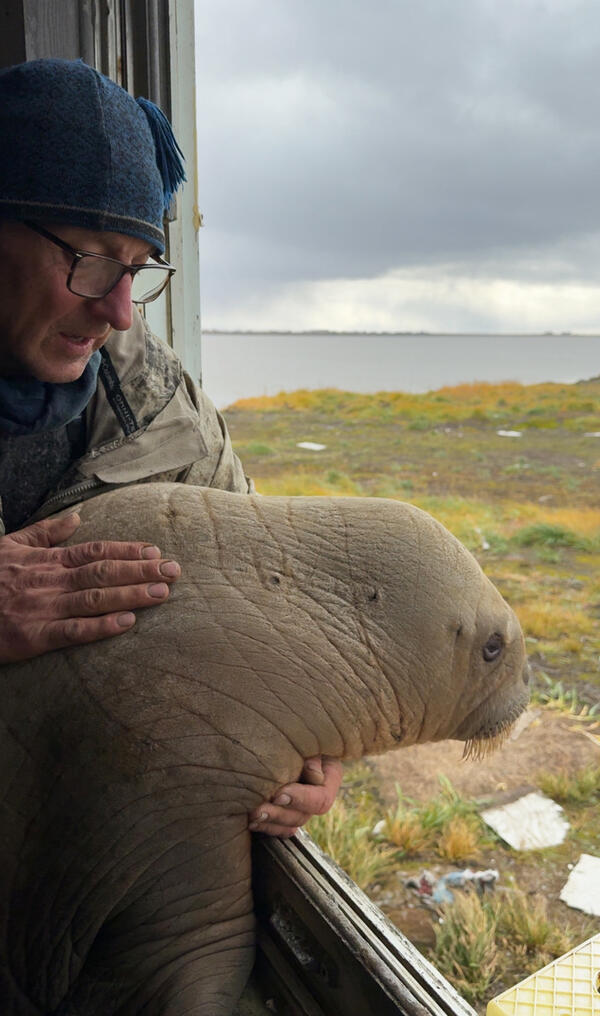
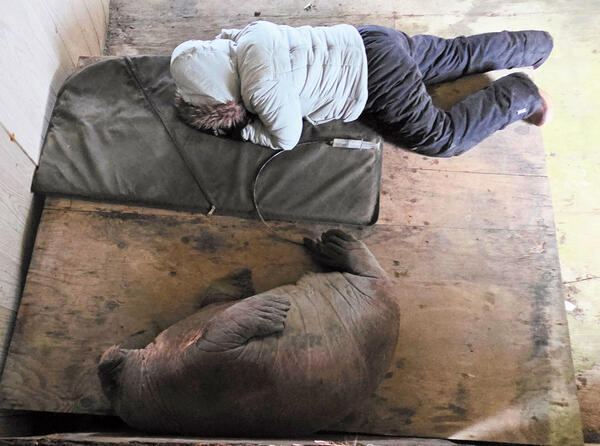
USGS research wildlife biologist attends to an orphaned walrus calf
USGS research wildlife biologist attends to an orphaned walrus calfUSGS research wildlife biologist Anthony attends to an orphan walrus calf encountered during a storm.
Permit: MA3376D
USGS research wildlife biologist attends to an orphaned walrus calf
USGS research wildlife biologist attends to an orphaned walrus calfUSGS research wildlife biologist Anthony attends to an orphan walrus calf encountered during a storm.
Permit: MA3376D
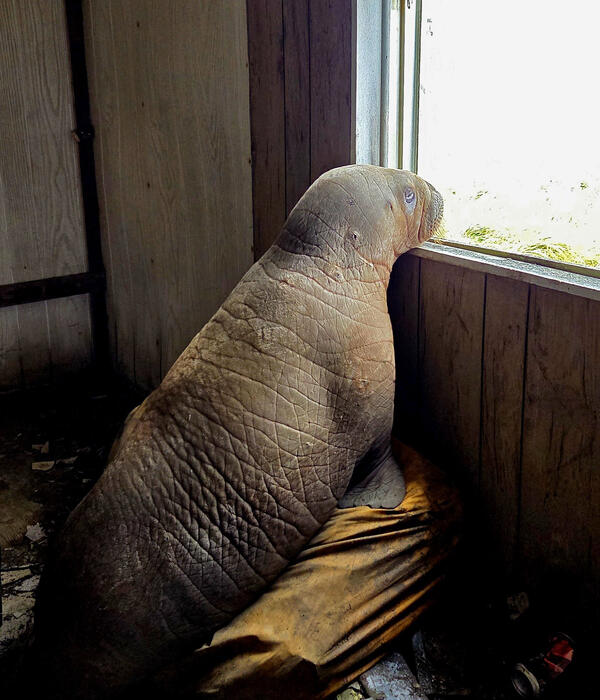
Walrus calf gazes out the window of an abandoned building
Walrus calf gazes out the window of an abandoned buildingAn orphan calf gazes out the window of an abandoned building where USGS research biologist Anthony Fischbach and Iḷisaġvik College intern Violett Annisket attended to his care during a September 2026 storm.
Permit: MA3376D
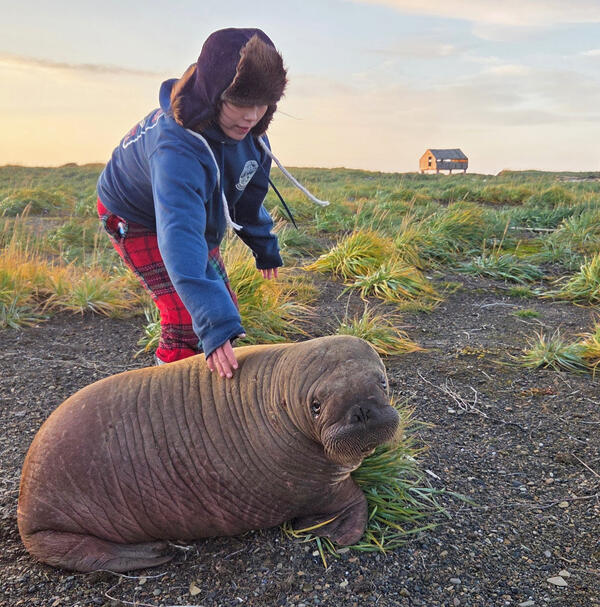
Attending to an orphan walrus calf encountered during USGS surveys
Attending to an orphan walrus calf encountered during USGS surveysIḷisaġvik College intern Violett Annisket attends to an orphan walrus calf encountered during USGS surveys. USGS is developing methods to detect and count walrus carcasses found onshore after herds return to the waters.
Permit:MA3376D
Attending to an orphaned walrus calf encountered during USGS surveys
Attending to an orphaned walrus calf encountered during USGS surveysIḷisaġvik College intern Violett Annisket attends to an orphan walrus calf encountered during USGS surveys. USGS is developing methods to detect and count walrus carcasses found onshore after herds return to the waters.
Permit: MA3376D
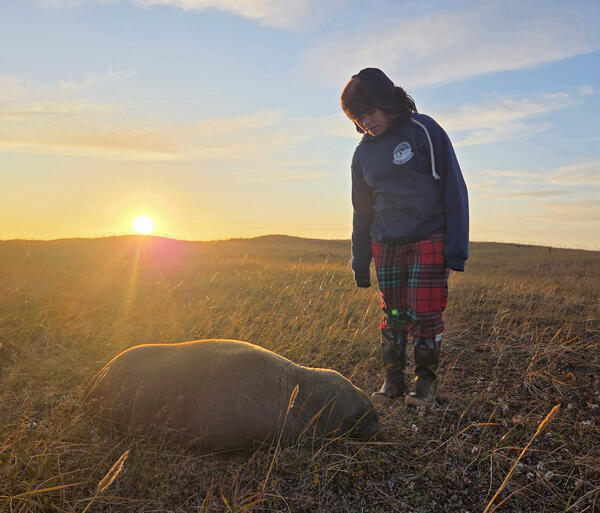
Attending to an orphan walrus calf
Iḷisaġvik College intern Violett Annisket attends to an orphan walrus calf encountered during USGS surveys. USGS is developing methods to detect and count walrus carcasses found onshore after herds return to the waters.
Permit: MA3376D
Iḷisaġvik College intern Violett Annisket attends to an orphan walrus calf encountered during USGS surveys. USGS is developing methods to detect and count walrus carcasses found onshore after herds return to the waters.
Permit: MA3376D
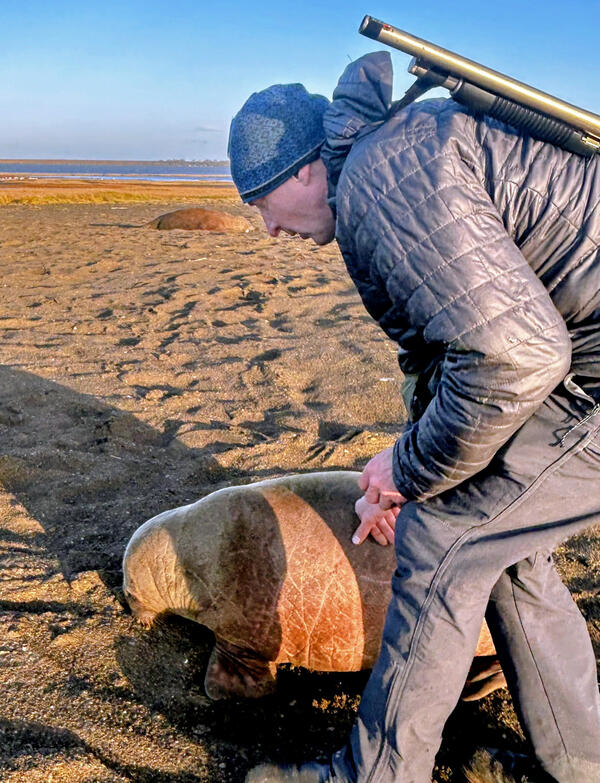
Onshore walrus carcass survey
USGS surveys walrus carcasses found onshore to survey for health concerns and to develop methods to detect and count carcasses from satellite to meet reporting requirements of the Marine Mammal Protection Act. Here USGS research wildlife biologist Anthony Fischbach attends to an orphan calf discovered during a survey.
Permit: MA3376D
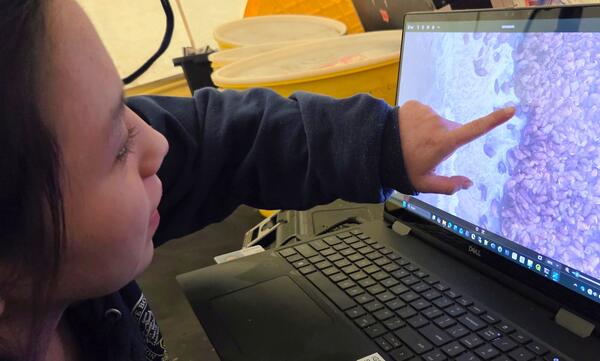
Reviewing survey imagery collected of walrus herds
Reviewing survey imagery collected of walrus herdsIḷisaġvik College intern Violett Annisket reviews survey imagery collected of walrus herds near her home community.
Reviewing survey imagery collected of walrus herds
Reviewing survey imagery collected of walrus herdsIḷisaġvik College intern Violett Annisket reviews survey imagery collected of walrus herds near her home community.
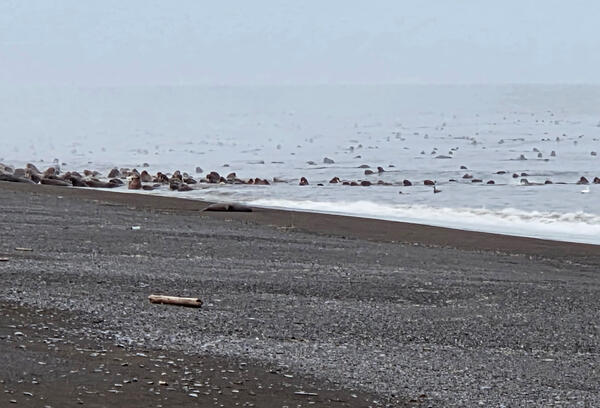
Walruses rest out of the water between foraging bouts
Walruses rest out of the water between foraging boutsWhen sea ice is available female walruses and young rest on ice pans near their foraging sites. When sea ice is absent walruses come to gather on shore. When walruses gather in large numbers on shore many remain in adjacent waters. USGS has used satellite-linked behavior monitoring tags to understand walrus behaviors and movements.
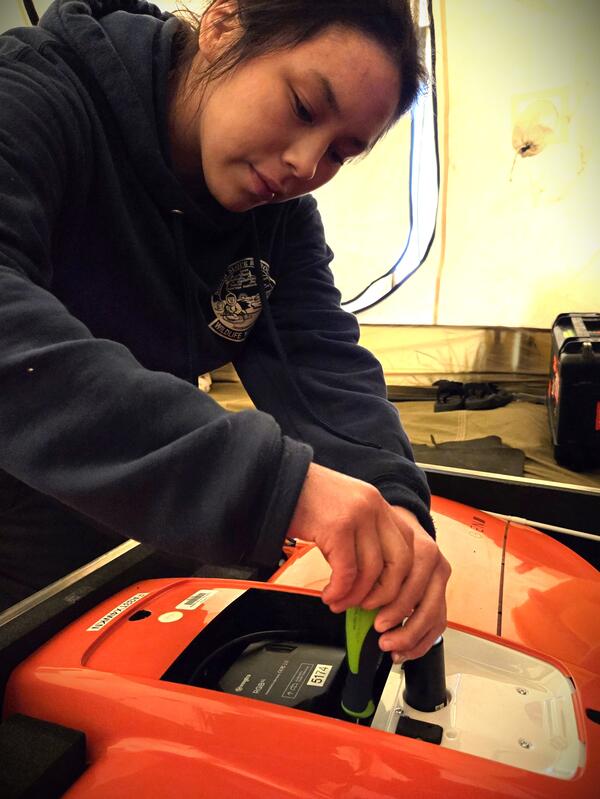
Preparing a USGS photo drone for surveys of walrus herds
Preparing a USGS photo drone for surveys of walrus herdsIḷisaġvik College intern Violett Annisket prepares a USGS photo drone for surveys of walrus herds.
Preparing a USGS photo drone for surveys of walrus herds
Preparing a USGS photo drone for surveys of walrus herdsIḷisaġvik College intern Violett Annisket prepares a USGS photo drone for surveys of walrus herds.
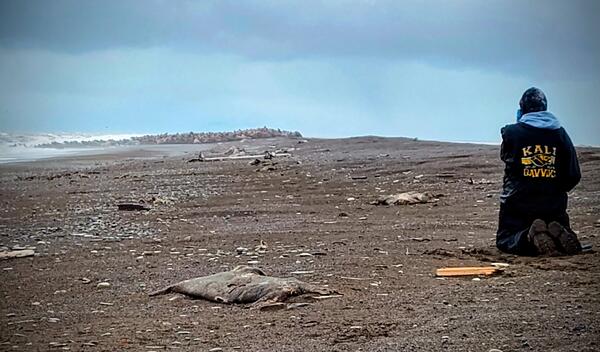
Walruses rest out of the water between foraging bouts
Walruses rest out of the water between foraging boutsWhen sea ice is available female walruses and young rest on ice pans near their foraging sites. When sea ice is absent walruses come to gather on shore where they may be surveyed. USGS works with local authorities and residents to survey walrus herds onshore.

Drones for Science: Walrus Calf Scavenged by Polar Bear
Drones for Science: Walrus Calf Scavenged by Polar BearThis is B-roll video collected during the fall of 2024 on the Alaskan shores of the Chukchi Sea.
Drones for Science: Walrus Calf Scavenged by Polar Bear
Drones for Science: Walrus Calf Scavenged by Polar BearThis is B-roll video collected during the fall of 2024 on the Alaskan shores of the Chukchi Sea.

Large walrus herd resting on Alaskan shore
Sounds from a large herd of walruses resting on Alaskan shores of the Chukchi Sea recorded. Deep full barks and calls of individual walruses near the edge of the herd are audible over a continuous rhythmic humming sound that arises from the calls of tens of thousands of walrsues from deeper within the herd.
Sounds from a large herd of walruses resting on Alaskan shores of the Chukchi Sea recorded. Deep full barks and calls of individual walruses near the edge of the herd are audible over a continuous rhythmic humming sound that arises from the calls of tens of thousands of walrsues from deeper within the herd.
Drone on beach
USGS uses small uncrewed aerial systems, also known as drones for science, to survey walrus herds and carcasses on remote Alaskan beaches. The USGS visual observer, Christina Ahlstrom, keeps her eyes on the survey drone while the remote pilot prepares it to survey the walrus herd that is visible in the distance behind her on the beach.
USGS uses small uncrewed aerial systems, also known as drones for science, to survey walrus herds and carcasses on remote Alaskan beaches. The USGS visual observer, Christina Ahlstrom, keeps her eyes on the survey drone while the remote pilot prepares it to survey the walrus herd that is visible in the distance behind her on the beach.

Drones for Science: Walrus Carcass Survey
This is B-roll video collected during the fall of 2024 on the Alaskan shores of the Chukchi Sea.
This is B-roll video collected during the fall of 2024 on the Alaskan shores of the Chukchi Sea.
Walrus carcasses
Aerial survey drone prepared for flight positioned on the beach near walrus calf carcasses. When sea ice retreats from large regions of the Chukchi Sea large herds of female and young walruses come to shore to rest.
Aerial survey drone prepared for flight positioned on the beach near walrus calf carcasses. When sea ice retreats from large regions of the Chukchi Sea large herds of female and young walruses come to shore to rest.

USGS flying drone
USGS is flying drones for science, small uncrewed areal systems (sUAS), to surveys walruses when they rest on shore. The sUAS makes minimal sound due it is broad wing and is flown high above the walrus herds to enables survey data collection with minimal risk to walruses.
USGS is flying drones for science, small uncrewed areal systems (sUAS), to surveys walruses when they rest on shore. The sUAS makes minimal sound due it is broad wing and is flown high above the walrus herds to enables survey data collection with minimal risk to walruses.

Two adult walrus carcasses
Two adult walrus carcasses on the beach observed during the summer after a large group of walruses had rested on shore. USGS is collaborating with the North Slope Borough Department of Wildlife Management to screen walruses for wildlife diseases and algal toxins. The University of Alaska Fairbanks is collaborating with USGS to validate drone survey metho
Two adult walrus carcasses on the beach observed during the summer after a large group of walruses had rested on shore. USGS is collaborating with the North Slope Borough Department of Wildlife Management to screen walruses for wildlife diseases and algal toxins. The University of Alaska Fairbanks is collaborating with USGS to validate drone survey metho

Community Flyer for USGS Walrus Carcass Surveys
This is a community flyer for distribution in Point Lay, Alaska, to alert community members of USGS activities in the area. A collaborative team of USGS, the North Slope Borough, University of Alaska Fairbanks, and Point Lay residents will assist in surveys of walrus carcasses at a remote coastal haulout that has been used by hundreds of thousands of walruses e
This is a community flyer for distribution in Point Lay, Alaska, to alert community members of USGS activities in the area. A collaborative team of USGS, the North Slope Borough, University of Alaska Fairbanks, and Point Lay residents will assist in surveys of walrus carcasses at a remote coastal haulout that has been used by hundreds of thousands of walruses e
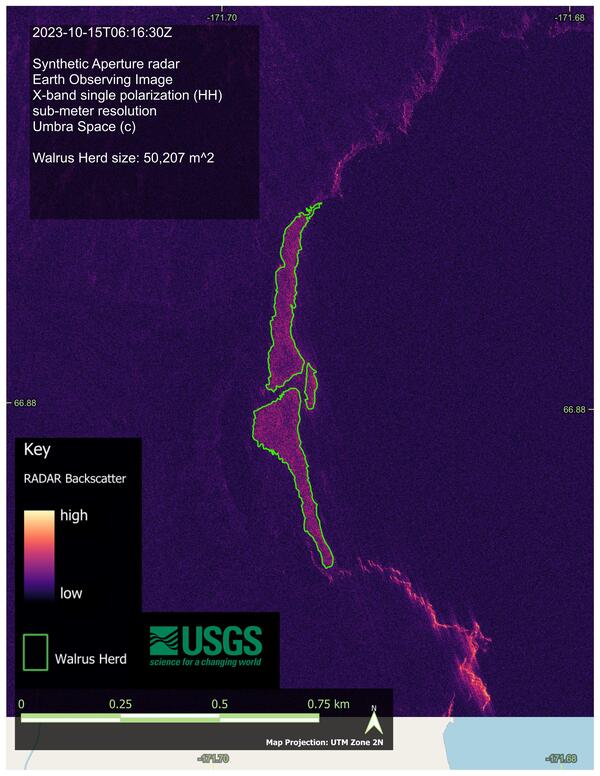
Outline of Pacific walrus herd at a large coastal haulout in Chukotka, Russia (Cape Serdtse Kamen) in 2023
Outline of Pacific walrus herd at a large coastal haulout in Chukotka, Russia (Cape Serdtse Kamen) in 2023This image shows the estimated outline and area (in square meters) occupied by Pacific walrus at a large coastal haulout in Chukotka Russia in 2023 at Cape Serdtse Kamen. The image is derived from images in 2022 and 2023 from a variety of Earth observing satellite imagery sources collected at known walrus coastal haulouts in Alaska and Chukotka, Russia.
Science and Products
Walrus Research
The USGS Alaska Science Center conducts long-term research on the Pacific walrus to provide scientific information to Department of Interior management agencies and Alaska Native co-management partners. In addition, the USGS Pacific walrus research program collaborates with the U.S. Fish and Wildlife Service (USFWS) and the State of Alaska’s Department of Fish and Game and Alaska Native co...
Tracking Data for Pacific Walrus (Odobenus rosmarus divergens)
Available here are tracking data of Pacific walrus, a marine mammal that ranges between the Alaska Peninsula, up through the Bering and Chukchi seas, and over to Russia. These data were collected from animals marked in the northern Bering and Chuckchi sea to understand seasonal movement patterns, use of coastal haulouts in northwestern Alaska, and determine estimates of abundance in autumn.
ASC Walrus Thematic Data Releases
ASC Walrus Thematic Data Releases. USGS publishes data and software to support Pacific walrus research and management. This page offers a location to find data and software products thematically organized under the headings of “satellite imagery” and “aerial imagery.”
Q&A: New Drone-Based Method Helps Monitor Walrus Health
Innovative drone technology provides critical insights into the body condition and health of Pacific walruses in a changing Arctic.
Q&A: Estimates of Abundance for Pacific Walrus
The Pacific walrus ranges across the Bering and Chukchi seas during the year. This wide geographic distribution makes it difficult to estimate Pacific walrus population abundance. However, recent technological advances in genetics and drone imagery have generated precise regional and range-wide abundance estimates.
Filter Total Items: 39
Polar bear tracks near a walrus haulout
In order to survey walrus herds, USGS surveys sites used by walruses from a remote field camp. Here you see the small boat used by USGS to access the field camp. In the foreground are polar bear tracks found along the shore near the USGS boat.
In order to survey walrus herds, USGS surveys sites used by walruses from a remote field camp. Here you see the small boat used by USGS to access the field camp. In the foreground are polar bear tracks found along the shore near the USGS boat.
Caring for an orphaned walrus calf encountered during USGS surveys
Caring for an orphaned walrus calf encountered during USGS surveysIḷisaġvik College intern Violett Annisket attends to an orphan walrus calf encountered during USGS surveys. USGS is developing methods to detect and count walrus carcasses found onshore after herds return to the waters.
Permit: MA3376D
USGS research wildlife biologist attends to an orphaned walrus calf
USGS research wildlife biologist attends to an orphaned walrus calfUSGS research wildlife biologist Anthony attends to an orphan walrus calf encountered during a storm.
Permit: MA3376D
USGS research wildlife biologist attends to an orphaned walrus calf
USGS research wildlife biologist attends to an orphaned walrus calfUSGS research wildlife biologist Anthony attends to an orphan walrus calf encountered during a storm.
Permit: MA3376D
Walrus calf gazes out the window of an abandoned building
Walrus calf gazes out the window of an abandoned buildingAn orphan calf gazes out the window of an abandoned building where USGS research biologist Anthony Fischbach and Iḷisaġvik College intern Violett Annisket attended to his care during a September 2026 storm.
Permit: MA3376D
Attending to an orphan walrus calf encountered during USGS surveys
Attending to an orphan walrus calf encountered during USGS surveysIḷisaġvik College intern Violett Annisket attends to an orphan walrus calf encountered during USGS surveys. USGS is developing methods to detect and count walrus carcasses found onshore after herds return to the waters.
Permit:MA3376D
Attending to an orphaned walrus calf encountered during USGS surveys
Attending to an orphaned walrus calf encountered during USGS surveysIḷisaġvik College intern Violett Annisket attends to an orphan walrus calf encountered during USGS surveys. USGS is developing methods to detect and count walrus carcasses found onshore after herds return to the waters.
Permit: MA3376D
Attending to an orphan walrus calf
Iḷisaġvik College intern Violett Annisket attends to an orphan walrus calf encountered during USGS surveys. USGS is developing methods to detect and count walrus carcasses found onshore after herds return to the waters.
Permit: MA3376D
Iḷisaġvik College intern Violett Annisket attends to an orphan walrus calf encountered during USGS surveys. USGS is developing methods to detect and count walrus carcasses found onshore after herds return to the waters.
Permit: MA3376D
Onshore walrus carcass survey
USGS surveys walrus carcasses found onshore to survey for health concerns and to develop methods to detect and count carcasses from satellite to meet reporting requirements of the Marine Mammal Protection Act. Here USGS research wildlife biologist Anthony Fischbach attends to an orphan calf discovered during a survey.
Permit: MA3376D
USGS surveys walrus carcasses found onshore to survey for health concerns and to develop methods to detect and count carcasses from satellite to meet reporting requirements of the Marine Mammal Protection Act. Here USGS research wildlife biologist Anthony Fischbach attends to an orphan calf discovered during a survey.
Permit: MA3376D
Reviewing survey imagery collected of walrus herds
Reviewing survey imagery collected of walrus herdsIḷisaġvik College intern Violett Annisket reviews survey imagery collected of walrus herds near her home community.
Reviewing survey imagery collected of walrus herds
Reviewing survey imagery collected of walrus herdsIḷisaġvik College intern Violett Annisket reviews survey imagery collected of walrus herds near her home community.
Walruses rest out of the water between foraging bouts
Walruses rest out of the water between foraging boutsWhen sea ice is available female walruses and young rest on ice pans near their foraging sites. When sea ice is absent walruses come to gather on shore. When walruses gather in large numbers on shore many remain in adjacent waters. USGS has used satellite-linked behavior monitoring tags to understand walrus behaviors and movements.
Preparing a USGS photo drone for surveys of walrus herds
Preparing a USGS photo drone for surveys of walrus herdsIḷisaġvik College intern Violett Annisket prepares a USGS photo drone for surveys of walrus herds.
Preparing a USGS photo drone for surveys of walrus herds
Preparing a USGS photo drone for surveys of walrus herdsIḷisaġvik College intern Violett Annisket prepares a USGS photo drone for surveys of walrus herds.
Walruses rest out of the water between foraging bouts
Walruses rest out of the water between foraging boutsWhen sea ice is available female walruses and young rest on ice pans near their foraging sites. When sea ice is absent walruses come to gather on shore where they may be surveyed. USGS works with local authorities and residents to survey walrus herds onshore.
Drones for Science: Walrus Calf Scavenged by Polar Bear
Drones for Science: Walrus Calf Scavenged by Polar BearThis is B-roll video collected during the fall of 2024 on the Alaskan shores of the Chukchi Sea.
Drones for Science: Walrus Calf Scavenged by Polar Bear
Drones for Science: Walrus Calf Scavenged by Polar BearThis is B-roll video collected during the fall of 2024 on the Alaskan shores of the Chukchi Sea.
Large walrus herd resting on Alaskan shore
Sounds from a large herd of walruses resting on Alaskan shores of the Chukchi Sea recorded. Deep full barks and calls of individual walruses near the edge of the herd are audible over a continuous rhythmic humming sound that arises from the calls of tens of thousands of walrsues from deeper within the herd.
Sounds from a large herd of walruses resting on Alaskan shores of the Chukchi Sea recorded. Deep full barks and calls of individual walruses near the edge of the herd are audible over a continuous rhythmic humming sound that arises from the calls of tens of thousands of walrsues from deeper within the herd.
Drone on beach
USGS uses small uncrewed aerial systems, also known as drones for science, to survey walrus herds and carcasses on remote Alaskan beaches. The USGS visual observer, Christina Ahlstrom, keeps her eyes on the survey drone while the remote pilot prepares it to survey the walrus herd that is visible in the distance behind her on the beach.
USGS uses small uncrewed aerial systems, also known as drones for science, to survey walrus herds and carcasses on remote Alaskan beaches. The USGS visual observer, Christina Ahlstrom, keeps her eyes on the survey drone while the remote pilot prepares it to survey the walrus herd that is visible in the distance behind her on the beach.
Drones for Science: Walrus Carcass Survey
This is B-roll video collected during the fall of 2024 on the Alaskan shores of the Chukchi Sea.
This is B-roll video collected during the fall of 2024 on the Alaskan shores of the Chukchi Sea.
Walrus carcasses
Aerial survey drone prepared for flight positioned on the beach near walrus calf carcasses. When sea ice retreats from large regions of the Chukchi Sea large herds of female and young walruses come to shore to rest.
Aerial survey drone prepared for flight positioned on the beach near walrus calf carcasses. When sea ice retreats from large regions of the Chukchi Sea large herds of female and young walruses come to shore to rest.
USGS flying drone
USGS is flying drones for science, small uncrewed areal systems (sUAS), to surveys walruses when they rest on shore. The sUAS makes minimal sound due it is broad wing and is flown high above the walrus herds to enables survey data collection with minimal risk to walruses.
USGS is flying drones for science, small uncrewed areal systems (sUAS), to surveys walruses when they rest on shore. The sUAS makes minimal sound due it is broad wing and is flown high above the walrus herds to enables survey data collection with minimal risk to walruses.
Two adult walrus carcasses
Two adult walrus carcasses on the beach observed during the summer after a large group of walruses had rested on shore. USGS is collaborating with the North Slope Borough Department of Wildlife Management to screen walruses for wildlife diseases and algal toxins. The University of Alaska Fairbanks is collaborating with USGS to validate drone survey metho
Two adult walrus carcasses on the beach observed during the summer after a large group of walruses had rested on shore. USGS is collaborating with the North Slope Borough Department of Wildlife Management to screen walruses for wildlife diseases and algal toxins. The University of Alaska Fairbanks is collaborating with USGS to validate drone survey metho
Community Flyer for USGS Walrus Carcass Surveys
This is a community flyer for distribution in Point Lay, Alaska, to alert community members of USGS activities in the area. A collaborative team of USGS, the North Slope Borough, University of Alaska Fairbanks, and Point Lay residents will assist in surveys of walrus carcasses at a remote coastal haulout that has been used by hundreds of thousands of walruses e
This is a community flyer for distribution in Point Lay, Alaska, to alert community members of USGS activities in the area. A collaborative team of USGS, the North Slope Borough, University of Alaska Fairbanks, and Point Lay residents will assist in surveys of walrus carcasses at a remote coastal haulout that has been used by hundreds of thousands of walruses e
Outline of Pacific walrus herd at a large coastal haulout in Chukotka, Russia (Cape Serdtse Kamen) in 2023
Outline of Pacific walrus herd at a large coastal haulout in Chukotka, Russia (Cape Serdtse Kamen) in 2023This image shows the estimated outline and area (in square meters) occupied by Pacific walrus at a large coastal haulout in Chukotka Russia in 2023 at Cape Serdtse Kamen. The image is derived from images in 2022 and 2023 from a variety of Earth observing satellite imagery sources collected at known walrus coastal haulouts in Alaska and Chukotka, Russia.
*Disclaimer: Listing outside positions with professional scientific organizations on this Staff Profile are for informational purposes only and do not constitute an endorsement of those professional scientific organizations or their activities by the USGS, Department of the Interior, or U.S. Government