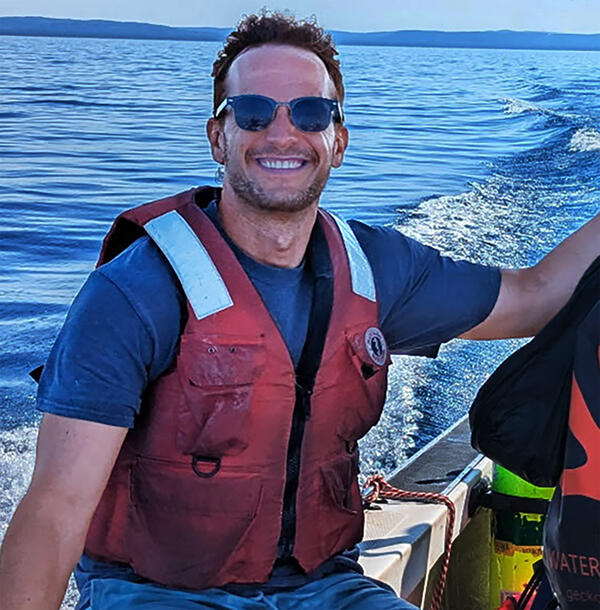
Dr. Benjamin Kramer is shown on a small research vessel in July 2025 near Sleeping Bear Dunes in Leelanau County, MI collecting benthic mats on Good Harbor Reef as part of USGS's UMESC SWIM (Spawning Whitefish Invasive Mussels) project. Photo Credi: Megan Lewan, USGS
Benjamin James Kramer, PhD
My research background primarily focuses on how climate change and eutrophication impact harmful algae in freshwater ecosystems. This has included determining how elevated temperatures as well as carbon dioxide levels, in tandem with nitrogen availability, impact the growth, toxin synthesis, and gene expression of cyanobacteria and other phytoplankton, particularly within the Great Lakes.
The term "harmful algae" encompasses a broad, highly diverse number of organisms in marine and freshwater environments that significantly impact ecosystems and devastate human health and industries. As we are in an ever-changing world, it is critical we understand how aquatic ecosystems will respond to climate change and other anthropogenic stressors, particularly when it comes to primary production. My dissertation and postdoctoral work involved extensive research into determining the importance of carbon dioxide on harmful freshwater cyanobacteria and the greater phytoplankton community. Freshwater carbonate chemistry is poorly understood relative to that of marine systems, even in the Great Lakes, and it is critical we fill those gaps in our understanding in order to better diagnose how phytoplankton and other primary producers such as harmful algae will respond. Thus, my work has involved analytical techniques such as the measurement of N2-fixation, dissolved inorganic carbon levels, and cyanotoxins as well as molecular techniques (metagenomics, metatranscriptomics, and metabolomics). All of this work has been done using traditional and novel experimental as well as field methods.
Professional Experience
Biologist (USGS Great Lakes Science Center; Aug 2024 - present)
Postdoctoral researcher (University of Minnesota Duluth; Jul 2022 - Aug 2024)
Graduate assistant (SUNY Stony Brook; Jul 2015 - Jun 2022)
Assistant professor (Suffolk Community College; Sep. 2017 - Dec. 2021)
Graduate assistant (UNC Wilmington; Aug. 2012 - May 2015)
Education and Certifications
Ph.D. 2022 SUNY Stony Book
M.Sc. 2015 UNC Wilmington
B.S. 2010 Georgia Institute of Technology
Affiliations and Memberships*
International Association of Great Lakes Research (IAGLR), 2024 - present
Association for the Sciences of Limnology and Oceanography (ASLO), 2024 - present
Honors and Awards
Chair for 2023 Gordon Research Seminar on Phycotoxins and Mycotoxins
Recipient for 2nd-best student presentation award (2019 US HAB Symposium)
Abstracts and Presentations
Carbonate chemistry and its potential impacts on phytoplankton in the Great Lakes (ASLO 2024)
The genome characteristics and distribution of Dolichospermum circinale in the Great Lakes (IAGLR 2024)
Carbonate chemistry and the N2–fixing potential of the Great Lakes (2024 CIGLR All Partners Meeting)
Understanding the impacts of climate change and eutrophication on cyanobacteria and the toxins they produce (2024 USDA Agricultural Research Services Seminar)
Inorganic carbonate chemistry of the Great Lakes (2024 USGS NOAA Workshop)
The effects of climate change processes and eutrophication on bloom-forming, toxin-producing, N2-fixing cyanobacteria (2023 GRC Mycotoxins and Phycotoxins)
Great Lakes acidification and harmful algal blooms (2023 NOAA OAP Community Meeting)
The effects of climate change and eutrophication on Dolichospermum: A harmful, diazotrophic cyanobacterial genus (2022 US Harmful Algal Symposium)
The effects of climate change and eutrophication on Dolichospermum: A harmful, diazotrophic cyanobacterial genus (2022 University of Minnesota Duluth Department of Biology Seminar)
Elevated CO2 significantly increases N2 fixation, growth rates, and alters microcystin, anatoxin, and saxitoxin cell quotes in strains of the bloom-forming cyanobacteria, Dolichospermum (2019 US Harmful Algal Symposium)
Transcriptomic and physiological responses of Dolichospermum sp. 54, an anatoxin-producing cyanobacterium, to different nutrient regimes (2018 International Conference of Harmful Algae)
The interactive roles of nitrogen loading and warming in controlling microcystin production in Microcystis (2017 US Harmful Algal Symposium)
Science and Products
Publications by this scientist
Nitrogen limitation, toxin synthesis potential, and toxicity of cyanobacterial populations in Lake Okeechobee and the St. Lucie River Estuary, Florida, during the 2016 state of emergency event Nitrogen limitation, toxin synthesis potential, and toxicity of cyanobacterial populations in Lake Okeechobee and the St. Lucie River Estuary, Florida, during the 2016 state of emergency event
Non-USGS Publications**
**Disclaimer: The views expressed in Non-USGS publications are those of the author and do not represent the views of the USGS, Department of the Interior, or the U.S. Government.
Cladophora biomass and supporting data collected in the Great Lakes, 2024 (ver. 1.1, July 2025) Cladophora biomass and supporting data collected in the Great Lakes, 2024 (ver. 1.1, July 2025)
Dr. Benjamin Kramer is shown on a small research vessel in July 2025 near Sleeping Bear Dunes in Leelanau County, MI collecting benthic mats on Good Harbor Reef as part of USGS's UMESC SWIM (Spawning Whitefish Invasive Mussels) project. Photo Credi: Megan Lewan, USGS
Science and Products
Publications by this scientist
Nitrogen limitation, toxin synthesis potential, and toxicity of cyanobacterial populations in Lake Okeechobee and the St. Lucie River Estuary, Florida, during the 2016 state of emergency event Nitrogen limitation, toxin synthesis potential, and toxicity of cyanobacterial populations in Lake Okeechobee and the St. Lucie River Estuary, Florida, during the 2016 state of emergency event
Non-USGS Publications**
**Disclaimer: The views expressed in Non-USGS publications are those of the author and do not represent the views of the USGS, Department of the Interior, or the U.S. Government.
Cladophora biomass and supporting data collected in the Great Lakes, 2024 (ver. 1.1, July 2025) Cladophora biomass and supporting data collected in the Great Lakes, 2024 (ver. 1.1, July 2025)
Dr. Benjamin Kramer is shown on a small research vessel in July 2025 near Sleeping Bear Dunes in Leelanau County, MI collecting benthic mats on Good Harbor Reef as part of USGS's UMESC SWIM (Spawning Whitefish Invasive Mussels) project. Photo Credi: Megan Lewan, USGS
*Disclaimer: Listing outside positions with professional scientific organizations on this Staff Profile are for informational purposes only and do not constitute an endorsement of those professional scientific organizations or their activities by the USGS, Department of the Interior, or U.S. Government