



Craig A Stricker, PhD
Craig Stricker is an ecologist at the Fort Collins Science Center that specializes in the application of chemical and isotopic tracers for addressing societally relevant questions related to ecosystem ecology. His research interests are focused on biogeochemistry, food webs, and animal resource allocation and movement.
Geology, Geophysics, and Geochemistry Stable Isotope Laboratory (GSIL)
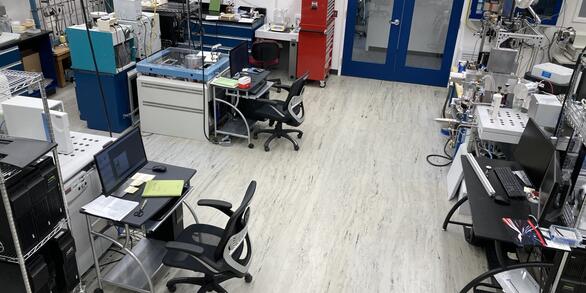
The GSIL is a state-of-the-art facility located on the Denver Federal Center that specializes in the measurement of light stable isotope — Hydrogen (H), Carbon (C), Nitrogen (N), Oxygen (O), and Sulfur (S) — compositions and other chemical and biomarker analytes in matrices relevant to the Earth sciences.
Research Highlights
- Continental-scale nutrient and contaminant delivery by Pacific salmon
- Diet and macronutrient assimilation in an Arctic predator
- Animal tracing with sulfur isotopes
- Effects of protein overconsumption limit dietary adaptation in an apex predator
- Carbon chemistry of peatlands in the southeastern USA
- Design, development, and implementation of IsoBank
- Diet energy density associated with survival, habitat, and population dynamics
As an ecologist at the Fort Collins Science Center, Craig Stricker’s research program focuses on an improved understanding of the roles of hydrology, biogeochemistry, and food web interactions on ecosystem structure and function with the goal of assisting land managers. His expertise in chemical and isotopic tracers offers novel insights in ecosystem ecology and has benefitted multidisciplinary collaborations across a variety of state, federal, and academic institutions. Tracer-based approaches to studying wildlife and ecosystems is a capability unique to Stricker’s research and the Fort Collins Science Center with examples ranging from wildlife nutrition, trophic dynamics, impacts of invasive species, animal movements and phenology, biogeochemistry, and environmental stressors such as fire and drought. The spatial domain of his work ranges from discrete habitats, regional assessments, to continental and oceanic basins, with studies from the sub-tropics to the high Arctic. Results of these projects inform on species life history and fitness to ecosystem health and function, but also offer frameworks for monitoring programs, model development, restoration, and risk assessment.