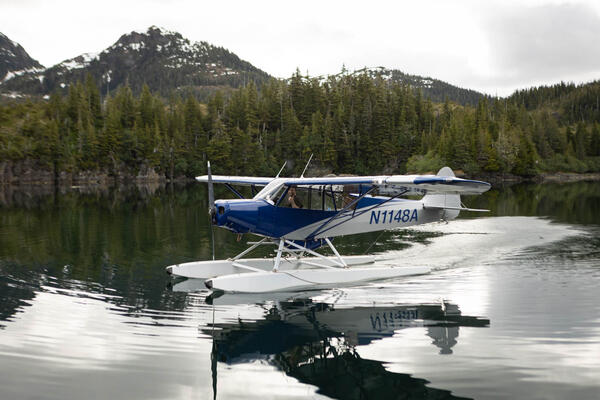
Float plane taking off in Prince William Sound for sea otter aerial survey
Float plane taking off in Prince William Sound for sea otter aerial surveyNorth River Air pilot Taj Shoemaker getting ready for takeoff in Prince William Sound.
An official website of the United States government
Here's how you know
Official websites use .gov
A .gov website belongs to an official government organization in the United States.
Secure .gov websites use HTTPS
A lock () or https:// means you’ve safely connected to the .gov website. Share sensitive information only on official, secure websites.
Using new technologies to study ecosystems; sea otter ecology; geographic information systems; population estimation; predator/prey interactions.
1998 - Present Zoologist, USGS, Alaska Biological Science Center Anchorage, Alaska
1995 - 1998 Fish and Wildlife Biologist, USGS, Alaska Biological Science Center Anchorage, Alaska
1993 - 1995 Biological Science Technician, U.S. Fish & Wildlife Service, Alaska Fish & Wildlife Research Center Anchorage, Alaska
1989 - 1993 Biological Science Technician, U.S. Fish & Wildlife Service, Migratory Bird Management Anchorage, Alaska
M.S. 2011 University of Alaska, Anchorage, AK Biological Sciences
B.S. 1993 Humboldt State University Arcata, CA Wildlife
North River Air pilot Taj Shoemaker getting ready for takeoff in Prince William Sound.
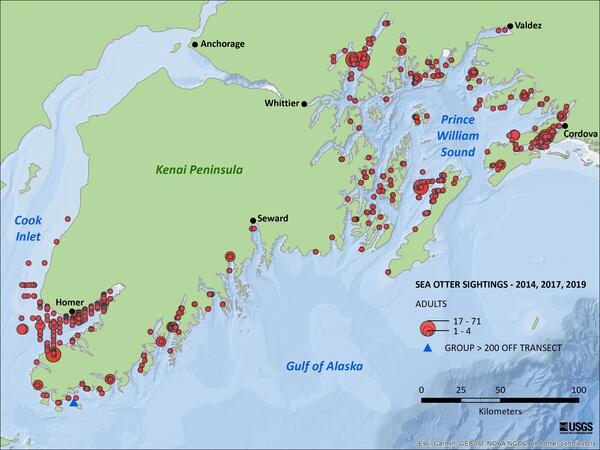
Distribution map of sea otters in southcentral Alaska from aerial surveys flown in 2014, 2017, and 2019.
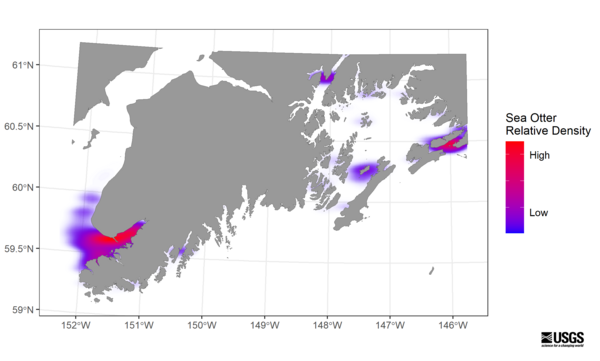
Density estimate of sea otters in southcentral Alaska from aerial surveys flown in 2014, 2017, and 2019. Sea otters in southcentral Alaska are the northernmost stock of sea otters and a keystone predator because they are known for structuring nearshore marine ecosystems through their feeding habits. Biologists with the USGS and USFWS conducted aerial
A resting sea otter in the Homer harbor, Alaska. Photo was taken in 2011. Sea otters provide one of the best documented examples of top-down forcing effects on the structure and function of nearshore marine ecosystems in the North Pacific Ocean.
A resting sea otter with eyes closed. Photo taken in the Homer harbor in Alaska. Sea otters provide one of the best documented examples of top-down forcing effects on the structure and function of nearshore marine ecosystems in the North Pacific Ocean
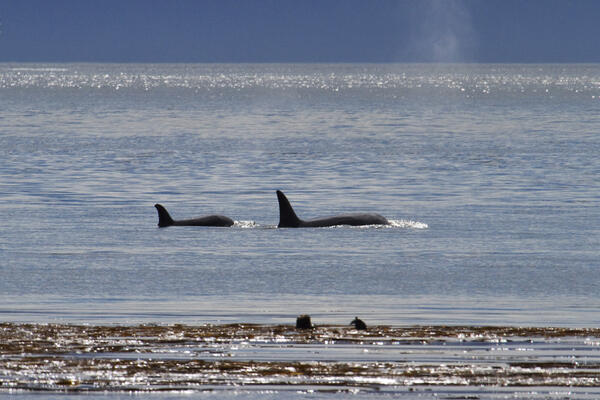
A sea otter resting in kelp as two orcas swim past. Photo taken in Glacier Bay at Point Carolus, Alaska
A female sea otter resting in the morning light in Cook Inlet Alaska.
Brian Robinson (USGS) and Ben Weitzman (NOAA) record observations along nearshore transects in Kachemak Bay, Alaska. USGS is studying the migration strategies and movement ecology of Black Oystercatchers as part of the new tracking study.
USGS Biologist Caitlin Marsteller prepares to release a Black Oystercatcher after assisting with the collection of morphometric data and tagging. Data were collected from Black Oystercatchers as part of a new study to better understand migration strategies and movement ecology of the species.
USGS Biologist Caitlin Marsteller releases a Black Oystercatcher after assisting with the collection of morphometric data and tagging. Data were collected from Black Oystercatchers as part of a new study to better understand migration strategies and movement ecology of the species.
A young sea otter foraging for small invertebrates off an emergent rock covered with seaweed, snails, and barnacles. Photo taken in Prince William Sound, Alaska.
A layout illustration of the R/V Alaskan Gyre deck.
A juvenile female sea otter eating small green urchins in the intertidal. Photo taken in Glacier Bay near Geikie Inlet, Alaska.
A sea otter at sunset eating a basket star in Glacier Bay near Bartlett Cove, Alaska
The R/V Alaskan Gyre in Katmai National Park, Alaska
North River Air pilot Taj Shoemaker getting ready for takeoff in Prince William Sound.
Distribution map of sea otters in southcentral Alaska from aerial surveys flown in 2014, 2017, and 2019.
Density estimate of sea otters in southcentral Alaska from aerial surveys flown in 2014, 2017, and 2019. Sea otters in southcentral Alaska are the northernmost stock of sea otters and a keystone predator because they are known for structuring nearshore marine ecosystems through their feeding habits. Biologists with the USGS and USFWS conducted aerial
A resting sea otter in the Homer harbor, Alaska. Photo was taken in 2011. Sea otters provide one of the best documented examples of top-down forcing effects on the structure and function of nearshore marine ecosystems in the North Pacific Ocean.
A resting sea otter with eyes closed. Photo taken in the Homer harbor in Alaska. Sea otters provide one of the best documented examples of top-down forcing effects on the structure and function of nearshore marine ecosystems in the North Pacific Ocean
A sea otter resting in kelp as two orcas swim past. Photo taken in Glacier Bay at Point Carolus, Alaska
A female sea otter resting in the morning light in Cook Inlet Alaska.
Brian Robinson (USGS) and Ben Weitzman (NOAA) record observations along nearshore transects in Kachemak Bay, Alaska. USGS is studying the migration strategies and movement ecology of Black Oystercatchers as part of the new tracking study.
USGS Biologist Caitlin Marsteller prepares to release a Black Oystercatcher after assisting with the collection of morphometric data and tagging. Data were collected from Black Oystercatchers as part of a new study to better understand migration strategies and movement ecology of the species.
USGS Biologist Caitlin Marsteller releases a Black Oystercatcher after assisting with the collection of morphometric data and tagging. Data were collected from Black Oystercatchers as part of a new study to better understand migration strategies and movement ecology of the species.
A young sea otter foraging for small invertebrates off an emergent rock covered with seaweed, snails, and barnacles. Photo taken in Prince William Sound, Alaska.
A layout illustration of the R/V Alaskan Gyre deck.
A juvenile female sea otter eating small green urchins in the intertidal. Photo taken in Glacier Bay near Geikie Inlet, Alaska.
A sea otter at sunset eating a basket star in Glacier Bay near Bartlett Cove, Alaska
The R/V Alaskan Gyre in Katmai National Park, Alaska