
Lee Tibbitts (Former Employee)
Science and Products
Tracking Data for Whimbrel (Numenius phaeopus)
Available here are tracking data for the whimbrel, a striking example of a shorebird with its long and curved bill. The whimbrel is found throughout tundra and boreal habitats of Alaska during the summer and spends the winter along coast lines of the continental U.S., and central and South America. These data were collected to better understand the migratory patterns of this iconic species.
Shorebird Research
With its vast size and geographic position at the northern end of several migration pathways, Alaska is a critically important site for the world’s shorebirds. Thirty-seven shorebird species regularly breed in Alaska. Most of these species conduct epically long migrations to take advantage of Alaska’s abundant food resources and breeding habitat, making Alaska a global resource for shorebirds...
USGS Alaska Science Center Wildlife Tracking Data Collection
Understanding the short- and long-distance movements of wildlife is critical for a wide variety of ecological research questions and management decisions. Since the mid-1980s, the USGS Alaska Science Center has used information from telemetry devices on wildlife species to determine locations of animals throughout their annual cycles, understand patterns of habitat use, quantify time spent on...
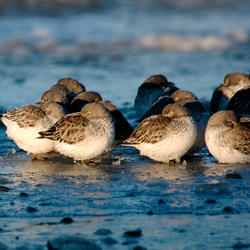
Past Shorebird Research
Below is information on past USGS research projects.
Filter Total Items: 19
Adult Shorebird Morphological Measurement Data Adult Shorebird Morphological Measurement Data
This dataset consists of five tables, 1) shorebird morphological measurements collected from various species captured from 1895-2021, 2) taxonomy, 3) contributors, 4) sampling locations, and 5) cross-reference publications. In addition, photographs of plumage patterns are available for several species. Researchers with the U.S. Geological Survey - Alaska Science Center, along with...
Juvenile Shorebird Morphological Data Collected in Alaska and Canada Juvenile Shorebird Morphological Data Collected in Alaska and Canada
This dataset consists of shorebird chick measurements (wing, primary feather 10, diagonal tarsus, and bill length) and body mass for various shorebird species captured in Alaska and Canada during 1978-2022. Researchers with the U.S. Geological Survey - Alaska Science Center, and collaborators from many government agencies and research institutions have studied shorebirds at numerous...
Inventory Data of Lowland-Breeding Birds and Associated Vegetation Types on the Alaska Peninsula, 2004-2007 Inventory Data of Lowland-Breeding Birds and Associated Vegetation Types on the Alaska Peninsula, 2004-2007
This release includes data collected using stratified random surveys to inventory the birds breeding in lowlands (elevation below 100m) of the Alaska Peninsula, during summers 2004-2007. Data were collected at 792 survey points (10-minute point counts) on 52 5-km x 5-km plots. The data are in seven tables: 1) geographic coordinates of the bounding corners of each of the 52 survey plots...
Tracking Data for Whimbrels (Numenius phaeopus) Tracking Data for Whimbrels (Numenius phaeopus)
This data release includes 2 child items with tracking data for Whimbrels, a shorebird found throughout tundra and boreal habitats of Alaska during the summer and winters along the coasts of the continental U.S., and central and South America. Child Item 1: "Argos Satellite Tracking Data for Whimbrels (Numenius phaeopus) - Processed Data" -- Quality-controlled data collected from Argos...
Buff-breasted Sandpiper (Calidris subruficollis) measurement data from Brazil, Texas, and Alaska Buff-breasted Sandpiper (Calidris subruficollis) measurement data from Brazil, Texas, and Alaska
This data consists of a single table morphologic measurement data and sex as determined by behavior and genetic techniques from 362 Buff-breasted Sandpipers (Calidris subruficollis) from Brazil, Texas and Alaska (1994 - 2017).
Measurements Used to Determine the Sex of Bristle-thighed Curlews (Numenius tahitiensis) Measurements Used to Determine the Sex of Bristle-thighed Curlews (Numenius tahitiensis)
This data set contains bill and tarsal measurements from 114 Bristle-thighed Curlews, captured on breeding grounds in Alaska, and non-breeding areas in Hawaii and Reitoru atoll, French Polynesia.
Filter Total Items: 55
Return rates of GPS-tagged Pacific Golden-Plovers: A controlled study in Hawaii Return rates of GPS-tagged Pacific Golden-Plovers: A controlled study in Hawaii
In a study of GPS-tagged Pacific Golden-Plovers wintering at Moorea, French Polynesia, Johnson et al. (2020) raised questions about possible tag-induced mortality. Similar concerns in other species have generated considerable attention in recent years. Of 19 tagged plovers that departed Moorea on northward migration, only one bird (5 %) uploaded a complete migratory cycle to Argos...
Authors
Oscar W. Johnson, Michael Weber, David R. Bybee, T. Lee Tibbitts, Susan Scott, Joshua Fisher, Wendy A. Kuntz, Susanne Spiessberger, Sigrid Southworth, Elizabeth Maynard, Laura Zoller, Carolyn Smith
Site fidelity of migratory shorebirds facing habitat deterioration: Insights from satellite tracking and mark-resighting Site fidelity of migratory shorebirds facing habitat deterioration: Insights from satellite tracking and mark-resighting
Background Site fidelity, the tendency to return to a previously visited site, is commonly observed in migratory birds. This behaviour would be advantageous if birds returning to the same site, benefit from their previous knowledge about local resources. However, when habitat quality declines at a site over time, birds with lower site fidelity might benefit from a tendency to move to...
Authors
Ying-Chi Chan, David Tsz-Chung Chan, T. Lee Tibbitts, Chris J. Hassell, Theunis Piersma
Disparate data streams together yield novel survival estimates of Alaska-breeding Whimbrels Disparate data streams together yield novel survival estimates of Alaska-breeding Whimbrels
Survival estimates are critical components of avian ecology. In well-intentioned efforts to maximize the utility of one's research, survival estimates often derive from data that were not originally collected for survival assessments, and such post hoc analyses may include unintentional biases. We estimated the survival of Whimbrels captured and marked at two breeding sites in Alaska...
Authors
Daniel R. Ruthrauff, Christopher M. Harwood, T. Lee Tibbitts, Vijay P. Patil
Hidden in plain sight: Migration routes of the elusive Anadyr bar-tailed godwit revealed by satellite tracking Hidden in plain sight: Migration routes of the elusive Anadyr bar-tailed godwit revealed by satellite tracking
Satellite and GPS tracking technology continues to reveal new migration patterns of birds which enables comparative studies of migration strategies and distributional information useful in conservation. Bar-tailed godwits in the East Asian–Australasian Flyway Limosa lapponica baueri and L. l. menzbieri are known for their long non-stop flights, however these populations are in steep...
Authors
Ying-Chi Chan, T. Lee Tibbitts, Dmitry Dorofeev, Chris J. Hassell, Theunis Piersma
Central-West Siberian-breeding Bar-tailed Godwits (Limosa lapponica) segregate in two morphologically distinct flyway populations Central-West Siberian-breeding Bar-tailed Godwits (Limosa lapponica) segregate in two morphologically distinct flyway populations
Long-distance migratory species often include multiple breeding populations, with distinct migration routes, wintering areas and annual-cycle timing. Detailed knowledge on population structure and migratory connectivity provides the basis for studies on the evolution of migration strategies and for species conservation. Currently, five subspecies of Bar-tailed Godwits Limosa lapponica...
Authors
Roeland A. Bom, Jesse R. Conklin, Yvonne I. Verkuil, Jose A. Alves, Jimmy De Fouw, Anne Dekinga, Chris J. Hassell, Raymond H. G. Klaassen, Eldar Rakhimberdiev, Andy Y. Kwarteng, Afonso Rocha, Job ten Horn, T. Lee Tibbitts, Pavel S. Tomkovich, Reginald Victor, Theunis Piersma
Diverse patterns of migratory timing, site use, and site fidelity by Alaska-breeding Whimbrels Diverse patterns of migratory timing, site use, and site fidelity by Alaska-breeding Whimbrels
Birds that conduct long-distance migrations exhibit varied patterns of consistency in migratory timing and site use. Understanding variation in these traits among populations can help uncover mechanisms driving migratory behaviors and identify potential population threats. Whimbrels (Numenius phaeopus) are long-distance migratory shorebirds with a Holarctic breeding distribution, and...
Authors
Daniel R. Ruthrauff, Christopher M. Harwood, T. Lee Tibbitts, Nils Warnock, Robert E. Gill
Science and Products
Tracking Data for Whimbrel (Numenius phaeopus)
Available here are tracking data for the whimbrel, a striking example of a shorebird with its long and curved bill. The whimbrel is found throughout tundra and boreal habitats of Alaska during the summer and spends the winter along coast lines of the continental U.S., and central and South America. These data were collected to better understand the migratory patterns of this iconic species.
Shorebird Research
With its vast size and geographic position at the northern end of several migration pathways, Alaska is a critically important site for the world’s shorebirds. Thirty-seven shorebird species regularly breed in Alaska. Most of these species conduct epically long migrations to take advantage of Alaska’s abundant food resources and breeding habitat, making Alaska a global resource for shorebirds...
USGS Alaska Science Center Wildlife Tracking Data Collection
Understanding the short- and long-distance movements of wildlife is critical for a wide variety of ecological research questions and management decisions. Since the mid-1980s, the USGS Alaska Science Center has used information from telemetry devices on wildlife species to determine locations of animals throughout their annual cycles, understand patterns of habitat use, quantify time spent on...
Past Shorebird Research
Below is information on past USGS research projects.
Filter Total Items: 19
Adult Shorebird Morphological Measurement Data Adult Shorebird Morphological Measurement Data
This dataset consists of five tables, 1) shorebird morphological measurements collected from various species captured from 1895-2021, 2) taxonomy, 3) contributors, 4) sampling locations, and 5) cross-reference publications. In addition, photographs of plumage patterns are available for several species. Researchers with the U.S. Geological Survey - Alaska Science Center, along with...
Juvenile Shorebird Morphological Data Collected in Alaska and Canada Juvenile Shorebird Morphological Data Collected in Alaska and Canada
This dataset consists of shorebird chick measurements (wing, primary feather 10, diagonal tarsus, and bill length) and body mass for various shorebird species captured in Alaska and Canada during 1978-2022. Researchers with the U.S. Geological Survey - Alaska Science Center, and collaborators from many government agencies and research institutions have studied shorebirds at numerous...
Inventory Data of Lowland-Breeding Birds and Associated Vegetation Types on the Alaska Peninsula, 2004-2007 Inventory Data of Lowland-Breeding Birds and Associated Vegetation Types on the Alaska Peninsula, 2004-2007
This release includes data collected using stratified random surveys to inventory the birds breeding in lowlands (elevation below 100m) of the Alaska Peninsula, during summers 2004-2007. Data were collected at 792 survey points (10-minute point counts) on 52 5-km x 5-km plots. The data are in seven tables: 1) geographic coordinates of the bounding corners of each of the 52 survey plots...
Tracking Data for Whimbrels (Numenius phaeopus) Tracking Data for Whimbrels (Numenius phaeopus)
This data release includes 2 child items with tracking data for Whimbrels, a shorebird found throughout tundra and boreal habitats of Alaska during the summer and winters along the coasts of the continental U.S., and central and South America. Child Item 1: "Argos Satellite Tracking Data for Whimbrels (Numenius phaeopus) - Processed Data" -- Quality-controlled data collected from Argos...
Buff-breasted Sandpiper (Calidris subruficollis) measurement data from Brazil, Texas, and Alaska Buff-breasted Sandpiper (Calidris subruficollis) measurement data from Brazil, Texas, and Alaska
This data consists of a single table morphologic measurement data and sex as determined by behavior and genetic techniques from 362 Buff-breasted Sandpipers (Calidris subruficollis) from Brazil, Texas and Alaska (1994 - 2017).
Measurements Used to Determine the Sex of Bristle-thighed Curlews (Numenius tahitiensis) Measurements Used to Determine the Sex of Bristle-thighed Curlews (Numenius tahitiensis)
This data set contains bill and tarsal measurements from 114 Bristle-thighed Curlews, captured on breeding grounds in Alaska, and non-breeding areas in Hawaii and Reitoru atoll, French Polynesia.
Filter Total Items: 55
Return rates of GPS-tagged Pacific Golden-Plovers: A controlled study in Hawaii Return rates of GPS-tagged Pacific Golden-Plovers: A controlled study in Hawaii
In a study of GPS-tagged Pacific Golden-Plovers wintering at Moorea, French Polynesia, Johnson et al. (2020) raised questions about possible tag-induced mortality. Similar concerns in other species have generated considerable attention in recent years. Of 19 tagged plovers that departed Moorea on northward migration, only one bird (5 %) uploaded a complete migratory cycle to Argos...
Authors
Oscar W. Johnson, Michael Weber, David R. Bybee, T. Lee Tibbitts, Susan Scott, Joshua Fisher, Wendy A. Kuntz, Susanne Spiessberger, Sigrid Southworth, Elizabeth Maynard, Laura Zoller, Carolyn Smith
Site fidelity of migratory shorebirds facing habitat deterioration: Insights from satellite tracking and mark-resighting Site fidelity of migratory shorebirds facing habitat deterioration: Insights from satellite tracking and mark-resighting
Background Site fidelity, the tendency to return to a previously visited site, is commonly observed in migratory birds. This behaviour would be advantageous if birds returning to the same site, benefit from their previous knowledge about local resources. However, when habitat quality declines at a site over time, birds with lower site fidelity might benefit from a tendency to move to...
Authors
Ying-Chi Chan, David Tsz-Chung Chan, T. Lee Tibbitts, Chris J. Hassell, Theunis Piersma
Disparate data streams together yield novel survival estimates of Alaska-breeding Whimbrels Disparate data streams together yield novel survival estimates of Alaska-breeding Whimbrels
Survival estimates are critical components of avian ecology. In well-intentioned efforts to maximize the utility of one's research, survival estimates often derive from data that were not originally collected for survival assessments, and such post hoc analyses may include unintentional biases. We estimated the survival of Whimbrels captured and marked at two breeding sites in Alaska...
Authors
Daniel R. Ruthrauff, Christopher M. Harwood, T. Lee Tibbitts, Vijay P. Patil
Hidden in plain sight: Migration routes of the elusive Anadyr bar-tailed godwit revealed by satellite tracking Hidden in plain sight: Migration routes of the elusive Anadyr bar-tailed godwit revealed by satellite tracking
Satellite and GPS tracking technology continues to reveal new migration patterns of birds which enables comparative studies of migration strategies and distributional information useful in conservation. Bar-tailed godwits in the East Asian–Australasian Flyway Limosa lapponica baueri and L. l. menzbieri are known for their long non-stop flights, however these populations are in steep...
Authors
Ying-Chi Chan, T. Lee Tibbitts, Dmitry Dorofeev, Chris J. Hassell, Theunis Piersma
Central-West Siberian-breeding Bar-tailed Godwits (Limosa lapponica) segregate in two morphologically distinct flyway populations Central-West Siberian-breeding Bar-tailed Godwits (Limosa lapponica) segregate in two morphologically distinct flyway populations
Long-distance migratory species often include multiple breeding populations, with distinct migration routes, wintering areas and annual-cycle timing. Detailed knowledge on population structure and migratory connectivity provides the basis for studies on the evolution of migration strategies and for species conservation. Currently, five subspecies of Bar-tailed Godwits Limosa lapponica...
Authors
Roeland A. Bom, Jesse R. Conklin, Yvonne I. Verkuil, Jose A. Alves, Jimmy De Fouw, Anne Dekinga, Chris J. Hassell, Raymond H. G. Klaassen, Eldar Rakhimberdiev, Andy Y. Kwarteng, Afonso Rocha, Job ten Horn, T. Lee Tibbitts, Pavel S. Tomkovich, Reginald Victor, Theunis Piersma
Diverse patterns of migratory timing, site use, and site fidelity by Alaska-breeding Whimbrels Diverse patterns of migratory timing, site use, and site fidelity by Alaska-breeding Whimbrels
Birds that conduct long-distance migrations exhibit varied patterns of consistency in migratory timing and site use. Understanding variation in these traits among populations can help uncover mechanisms driving migratory behaviors and identify potential population threats. Whimbrels (Numenius phaeopus) are long-distance migratory shorebirds with a Holarctic breeding distribution, and...
Authors
Daniel R. Ruthrauff, Christopher M. Harwood, T. Lee Tibbitts, Nils Warnock, Robert E. Gill
*Disclaimer: Listing outside positions with professional scientific organizations on this Staff Profile are for informational purposes only and do not constitute an endorsement of those professional scientific organizations or their activities by the USGS, Department of the Interior, or U.S. Government