



At Kīlauea Volcano's summit, inward slumping of the rim and walls of Halema‘uma‘u continues in response to ongoing subsidence. In this view to the southwest taken after this morning's event, a section of dark-colored wall rock (center left) has detached and dropped downward into the crater.
Images
Kīlauea images of eruptive activity, field work, and more.
Filter Total Items: 3089

Kīlauea Volcano — Halema`uma`u Slumping
At Kīlauea Volcano's summit, inward slumping of the rim and walls of Halema‘uma‘u continues in response to ongoing subsidence. In this view to the southwest taken after this morning's event, a section of dark-colored wall rock (center left) has detached and dropped downward into the crater.

Fissure activity and active ocean entry in Kīlauea's LERZ
Fissure activity and active ocean entry in Kīlauea's LERZFissure 8 produces a lava fountain that pulses to heights of 55 to 60 m (185 to 200 ft). Spattering has built a cinder cone that partially encircles fissure 8, now 51 m (170 ft) tall at its highest point. The steam in the foreground is the result of heavy morning rain falling on warm (not hot) tephra (lava fragments).
Fissure activity and active ocean entry in Kīlauea's LERZ
Fissure activity and active ocean entry in Kīlauea's LERZFissure 8 produces a lava fountain that pulses to heights of 55 to 60 m (185 to 200 ft). Spattering has built a cinder cone that partially encircles fissure 8, now 51 m (170 ft) tall at its highest point. The steam in the foreground is the result of heavy morning rain falling on warm (not hot) tephra (lava fragments).

Kilauea Volcano -- Lower East Rift Zone lava flows and fissures
Kilauea Volcano -- Lower East Rift Zone lava flows and fissuresMap as of 10:00 a.m. HST, June 15, 2018.

Kīlauea Volcano — Spatter Cone Building
Lava fountains from Fissure 8 reach heights of 200 ft overnight. The cinder and spatter cone that is building around the fissure is now about 165 ft at its highest point.
Lava fountains from Fissure 8 reach heights of 200 ft overnight. The cinder and spatter cone that is building around the fissure is now about 165 ft at its highest point.

Kīlauea Volcano — Fissure 8 Lava Fountain
Photograph taken during helicopter overflight captures fissure 8 lava fountain.
Photograph taken during helicopter overflight captures fissure 8 lava fountain.
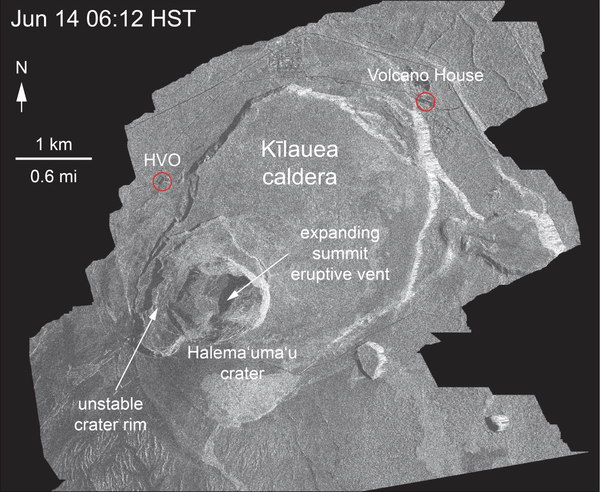
Kīlauea Volcano — Halema`uma`u Crater Enlargement
This animated GIF shows a sequence of radar amplitude images that were acquired by the Agenzia Spaziale Italiana CosmoSkyMed satellite system. The images illustrate changes to the caldera area of Kīlauea Volcano that occurred between May 5 and June 14 at about 6:00 a.m. HST.
This animated GIF shows a sequence of radar amplitude images that were acquired by the Agenzia Spaziale Italiana CosmoSkyMed satellite system. The images illustrate changes to the caldera area of Kīlauea Volcano that occurred between May 5 and June 14 at about 6:00 a.m. HST.

Kīlauea Volcano — Ocean Entry
The ocean entry remains fairly broad with a white steam/laze plume blowing onshore. USGS image taken June 15, 2018.
The ocean entry remains fairly broad with a white steam/laze plume blowing onshore. USGS image taken June 15, 2018.

Kīlauea Volcano — Fissure 8 Cone Building
The Fissure 8 viewed from the north at 7:50 AM. The cone is roughly 50 m (165 ft) high at is peak, and a plume of sulfur dioxide and other volcanic gases rises as an orange tinge from the erupting lava fountains (hidden within the cone). Lava is still flowing out of the ventunabated as a full channel.
The Fissure 8 viewed from the north at 7:50 AM. The cone is roughly 50 m (165 ft) high at is peak, and a plume of sulfur dioxide and other volcanic gases rises as an orange tinge from the erupting lava fountains (hidden within the cone). Lava is still flowing out of the ventunabated as a full channel.

Kīlauea Volcano — Laze Plumes
Several laze plumes rise along the ocean entry margin as break outs feed many small and large flows. The largest Pāhoehoe breakout area is on the northern margin of the flow.
Several laze plumes rise along the ocean entry margin as break outs feed many small and large flows. The largest Pāhoehoe breakout area is on the northern margin of the flow.

Kīlauea Volcano — Pāhoehoe Breakouts
A close up view of the pāhoehoe breakouts along the northern ocean entry.
A close up view of the pāhoehoe breakouts along the northern ocean entry.

Kīlauea Volcano — Fissure 8
Fissure 8 lava fountain during this morning's overflight of the lower East Rift Zone.
Fissure 8 lava fountain during this morning's overflight of the lower East Rift Zone.

Kīlauea Volcano — Fissure 8
Fissure 8 fountains to heights of 130-140 ft. The lava spatter chills and the fragments are building a cone on the downwind side, now nearly as tall as the fountain itself.
Fissure 8 fountains to heights of 130-140 ft. The lava spatter chills and the fragments are building a cone on the downwind side, now nearly as tall as the fountain itself.

Kīlauea Volcano — Fissure 8
Fissure 8 lava fountains continue to reach heights of 40-45 m (130-150 ft) from within the growing cone of cinder and spatter, which
Fissure 8 lava fountains continue to reach heights of 40-45 m (130-150 ft) from within the growing cone of cinder and spatter, which

Kīlauea Volcano — Kapoho New Land
Closer view of new land in the Kapoho area. The new coastline, following the ragged lava-ocean interface, is approximately 2.1 km (1.3 mi) in length. The white steam/laze plume marks the location of the most active lava entry site during the morning overflight.
Closer view of new land in the Kapoho area. The new coastline, following the ragged lava-ocean interface, is approximately 2.1 km (1.3 mi) in length. The white steam/laze plume marks the location of the most active lava entry site during the morning overflight.

Kīlauea Volcano — Ocean Entry Laze Plume

Kīlauea LERZ lava flows and fissures, June 13, 10:00 a.m.
Kīlauea LERZ lava flows and fissures, June 13, 10:00 a.m.Map as of 10:00 a.m. HST, June 13, 2018. Given the dynamic nature of Kīlauea's lower East Rift Zone eruption, with changing vent locations, fissures starting and stopping, and varying rates of lava effusion, map details shown here are accurate as of the date/time noted. Shaded purple areas indicate lava flows erupted in 1840, 1955, 1960, and 2014-2015.
Kīlauea LERZ lava flows and fissures, June 13, 10:00 a.m.
Kīlauea LERZ lava flows and fissures, June 13, 10:00 a.m.Map as of 10:00 a.m. HST, June 13, 2018. Given the dynamic nature of Kīlauea's lower East Rift Zone eruption, with changing vent locations, fissures starting and stopping, and varying rates of lava effusion, map details shown here are accurate as of the date/time noted. Shaded purple areas indicate lava flows erupted in 1840, 1955, 1960, and 2014-2015.

Kīlauea Volcano — Ocean Entry

Kīlauea Volcano — Halema‘uma‘u Crater
Events at the summit of Kīlauea over the past few weeks have dramatically reshaped Halema‘uma‘u, shown here in this aerial view, which looks west across the crater. The obvious flat surface (photo center) is the former Halema‘uma‘u crater floor, which has subsided at least 100 m (about 300 ft) during the past couple weeks.
Events at the summit of Kīlauea over the past few weeks have dramatically reshaped Halema‘uma‘u, shown here in this aerial view, which looks west across the crater. The obvious flat surface (photo center) is the former Halema‘uma‘u crater floor, which has subsided at least 100 m (about 300 ft) during the past couple weeks.

Kīlauea Volcano — Multiple Ocean Entries
The south side of the ocean entry was most active today, with many small streams of lava and corresponding steam plumes spread along a fairly broad section of the southern part of the delta. USGS image taken June 12, 2018, around 6:13 AM.
The south side of the ocean entry was most active today, with many small streams of lava and corresponding steam plumes spread along a fairly broad section of the southern part of the delta. USGS image taken June 12, 2018, around 6:13 AM.

Kīlauea Volcano — Halema`uma`u Crater Cracks
A closer view of the cracks cutting across the parking lot for the former Halema‘uma‘u visitor overlook (closed since 2008, when an active vent opened within the crater). Additional photos—ground views—of the parking lot cracks were posted on June 7 and 11.
A closer view of the cracks cutting across the parking lot for the former Halema‘uma‘u visitor overlook (closed since 2008, when an active vent opened within the crater). Additional photos—ground views—of the parking lot cracks were posted on June 7 and 11.

Kīlauea summit
Events at the summit of Kīlauea over the past few weeks have dramatically reshaped Halema‘uma‘u, shown here in this aerial view, which looks west across the crater. The obvious flat surface (photo center) is the former Halema‘uma‘u crater floor, which has subsided at least 100 m (about 300 ft) during the past couple weeks.
Events at the summit of Kīlauea over the past few weeks have dramatically reshaped Halema‘uma‘u, shown here in this aerial view, which looks west across the crater. The obvious flat surface (photo center) is the former Halema‘uma‘u crater floor, which has subsided at least 100 m (about 300 ft) during the past couple weeks.