



The Hawaiian Volcano Observatory (HVO), founded in 1912 by Thomas A. Jaggar, was the first of five volcano observatories supported by USGS today. The “Technology Station” (circled) on the eastern rim of Halema‘uma‘u crater—at the summit of Kīlauea—was the first, though temporary, of several buildings that HVO has occupied since its founding.
Images
Kīlauea images of eruptive activity, field work, and more.
Filter Total Items: 3304

Hawaiian Volcano Observatory “Technology Station”
The Hawaiian Volcano Observatory (HVO), founded in 1912 by Thomas A. Jaggar, was the first of five volcano observatories supported by USGS today. The “Technology Station” (circled) on the eastern rim of Halema‘uma‘u crater—at the summit of Kīlauea—was the first, though temporary, of several buildings that HVO has occupied since its founding.

Shaded relief map of Kīlauea's summit with caldera
Shaded relief map of Kīlauea's summit with calderaShaded relief map of Kīlauea Volcano's summit with caldera bounding faults delineated.
Shaded relief map of Kīlauea's summit with caldera
Shaded relief map of Kīlauea's summit with calderaShaded relief map of Kīlauea Volcano's summit with caldera bounding faults delineated.

Coconut grove and campground on the southern shoreline of Kīlauea a...
Coconut grove and campground on the southern shoreline of Kīlauea a...Coconut grove and campground on the southern shoreline of Kīlauea Volcano at Halapē before 1975 magnitude 7.7 earthquake. Halapē was a popular hiking destination in Hawai‘i Volcanoes National Park.

Children pose with 8 ton ballistic block at Kīlauea, Hawai‘i.
Children pose with 8 ton ballistic block at Kīlauea, Hawai‘i.Some of the large ballistic blocks from the Kīlauea eruption of 1924 later became visitor attractions. Many of these blocks remain in place today as evidence of the forces unleashed at Kīlauea during the eruption of 1924.

1892 and 1894 cross-sections of Halemaʻumaʻu crater
1892 and 1894 cross-sections of Halemaʻumaʻu craterSurveyor Frank Dodge's 1894 cross-section of Halema‘uma‘u overlaid on his 1892 cross-section. The 1892 lava lake was measured at 73 m (240 ft) below the rim of Halema‘uma‘u pit and by early-1894, the lava lake had filled the pit and frequently overflowed onto the caldera floor.

1894 view of lava flows in Kaluapele
Photograph taken on March 20, 1894 looking up at the Halemaʻumaʻu lava lake perched atop a low dome on the floor of Kaluapele (Kīlauea caldera).
Photograph taken on March 20, 1894 looking up at the Halemaʻumaʻu lava lake perched atop a low dome on the floor of Kaluapele (Kīlauea caldera).
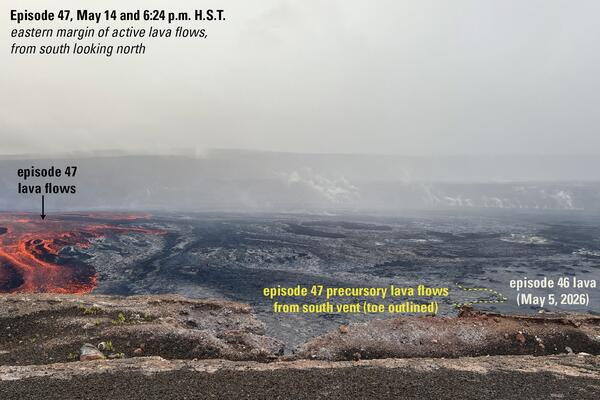
May 14, 2026 — Kīlauea episode 47 lava flows
This annotated photo was taken at 6:24 p.m. HST on May 14, 2026, from the south rim of Halema‘uma‘u crater and looks north during episode 47 of lava fountaining at the summit of Kīlauea on May 14, 2026. Only north vent produced a lava fountain, and associated lava flows traversed east across the crater floor.
This annotated photo was taken at 6:24 p.m. HST on May 14, 2026, from the south rim of Halema‘uma‘u crater and looks north during episode 47 of lava fountaining at the summit of Kīlauea on May 14, 2026. Only north vent produced a lava fountain, and associated lava flows traversed east across the crater floor.