An official website of the United States government
Here's how you know
Official websites use .gov
A .gov website belongs to an official government organization in the United States.
Secure .gov websites use HTTPS
A lock () or https:// means you’ve safely connected to the .gov website. Share sensitive information only on official, secure websites.
Kīlauea's summit eruption continues on the Island of Hawai‘i; Halema‘uma‘u west vent erupts lava into the lava lake, which was 229 m (751 ft) deep this morning, May 20. Gas emissions and seismic activity at the summit remain elevated. HVO field crews—equipped with specialized safety gear—monitor the eruption from within
HVO scientists collect detailed data to assess hazards and understand how the eruption is evolving at Kīlauea's summit, all of which are shared with the National Park Service and emergency managers. Access to this hazardous area is by permission from, and in coordination with, Hawai‘i Volcanoes National Park.
The area of active surface lava has diminished over the past month in Halema`uma`u crater, at the summit of Kilauea. Yesterday, active surface lava was limited to a small pond, about 20 meters (yards) long. The pond surface was normally covered with a stationary crust, but occasionally resurfaced. This video shows crustal foundering during a resurfacing event. A gust of wind shakes the camera at the start of the video.
Active surface lava limited to a small pond in Halema‘uma‘u
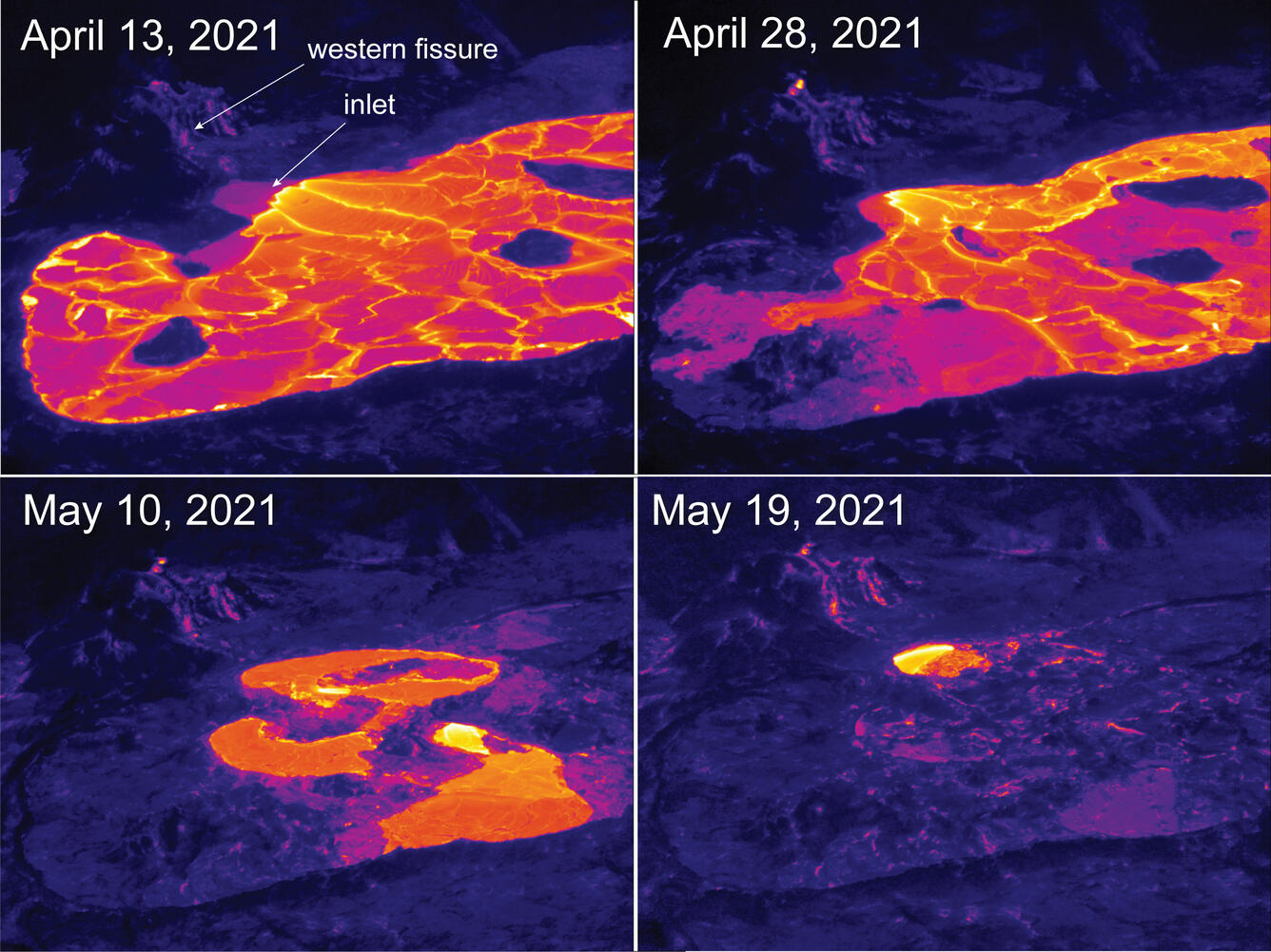
This comparison of thermal images taken from the south rim of Halema‘uma‘u, at the summit of Kīlauea, show the diminishing area of active lava on the surface over the past month. Yesterday, active lava was limited to a small pond, about 20 meters (yards) long, near the western fissure. USGS images by M. Patrick.
Active surface lava in Halema‘uma‘u, at the summit of Kīlauea, is now limited to a small lava pond near the western fissure. Normally the lava pond is covered in a stationary crust, as shown by the image on the left. Occasionally, the pond abruptly resurfaces with fluid lava, with foundering of crustal plates and abundant bubbling, shown by the image on the right. The resurfacing process takes just a few minutes. USGS photos by M. Patrick.
The lava lake in Halemaʻumaʻu crater, at the summit of Kīlauea, remains active but has diminished in area and vigor over the past month. This thermal timelapse sequence shows the changes in the lake activity over the past month. In mid-April the area of active surface lava in the lake was approximately 7.5 acres (3 hectares). By mid-May the area was about 0.5 acres (0.2 hectares). Taken from the automated camera (F1cam).