U.S. flag

An official website of the United States government

Images

Images of Yellowstone.

Filter Total Items: 687
A Ptychopariid trilobite from Yellowstone National Park

A Ptychopariid trilobite from Yellowstone National Park. Scale is in millimeters.  Specimen located at the Smithsonian National Museum of Natural History.

A Ehmania walcotti trilobite from Yellowstone National Park

A Ehmania walcotti trilobite from Yellowstone National Park. Scale is in millimeters.  Specimen located at the Smithsonian National Museum of Natural History.

Yellowstone subsurface cross-section schematic oriented SW-NE, depi...

Yellowstone subsurface cross-section schematic oriented SW-NE, depicts rise of magma beneath mantle plus heating and movement of mantle and crustal material. Credit Univ Utah. Click to enlarge.

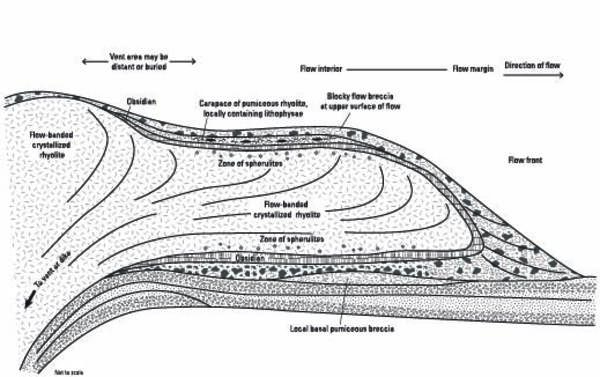
cartoon showing internal structure of a rhyolite lava flow
Schematic cartoon showing internal structure of a rhyolite lava flow
Map of the Heart Mountain slide block

Map of the Heart Mountain slide block. From Mitchell et al., 2015 ("Catastrophic emplacement of giant landslides aided by thermal decomposition: Heart Mountain, Wyoming." Earth and Planetary Science Letters 411: 199-207), modified from Anders et al. (2010).

Pitchstone Plateau, Yellowstone, rhyolite with sanidine

(Left) Sample of the Pitchstone Plateau rhyolite flow, which erupted about 72,000 years ago, making it is the youngest rhyolite at Yellowstone. The blocky white crystals in this sample are the mineral sanidine, whereas the rounded crystals are quartz.

(Left) Sample of the Pitchstone Plateau rhyolite flow, which erupted about 72,000 years ago, making it is the youngest rhyolite at Yellowstone. The blocky white crystals in this sample are the mineral sanidine, whereas the rounded crystals are quartz.

Aerial thermal infrared images of Yellowstone National Park from the 2000s

Top: Thermographic mosaic of Yellowstone acquired by the NASA’s MODIS-ASTER Airborne Simulator (MASTER), a thermal infrared scanner, in September 2006.  Dark shades indicate cool temperatures and bright are warm; this reflects not only hydrothermal activity, but also types of ground cover.

Top: Thermographic mosaic of Yellowstone acquired by the NASA’s MODIS-ASTER Airborne Simulator (MASTER), a thermal infrared scanner, in September 2006.  Dark shades indicate cool temperatures and bright are warm; this reflects not only hydrothermal activity, but also types of ground cover.

Gas collection from a bubbling source within Pelican Creek, Yellows...

Gas collection from a bubbling source within Pelican Creek, Yellowstone. Inverted funnel placed over gas source, gas travels through tubing into evacuated/vacuum glas flask to be analyzed in lab.

Gas collection from a bubbling source within Pelican Creek, Yellowstone. Inverted funnel placed over gas source, gas travels through tubing into evacuated/vacuum glas flask to be analyzed in lab.

Gas flask sampling at West Astringent Creek, Yellowstone. Open tube...

Gas flask sampling at West Astringent Creek, Yellowstone. Open tube with attached gas chamber inserted into ground, gas travels through tube into vacuum flask being held by scientist.

Lidar coverage of the Hebgen and Red Canyon faults collected in 2014

Lidar coverage of the Hebgen and Red Canyon faults collected in 2014. Magenta lines show fault scarps mapped by USGS geologists shortly after the 1959 earthquake. Yellow lines show fault scarps interpreted from lidar data 55 years after the earthquake.

Lidar coverage of the Hebgen and Red Canyon faults collected in 2014. Magenta lines show fault scarps mapped by USGS geologists shortly after the 1959 earthquake. Yellow lines show fault scarps interpreted from lidar data 55 years after the earthquake.

Schematic cross section of the magmatic and hydrothermal systems underlying Yellowstone Caldera

Schematic cross section of the magmatic and hydrothermal systems underlying Yellowstone Caldera, showing magmatic volatiles emitted during crystallization of the rhyolitic magma and/or from basalt intrusions or convection, and the hypothesized relation with earthquake swarms on the caldera margins.  The exsolved fluids accumulate at lithostatic pressures in the

Schematic cross section of the magmatic and hydrothermal systems underlying Yellowstone Caldera, showing magmatic volatiles emitted during crystallization of the rhyolitic magma and/or from basalt intrusions or convection, and the hypothesized relation with earthquake swarms on the caldera margins.  The exsolved fluids accumulate at lithostatic pressures in the

Frosted trees in the Fairy Falls area of Yellowstone National Park near the Firehole River
Lava Mountain, Wyoming

Lava Mountain, Wyoming.  (A) View from Dubois, WY, in the Wind River basin looking northwest ~30 km toward Lava Mountain.

Lava Mountain, Wyoming.  (A) View from Dubois, WY, in the Wind River basin looking northwest ~30 km toward Lava Mountain.

The contact between Huckleberry Ridge Tuff ignimbrite members A and B
Contact between Huckleberry Ridge Tuff ignimbrite members A and B

The contact (red arrow) between Huckleberry Ridge Tuff ignimbrite members A and B is marked by a time break of probably weeks to a month or so.

Boiling dark gray mud splashing within a small depression
Mud Pot within the Mud Volcano thermal area of Yellowstone National Park

A mud pot in the Obsidian Pool Thermal Area, near Mud Volcano. The large amounts of suspended sediment make the thermal water much more viscous than pure water. Photo by Shaul Hurwitz, September 2014.

Ashfall model output for Yellowstone supereruption

Example model output of possible ash distribution from a month-long Yellowstone supereruption. Results vary depending on wind and eruption conditions. Historical winds for January 2001 used here.

Example model output of possible ash distribution from a month-long Yellowstone supereruption. Results vary depending on wind and eruption conditions. Historical winds for January 2001 used here.

Beryl Spring's boiling blue pool. Yellowstone
Blue pool of boiling water at Beryl Springs, Yellowstone National Park

Beryl Spring's strongly boiling blue pool is about 8 m (25 ft) wide and contains high-chloride liquid water with a near-neutral pH. Immediately behind the pool is a loud, hissing fumarole producing a white cloud of steam. USGS Photo by Pat Shanks, 2002.

Beryl Spring's strongly boiling blue pool is about 8 m (25 ft) wide and contains high-chloride liquid water with a near-neutral pH. Immediately behind the pool is a loud, hissing fumarole producing a white cloud of steam. USGS Photo by Pat Shanks, 2002.

Cumulative earthquake counts (provided by the University of Utah) l...
Cumulative earthquake counts (provided by the Univ. of Utah) locate...

The left axis shows the number of earthquakes per week. The right axis is the total cumulative number of earthquakes, which means it has to always increase. It increased a lot in the period 1996-2003 when there was a period of uplift near Norris.

The left axis shows the number of earthquakes per week. The right axis is the total cumulative number of earthquakes, which means it has to always increase. It increased a lot in the period 1996-2003 when there was a period of uplift near Norris.

Seismograms of the magnitude 4.8 earthquake that occurred in Yellowstone on March 30, 2014
Seismograms of the M4.8 earthquake in Yellowstone March 30, 2014

Seismograms of the magnitude 4.8 earthquake that occurred in Yellowstone on March 30, 2014, as recorded by seismometers at station YNR near Norris Geyser Basin.  Top: Seismogram recorded on the accelerometer, which stayed on scale during the shaking.  Bottom: “Clipped” seismogram recorded on the broadband seismometer, which went off scale during the shakin

Seismograms of the magnitude 4.8 earthquake that occurred in Yellowstone on March 30, 2014, as recorded by seismometers at station YNR near Norris Geyser Basin.  Top: Seismogram recorded on the accelerometer, which stayed on scale during the shaking.  Bottom: “Clipped” seismogram recorded on the broadband seismometer, which went off scale during the shakin

Telemetry system of the Yellowstone Seismic Network

Telemetry system of the Yellowstone Seismic Network operated by the University of Utah Seismograph Stations.  Black arrows show analog telemetry and pink arrows show digital telemetry.  The green line is the boundary of Yellowstone National Park.

Telemetry system of the Yellowstone Seismic Network operated by the University of Utah Seismograph Stations.  Black arrows show analog telemetry and pink arrows show digital telemetry.  The green line is the boundary of Yellowstone National Park.

Seismic stations used to located the March 30, 2014, M4.8 Norris earthquake in Yellowstone
Seismic stations used to located the March 30, 2014, M4.8 Norris quake

Station map showing seismograph stations used in the location of the M4.8 earthquake that occurred near Norris Geyser Basin on March 30, 2014.  The yellow star shows the earthquake epicenter.  Red triangles represent seismograph stations with a P-wave arrival pick.  Green triangles represent seismograph stations with both a P-wave and a S-wave arrival

Station map showing seismograph stations used in the location of the M4.8 earthquake that occurred near Norris Geyser Basin on March 30, 2014.  The yellow star shows the earthquake epicenter.  Red triangles represent seismograph stations with a P-wave arrival pick.  Green triangles represent seismograph stations with both a P-wave and a S-wave arrival

Was this page helpful?