



Classroom Currents - Water Science School Newsletter Autumn 2025
In this newsletter, educator Samantha Willsey shares how she uses Water Science School resources to enhance student engagement and environmental awareness.
About Samantha Willsey
I am a science educator with more than 16 years of teaching and program leadership experience. My career has spanned secondary school classrooms in 5 different countries, international experiential education, and national fellowships, including serving as a Fulbright Teachers for Global Classrooms Fellow and an Albert Einstein Distinguished Educator Fellow at the U.S. Geological Survey. In every role, I have worked to connect students with the interdisciplinary nature of geoscience. My goal is always to help students see themselves as agents of change who can apply their learning to both local and global challenges.
My time with the USGS provided me with a unique window into how federal science directly informs policy, resource management, and community resilience. Similarly, my Fulbright fellowship deepened my commitment to global competence by highlighting how science education must bridge cultures, perspectives, and lived experiences. Both experiences increased my understanding and awareness of the interconnections between Earth systems and human systems, and the importance of integrating socio-science concepts such as climate change and resource equity into curriculum. USGS science can be a powerful classroom tool not only through the data and diagrams it provides but also through the authentic stories of how science impacts people’s lives. When students engage with these resources, they are not only learning scientific content but also seeing how science supports decision-making, sustainability efforts, and global cooperation. This empowers them to connect classroom learning to real-world challenges and to imagine themselves as part of the solutions.
In the Classroom
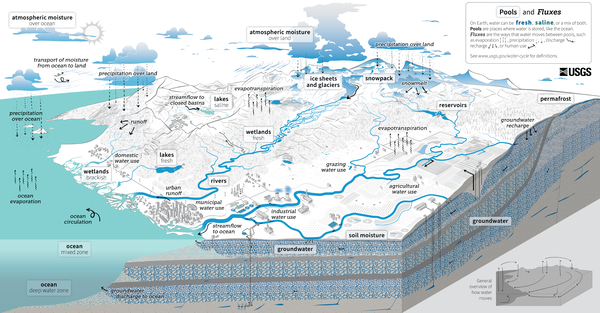
Currently, in my 8th grade science classroom in Bremen, Indiana, we are studying kinetic molecular theory. During these lessons, students engage with the USGS water cycle diagram to connect molecular chemistry with environmental processes. Students annotate the diagram by marking fluxes like evaporation, condensation, evapotranspiration, and snowmelt to show precisely where water molecules are absorbing or releasing kinetic energy and where thermal energy increases or decreases. For example, as solar radiation heats liquid water at the ocean surface, molecules gain both kinetic and thermal energy and undergo a phase change into vapor. In contrast, condensation corresponds to a molecular decrease in thermal and kinetic energy. Students can also note that phase changes require or release latent heat, so even when temperature seems constant, energy is being absorbed or emitted in the molecular structure. Lessons like annotating the USGS water cycle diagram to trace molecular energy changes serve as a stepping-stone in helping students understand how energy is stored and transferred in molecular bonds later in a deeper study of climate change and the role of energy in driving Earth’s systems.
This goes beyond science mechanics as the diagram also shows human‐mediated fluxes and altered pools like diverted rivers, groundwater extraction, dam reservoir storage, and pollution runoff. These give students entry points into pressing local and global issues. Students are introduced to how water quantity and quality are shifting under climate change and how melting glaciers, changing precipitation patterns, or overuse of groundwater migrate people, affect agriculture, or damage ecosystems. When students see beyond the chemistry of molecular interactions and begin to understand how geography and human choices alter water cycles, they begin to feel their role. If we help students see the interconnections between nature and people, then global challenges can be framed not only in terms of risk, but also in terms of promise and hope. Students are empowered to recognize their agency by conserving water, advocating for equitable water policy, and restoring watershed health. They begin to see themselves as part of solutions that reach beyond their immediate context, bridging chemistry and society.
Samantha Willsey