



FAQ
So, you say the water from your faucet smells like rotten eggs? Maybe you wonder how water gets to your house way up on that hilltop or would like to know why your pond is full of slimy green algae. Hopefully, this FAQ page can supply you with some answers.
-

What is the Earth's "water cycle?" What is the Earth's "water cycle?"
The water cycle, also known as the hydrologic cycle, describes where water is stored on Earth and how it moves. Water is stored in the atmosphere, on the land surface, and below the ground. It can be a liquid, a solid, or a gas. Liquid water can be fresh or saline (salty). Water moves between the places it is stored. It moves at large scales (through watersheds, the atmosphere, and below the Earth...

How much of the Earth's water is stored in glaciers? How much of the Earth's water is stored in glaciers?
About 2.1% of all of Earth's water is frozen in glaciers. 97.2% is in the oceans and inland seas 2.1% is in glaciers 0.6% is in groundwater and soil moisture less than 1% is in the atmosphere less than 1% is in lakes and rivers less than 1% is in all living plants and animals. About three-quarters of Earth's freshwater is stored in glaciers. Therefore, glacier ice is the second largest reservoir...

How important is groundwater? How important is groundwater?
Groundwater, which is in aquifers below the surface of the Earth, is one of the Nation's most important natural resources. Groundwater is the source of about 37 percent of the water that county and city water departments supply to households and businesses (public supply). It provides drinking water for more than 90 percent of the rural population who do not get their water delivered to them from...

What can cause our water to have an earthy odor or to smell like rotten eggs? What can cause our water to have an earthy odor or to smell like rotten eggs?
Naturally-occurring organic compounds are created when plant material decays in lakes and reservoirs. Those organic compounds frequently cause musty, earthy odors, especially toward the end of summer. The odors can be objectionable, but generally are not harmful to health. However, odors can be caused by other constituents as well, so you might want to call your local Health Department and mention...

What determines if a well will go dry? What determines if a well will go dry?
A well is said to have gone dry when water levels drop below a pump intake. This does not mean that a dry well will never have water in it again, as the water level may come back through time as recharge increases. The water level in a well depends on a number of things, such as the depth of the well, the type (confined or unconfined) of aquifer the well taps, the amount of pumping that occurs in...

Where can I get my well water tested? Where can I get my well water tested?
Some counties offer free well water testing, so check with your county first. If they don't, use this EPA website to find a list of state-certified laboratories in your area that do water testing, or contact your county or state health department or your State Certification Officer for assistance. Prices will vary depending on the laboratory and the test(s), but most people consider the cost to be...

We had a "100-year flood" two years in a row. How can that be? We had a "100-year flood" two years in a row. How can that be?
The term "100-year flood" is used to describe the recurrence interval of floods. The 100-year recurrence interval means that a flood of that magnitude has a one percent chance of occurring in any given year. In other words, the chances that a river will flow as high as the 100-year flood stage this year is 1 in 100. Statistically, each year begins with the same 1-percent chance that a 100-year...

Why do the values for the 100-year flood seem to change with every flood? Why do the values for the 100-year flood seem to change with every flood?
The amount of water corresponding to a 100-year flood, a 500-year flood, or a 1,000-year flood is known as a "flood quantile." For instance, on a given river, the flood quantile corresponding to the 50-year flood might be 10,000 cubic feet per second (cfs) and the flood quantile corresponding to the 100-year flood might be 15,000 cfs. The estimates of the flood quantiles are calculated using...

What does the term "stream stage" mean? What does the term "stream stage" mean?
Stream stage (aka gage height) is an important concept when analyzing how much water is moving in a stream at any given moment. "Stage" is the water level above some arbitrary point in the river and is commonly measured in feet. For example, on a normal day when no rain has fallen for a while, a river might have a stage of 2 feet. If a big storm hits, the river stage could rise to 15 or 20 feet...

If the ground filters water, is groundwater always clean? If the ground filters water, is groundwater always clean?
Water drawn from a well was once precipitation that fell onto Earth's surface. It seeped into the ground and, over time, occupied the porous space in some subsurface material. Big particles that are in surface streams, such as leaf chunks, will not be seen in groundwater. So, yes, big particles are filtered out by the ground, along with some minerals and chemicals that are too small to see...

Why does my drinking water look cloudy sometimes? Why does my drinking water look cloudy sometimes?
Once in a while you get a glass of water that looks cloudy; maybe milky is a better term. After a few seconds it miraculously clears up! The cloudiness is due to tiny air bubbles in the water. Like any bubbles, the air rises to the top of the water and goes into the air, clearing up the water. The water in the pipes coming into your house might be under a bit of pressure. This causes gases (air)...

What can be causing our drinking water to have a reddish color? What can be causing our drinking water to have a reddish color?
Your water might be affected by iron, which is a commonly-occurring constituent of drinking water. Iron tends to add a rusty, reddish-brown (or sometimes yellow) color to water. If the color is more black than red, your water might contain a combination of iron and manganese. Both of these metals can cause staining of plumbing fixtures, porcelain sinks, or laundry, but they are not known to cause...

Where can I find information about my local drinking water supply? Where can I find information about my local drinking water supply?
The best way to learn about your local drinking water quality is to read the annual drinking water quality report/consumer confidence report that water suppliers now send out by July 1 of each year. The reports are often sent out with water bills, but they may be sent separately. The reports tell where drinking water comes from, what contaminants are in it, and at what levels. The U.S...

How much water is used by people in the United States? How much water is used by people in the United States?
Since 1950, the USGS has collected and analyzed water-use data for the United States and its Territories. That data is revised every 5 years. As of 2015, the United States uses 322 billion gallons of water per day (Bgal/day). The three largest water-use categories were irrigation (118 Bgal/day), thermoelectric power (133 Bgal/day), and public supply (39 Bgal/day), cumulatively accounting for 90...

What is the difference between "mountain", "hill", and "peak"; "lake" and "pond"; or "river" and "creek?" What is the difference between "mountain", "hill", and "peak"; "lake" and "pond"; or "river" and "creek?"
There are no official definitions for generic terms as applied to geographic features. The Geographic Names Information System (GNIS) utilizes 43 broad categories of feature classes defined solely to facilitate retrieval of entries with similar characteristics. Go to GNIS Domestic Names Feature Classes to see the full list. These categories generally match dictionary definitions, but not always...

What is a sinkhole? What is a sinkhole?
A sinkhole is a depression in the ground that has no natural external surface drainage. Basically, this means that when it rains, all of the water stays inside the sinkhole and typically drains into the subsurface. Sinkholes are most common in what geologists call, “ karst terrain.” These are regions where the types of rock below the land surface can naturally be dissolved by groundwater...

What is the difference between a sinkhole and a pothole? What is the difference between a sinkhole and a pothole?
A sinkhole is a closed natural depression in the ground surface caused by removal of material below the ground and either collapse or gradual subsidence of the surface into the resulting void. A pothole is usually a fairly small feature caused by failure of paving materials, usually associated with roads, parking lots, and airports. In the colder parts of the country, potholes become more abundant...

What is the difference between a sinkhole and land subsidence? What is the difference between a sinkhole and land subsidence?
Sinkholes are just one of many forms of ground collapse, or subsidence. Land subsidence is a gradual settling or sudden sinking of the Earth’s surface owing to subsurface movement of earth materials. The principal causes of land subsidence are aquifer-system compaction, drainage of organic soils, underground mining, hydrocompaction, natural compaction, sinkholes, and thawing permafrost. Land...

How many sinkholes open up in a year? How many sinkholes open up in a year?
There is no database of sinkhole collapses for the United States, so these data are unavailable. Some individual state geologic surveys track reported collapses within their state. Many sinkhole collapses are not reported to authorities or news organizations, and many occur in rural areas where they are unobserved. Learn more: USGS Water Science School - Sinkholes Karst Map of the Conterminous...

What is the largest sinkhole in the United States? What is the largest sinkhole in the United States?
There are some very large, ancient, ‘inactive’ sinkholes in some areas of the U.S. that are thousands of years old. Alabama claims to have the largest recent collapse sinkhole. It is called the “Golly Hole” and is located in Shelby County in the central part of the state. It collapsed suddenly in 1972. The sinkhole is about 325 feet long, 300 feet wide, and 120 feet deep. Learn more: USGS Water...

Why are some lakes full of algae and thick plants? Why are some lakes full of algae and thick plants?
Plants naturally grow in and around lakes, but sometimes lakes and ponds can get an overgrowth of plants, algae, or bacteria. In many cases, humans are responsible. Chemicals that are used on lawns and in agriculture (like nitrogen and potassium) wash into our water systems. Once there, plants and algae have a feast on this “food.” Sometimes overgrowths of cyanobacteria (called “blooms”) can make...

Why does it take so long to rinse the soap off my hands? What are hard water and soft water? Why does it take so long to rinse the soap off my hands? What are hard water and soft water?
Water is said to be soft if it has a low concentration of calcium and magnesium ions in it, while hard water has a high concentration of calcium and magnesium. The minerals in hard water often react with most soaps to create a "soap scum," which is an insoluble substance that can temporarily adhere to your hands or the shower walls. When using hard water, you may have a harder time working your...

Is saline water used for anything? Is saline water used for anything?
In the U.S., about 13 percent of all water used is saline water. But saline water can only be used for certain purposes. The main use is for thermoelectric power-plant cooling. About 5 percent of water used for industrial purposes is saline, and about 53 percent of all water used for mining purposes is saline. Saline water can be desalinated for use as drinking water by putting it through a...

What is a 1,000-year flood? What is a 1,000-year flood?
The term “1,000-year flood” means that, statistically speaking, a flood of that magnitude (or greater) has a 1 in 1,000 chance of occurring in any given year. In terms of probability, the 1,000-year flood has a 0.1% chance of happening in any given year. These statistical values are based on observed data.

How can a 1,000-year rainfall not result in a 1,000-year flood? How can a 1,000-year rainfall not result in a 1,000-year flood?
It comes down to a number of factors, including the pattern of movement of the rainstorm in each particular watershed, the conditions of the soil and plant matter in the watershed, and the timing of the rainstorm in one watershed versus other watersheds. For example, if the ground is already saturated before a rainstorm, much of the rain will run off into streams, but if the ground is dry, it will...

Does an increase in the 100-year flood estimate originate from climate or land-use change? Does an increase in the 100-year flood estimate originate from climate or land-use change?
Climate variability (dry cycles to wet cycles) and land-use change play a significant role, but there is a large amount of uncertainty around the flood quantile estimates (the value of discharge corresponding to the 100-year flood), particularly if there isn’t a long record of observed data at a stream location. Learn more: The 100-Year Flood The 100-Year Flood--It's All About Chance

What is a reach? What is a reach?
“Reach” can have slightly different meanings, depending on how it is used. A reach is a section of a stream or river along which similar hydrologic conditions exist, such as discharge, depth, area, and slope. It can also be the length of a stream or river (with varying conditions) between two streamgages, or a length of river for which the characteristics are well described by readings at a single...

How is the salinity of Great Salt Lake measured? How is the salinity of Great Salt Lake measured?
The salinity of Great Salt Lake is measured by taking specific gravity and temperature measurements and comparing them to standardized values reported in a table. Specific gravity is measured in the field by testing a water sample with a device very similar to a battery or antifreeze tester. Learn more: Water-Resources Investigations Report for Great Salt Lake, Utah

Is there a way to get alerts about streamflow conditions? Is there a way to get alerts about streamflow conditions?
Yes! The U.S. Geological Survey WaterAlert service provides notifications to your email or phone for changes in water conditions based on thresholds you choose.

Why does the USGS use the spelling "gage" instead of "gauge"? Why does the USGS use the spelling "gage" instead of "gauge"?
The spelling of “gage” is part of our very rich USGS history. We have used that spelling for over a hundred years. In 1888, USGS Director John Wesley Powell met a very forward-thinking graduate student named Frederick Haynes Newell. Powell was so impressed that he made Newell the first full-time appointee to the new Irrigation Survey, which was created to investigate the potential for dams and...

How is a rating curve used to convert gage height into streamflow? How is a rating curve used to convert gage height into streamflow?
In order to convert gage height (or "stage", usually expressed as feet) into streamflow (or "discharge", usually expressed as cubic feet per second), USGS hydrographers must establish a relationship between them. This stage-discharge relationship is called a rating curve. It’s developed by making frequent manual discrete discharge measurements at stream gaging stations. The rating curve depends on...

How can I obtain river forecasts (flood forecasts)? How can I obtain river forecasts (flood forecasts)?
River forecasts (flood forecasts) are made by the National Weather Service - National Water Prediction Service. The overall map on the website uses color designations to give a quick overview of current conditions. A legend and other information can be selected in the right column. From the main map, click on a station to bring up a box which includes a graph showing current information and a...

Where can I find detailed sampling methods for surface water and groundwater? Where can I find detailed sampling methods for surface water and groundwater?
The National Field Manual for the Collection of Water-Quality Data (National Field Manual) provides guidelines and standard procedures for USGS personnel who collect data used to assess the quality of the Nation’s surface water and groundwater resources. The manual is published as separate chapters. Learn more: Techniques of Water-Resources Investigations Reports

Where can I find flood maps? Where can I find flood maps?
FEMA is the official public source for flood maps for insurance purposes: FEMA’s Flood Map Service Center FEMA’s National Flood Hazard Layer NOAA is responsible for producing flood forecast maps that combine precipitation data with USGS streamflow data: NWS - National Water Prediction Service: River forecasts and long range flood outlook Coastal Inundation Dashboard: Real-time and historical...

How are floods predicted? How are floods predicted?
Flood predictions require several types of data: The amount of rainfall occurring on a real-time basis. The rate of change in river stage on a real-time basis, which can help indicate the severity and immediacy of the threat. Knowledge about the type of storm producing the moisture, such as duration, intensity and areal extent, which can be valuable for determining possible severity of the...

What is the difference between a confined and an unconfined (water table) aquifer? What is the difference between a confined and an unconfined (water table) aquifer?
A confined aquifer is an aquifer below the land surface that is saturated with water. Layers of impermeable material are both above and below the aquifer, causing it to be under pressure so that when the aquifer is penetrated by a well, the water will rise above the top of the aquifer. A water table--or unconfined--aquifer is an aquifer whose upper water surface (water table) is at atmospheric...

Why doesn't a drought end when it rains? Why doesn't a drought end when it rains?
Rainfall in any form will provide some drought relief. A good analogy might be how medicine and illness relate to each other. A single dose of medicine can alleviate symptoms of illness, but it usually takes a sustained program of medication to cure an illness. Likewise, a single rainstorm will not break the drought, but it might provide temporary relief. A light to moderate shower will probably...

What is groundwater? What is groundwater?
Groundwater is water that can be found under the Earth’s surface, in the ground. Some people think groundwater is like a large lake or river underground, but that isn’t the case. Groundwater is more like the liquid trapped in a sponge, or the liquid in a glass of ice water. When permeable layers of rock, sand, or gravel store and transmit enough groundwater to provide usable quantities to wells...

When does a drought begin and end? When does a drought begin and end?
The beginning of a drought is difficult to determine. Several weeks, months, or even years might pass before people know that a drought is occurring. The end of a drought can occur as gradually as it began. The first evidence of drought is usually seen in records of rainfall. Within a short period of time, the amount of moisture in soils can begin to decrease. The effects of a drought on flow in...
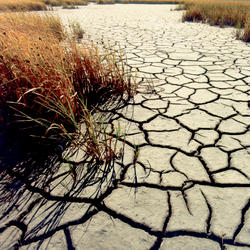
What causes drought? What causes drought?
A drought is a period of drier-than-normal conditions that results in water-related problems. The amount of precipitation at a particular location varies from year to year, but over a period of years the average amount is fairly constant. In the deserts of the Southwest, the average precipitation is less than 3 inches per year. In contrast, the average precipitation in the Northwest is more than...

What are the two types of floods? What are the two types of floods?
There are two basic types of floods: flash floods and the more widespread river floods. Flash floods generally cause greater loss of life and river floods generally cause greater loss of property. A flash flood occurs when runoff from excessive rainfall causes a rapid rise in the water height (stage) of a stream or normally-dry channel. Flash floods are more common in areas with a dry climate and...

Does the use of pesticides affect our Nation's water quality? Does the use of pesticides affect our Nation's water quality?
Pesticide use in the United States has increased because not only must we supply our exploding population with food, but crops and food are also grown for export to other countries. The United States has become the largest producer of food products in the world, partly owing to our use of modern chemicals (pesticides) to control the insects, weeds, and other organisms that attack food crops. But...

How frequently are volatile organic compounds (VOCs) detected in groundwater? How frequently are volatile organic compounds (VOCs) detected in groundwater?
Volatile organic compounds (VOCs) are chemicals used to make everyday products, including refrigerants, plastics, adhesives, paints, and petroleum products. USGS has monitored VOCs and other groundwater contaminants since the late 1980s. VOCs can get into groundwater through spills, leaks, or through improper waste disposal. They are most often found in shallow groundwater beneath urban areas. The...

How does acid precipitation affect marble and limestone buildings? How does acid precipitation affect marble and limestone buildings?
When sulfurous, sulfuric, and nitric acids in polluted air and rain react with the calcite in marble and limestone, the calcite dissolves. In exposed areas of buildings and statues, we see roughened surfaces, removal of material, and loss of carved details. Stone surface material may be lost all over or only in spots that are more reactive. You might expect that sheltered areas of stone buildings...

What is methane and why is it a safety concern? What is methane and why is it a safety concern?
Methane (a gas composed of carbon and hydrogen) is produced two ways: Through biologic decomposition of organic matter at shallow depths. Swamps, landfills, and even shallow bedrock are some settings where this occurs. Methane can also be derived over millions of years by high pressure and high temperature processes that produce fossil fuels deep underground. Examples include coal deposits and oil...