



The sampling team at Chandler Lake, Gates of the Arctic National Park, walk along the shoreline to a new angling location. While treated to beautiful views, field biologists fished for lake trout (Salvelinus namaycush) as part of a study investigating the biomagnification of mercury through lake food webs.
Images
Browse images from a wide range of science topics covered by USGS. All items in this gallery are considered public domain unless otherwise noted.
Filter Total Items: 1611

Chandler Lake fishing
The sampling team at Chandler Lake, Gates of the Arctic National Park, walk along the shoreline to a new angling location. While treated to beautiful views, field biologists fished for lake trout (Salvelinus namaycush) as part of a study investigating the biomagnification of mercury through lake food webs.

Netleaf willow
Summer photo of Salix reticulata in the USFWS Arctic National Wildlife Refuge, a forage species commonly consumed by barren-ground caribou. The bright red bulbs on the right leaf are not berries, but galls, likely caused by bacteria, fungi, or insects.
Summer photo of Salix reticulata in the USFWS Arctic National Wildlife Refuge, a forage species commonly consumed by barren-ground caribou. The bright red bulbs on the right leaf are not berries, but galls, likely caused by bacteria, fungi, or insects.

Arctic sweet coltsfoot
The dominant plant in the photo is Arctic sweet coltsfoot (Petasides frigidus), a forage species commonly consumed by barren-ground caribou during the summer in the USFWS Arctic National Wildlife Refuge.
The dominant plant in the photo is Arctic sweet coltsfoot (Petasides frigidus), a forage species commonly consumed by barren-ground caribou during the summer in the USFWS Arctic National Wildlife Refuge.

Diamond-leaf willow
Summer photo of diamond-leaf willow (Salix pulchra) in the USFWS Arctic National Wildlife Refuge, a forage species commonly consumed by barren-ground caribou.
Summer photo of diamond-leaf willow (Salix pulchra) in the USFWS Arctic National Wildlife Refuge, a forage species commonly consumed by barren-ground caribou.
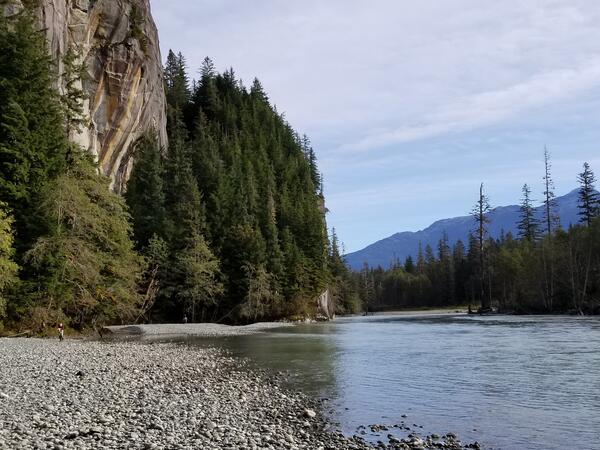
Unuk River Streamgage
USGS Staff at the Unuk River Streamgage in Southeast Alaska. The Unuk River is the second smallest watershed in the transboundary study of Southeast Alaska, but has three large mining projects in development (Kerr-Sulplherets-Mitchell (KSM), Brucejack, and Eskay Creek)
USGS Staff at the Unuk River Streamgage in Southeast Alaska. The Unuk River is the second smallest watershed in the transboundary study of Southeast Alaska, but has three large mining projects in development (Kerr-Sulplherets-Mitchell (KSM), Brucejack, and Eskay Creek)

Walrus group on sea ice in the Chukchi Sea
Pacific walrus group hauled-out on sea ice in the Chukchi Sea. The photo was captured during a survey of the age structure of the population to evaluate population status. Observers assign each animal in a group to an age/sex category according to published criteria. USFWS Permit No. 33776D.
Pacific walrus group hauled-out on sea ice in the Chukchi Sea. The photo was captured during a survey of the age structure of the population to evaluate population status. Observers assign each animal in a group to an age/sex category according to published criteria. USFWS Permit No. 33776D.

Pacific walrus group hauled-out on sea ice in the Chukchi Sea.
Pacific walrus group hauled-out on sea ice in the Chukchi Sea.Pacific walrus group hauled-out on sea ice in the Chukchi Sea. The photo was captured during a survey of the age structure of the population to evaluate population status. Observers assign each animal in a group to an age/sex category according to published criteria. USFWS Permit No. 33776D.
Pacific walrus group hauled-out on sea ice in the Chukchi Sea.
Pacific walrus group hauled-out on sea ice in the Chukchi Sea.Pacific walrus group hauled-out on sea ice in the Chukchi Sea. The photo was captured during a survey of the age structure of the population to evaluate population status. Observers assign each animal in a group to an age/sex category according to published criteria. USFWS Permit No. 33776D.

Chelle Lake trout collection
A biologist samples lake trout (Salvelinus namaycush) tissues. This fish, captured in Chelle Lake within Wrangell-St. Elias National Park, is part of a study investigating the biomagnification of mercury through lake food webs. Mount Drum rises above the hills to the southeast.
A biologist samples lake trout (Salvelinus namaycush) tissues. This fish, captured in Chelle Lake within Wrangell-St. Elias National Park, is part of a study investigating the biomagnification of mercury through lake food webs. Mount Drum rises above the hills to the southeast.

Clear Creek
Scientists collecting a 1/5 yard composite sample in blue 5-gallon buckets from gold placer tailings to analyze for critical mineral contents in Clear Creek, in the Zane Hills north central Alaska.
Scientists collecting a 1/5 yard composite sample in blue 5-gallon buckets from gold placer tailings to analyze for critical mineral contents in Clear Creek, in the Zane Hills north central Alaska.
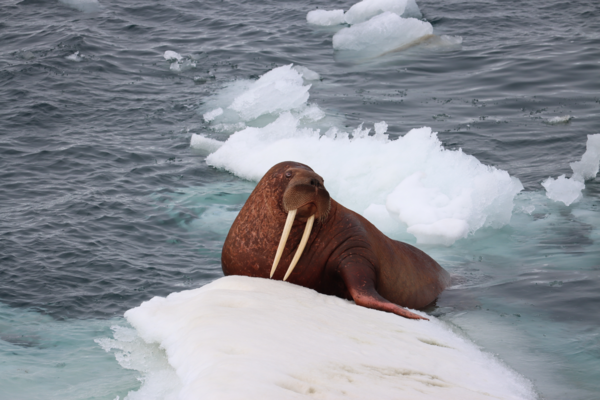
Adult female Pacific walrus sliding into the water
Adult female Pacific walrus sliding into the waterAn adult female Pacific walrus slides into the water as she assesses her surroundings. The female is 15 years or older based on the length of the tusks. USGS and the U.S.
Adult female Pacific walrus sliding into the water
Adult female Pacific walrus sliding into the waterAn adult female Pacific walrus slides into the water as she assesses her surroundings. The female is 15 years or older based on the length of the tusks. USGS and the U.S.
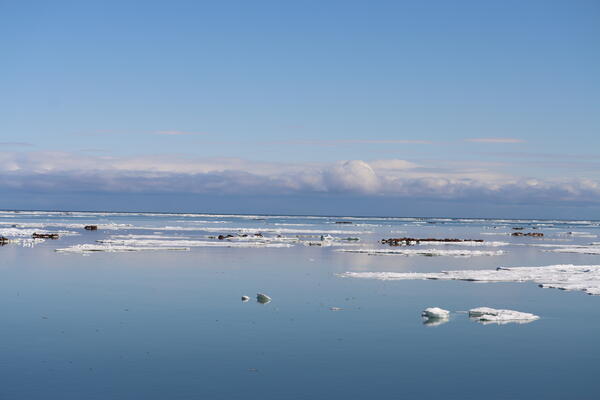
Walruses everywhere
Walrus groups hauled on sea ice as far as the eye can see in the Chukchi Sea. USGS and the U.S.
Walrus groups hauled on sea ice as far as the eye can see in the Chukchi Sea. USGS and the U.S.
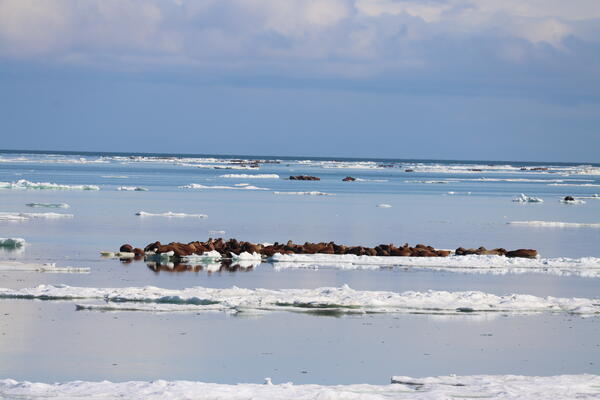
A large and noisy walrus group amidst an aggregation of groups
A large and noisy walrus group amidst an aggregation of groupsAlarge, active, and noisy walrus group hauled on sea ice in the Chukchi Sea. USGS and the U.S.
A large and noisy walrus group amidst an aggregation of groups
A large and noisy walrus group amidst an aggregation of groupsAlarge, active, and noisy walrus group hauled on sea ice in the Chukchi Sea. USGS and the U.S.

Observers onboard the R/V Norseman II
Amanda Herbert (foreground) and Ami Everett onboard the R/V Norseman II. Amanda and Ami are on top of the wheelhouse of the ship to observe groups of Pacific walrus hauled-out on sea ice. Observers assign each animal in a group to an age/sex category according to published criteria.
Amanda Herbert (foreground) and Ami Everett onboard the R/V Norseman II. Amanda and Ami are on top of the wheelhouse of the ship to observe groups of Pacific walrus hauled-out on sea ice. Observers assign each animal in a group to an age/sex category according to published criteria.
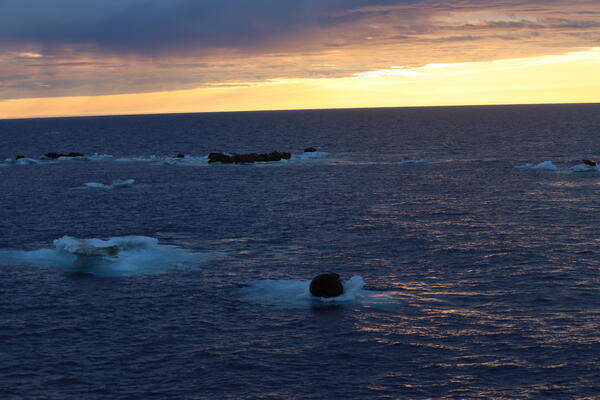
Arctic sunrise over resting walruses
A dim light shines during the summer Arctic morning in the Chukchi Sea as groups of Pacific walruses rest. USGS and the U.S.
A dim light shines during the summer Arctic morning in the Chukchi Sea as groups of Pacific walruses rest. USGS and the U.S.

Team members on the RV Norseman II
From left: Joshua Carpenter (USGS volunteer), William Beatty (USGS research wildlife biologist), Caroline Cummings (USGS volunteer), Amanda Herbert (USGS biological science technician), and Ami Everett (USGS biological science technician) conducting Pacific walrus age structure surveys from the RV Norseman II. The team observed walruses hau
From left: Joshua Carpenter (USGS volunteer), William Beatty (USGS research wildlife biologist), Caroline Cummings (USGS volunteer), Amanda Herbert (USGS biological science technician), and Ami Everett (USGS biological science technician) conducting Pacific walrus age structure surveys from the RV Norseman II. The team observed walruses hau

USGS team members on the RV Norseman II
From left: Joshua Carpenter (USGS volunteer), Ami Everett (USGS biological science technician), Amanda Herbert (USGS biological science technician), and Caroline Cummings (USGS volunteer) conducting Pacific walrus age structure surveys from the RV Norseman II.
From left: Joshua Carpenter (USGS volunteer), Ami Everett (USGS biological science technician), Amanda Herbert (USGS biological science technician), and Caroline Cummings (USGS volunteer) conducting Pacific walrus age structure surveys from the RV Norseman II.
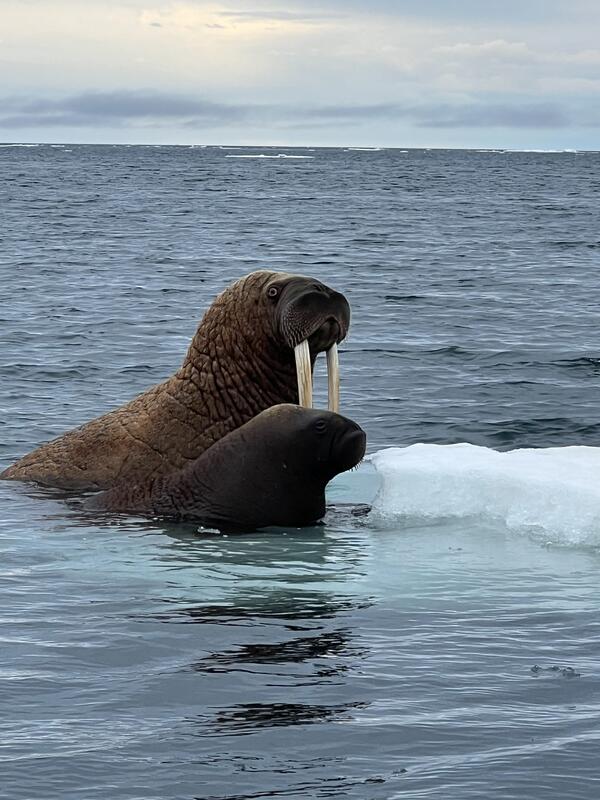
Adult female walrus and one-year old young
An adult female walrus with a one-year old offspring. USGS and the U.S.
An adult female walrus with a one-year old offspring. USGS and the U.S.

Nine pacific walruses hauled out on sea ice in the Chukchi Sea
Nine pacific walruses hauled out on sea ice in the Chukchi SeaPacific walrus group hauled-out on sea ice in the Chukchi Sea. The photo was captured during a survey of the age structure of the population to evaluate population status. Observers assign each animal in a group to an age/sex category according to published criteria. USFWS Permit No. 33776D.
Nine pacific walruses hauled out on sea ice in the Chukchi Sea
Nine pacific walruses hauled out on sea ice in the Chukchi SeaPacific walrus group hauled-out on sea ice in the Chukchi Sea. The photo was captured during a survey of the age structure of the population to evaluate population status. Observers assign each animal in a group to an age/sex category according to published criteria. USFWS Permit No. 33776D.
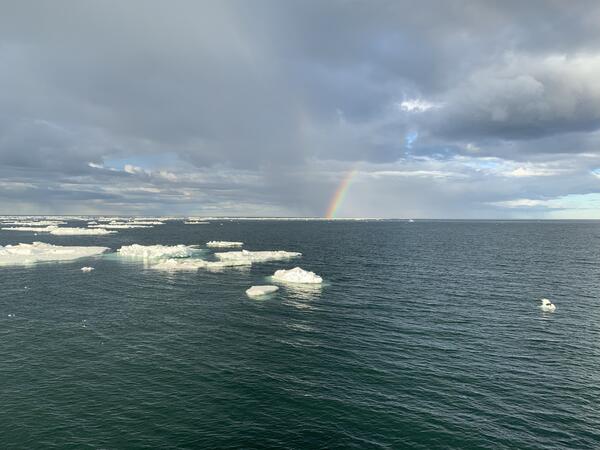
Arctic rainbow over sea ice in the Chukchi Sea
A rainbow emerges from an evening shower in the Chukchi Sea. USGS and the U.S.
A rainbow emerges from an evening shower in the Chukchi Sea. USGS and the U.S.

An orange tributary mixing into the pristine Kugururok River
An orange tributary mixing into the pristine Kugururok RiverOrange streams are increasingly common in the Brooks Range of northern Alaska. The orange stream color reflects oxidized iron, but also often indicates elevated heavy metal concentrations. Our ongoing study aims to document these occurrences and the timing of their onset.
An orange tributary mixing into the pristine Kugururok River
An orange tributary mixing into the pristine Kugururok RiverOrange streams are increasingly common in the Brooks Range of northern Alaska. The orange stream color reflects oxidized iron, but also often indicates elevated heavy metal concentrations. Our ongoing study aims to document these occurrences and the timing of their onset.

Orange water from a tributary of the Kugururok River
Orange water from a tributary of the Kugururok RiverOrange streams are increasingly common in the Brooks Range of northern Alaska. The orange stream color reflects oxidized iron, but also often indicates elevated heavy metal concentrations. Our ongoing study aims to document these occurrences and the timing of their onset.
Orange water from a tributary of the Kugururok River
Orange water from a tributary of the Kugururok RiverOrange streams are increasingly common in the Brooks Range of northern Alaska. The orange stream color reflects oxidized iron, but also often indicates elevated heavy metal concentrations. Our ongoing study aims to document these occurrences and the timing of their onset.