An official website of the United States government
Here's how you know
Official websites use .gov
A .gov website belongs to an official government organization in the United States.
Secure .gov websites use HTTPS
A lock () or https:// means you’ve safely connected to the .gov website. Share sensitive information only on official, secure websites.
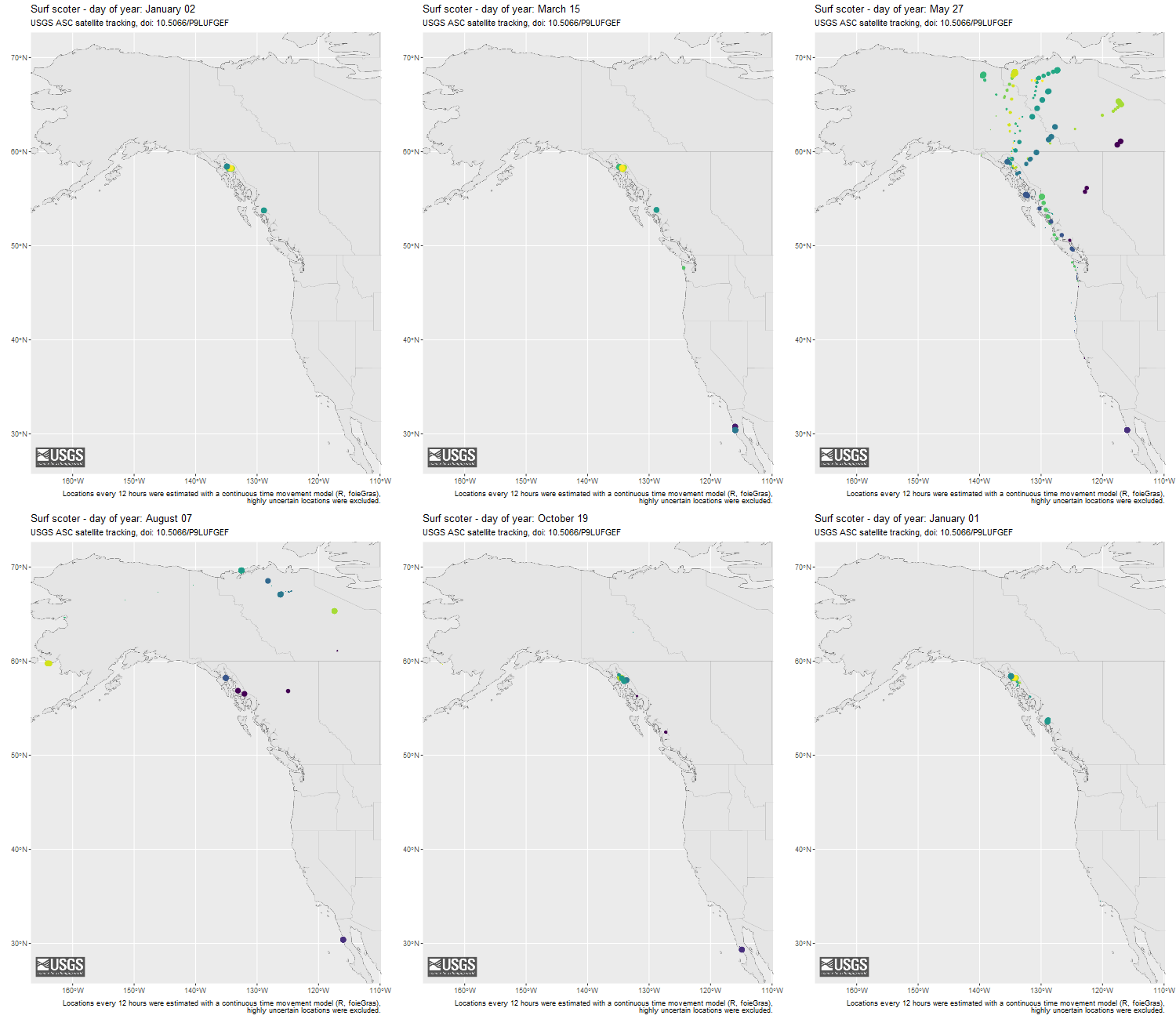
Available here are tracking data of Surf Scoter, a duck species that breeds throughout higher latitudes of Alaska and Canada and winters along coastal areas of North America. These data were collected to better understand the timing and patterns of migratory movements between breeding and wintering areas.
Male Surf Scoter.(Credit: Dan Esler, USGS. Public domain.)
USGS Alaska Science Center scientists collect data from wildlife tracking devices to: determine locations of animals throughout their annual cycles, understand patterns of habitat use, quantify time spent on various behaviors, and identify geographic areas repeatedly used by wildlife that may indicate sites of importance to species and populations. Tracking data from other wildlife species can be found at: https://doi.org/10.5066/P9VYSWEH
Note: These maps serve only as a depiction of the geographic content of the specific data provided and may be inappropriate for inferences and interpretation outside the intent of the original study. For example, maps may portray only certain ages, sexes, limited numbers of animals or variable tracking duration and start times that may limit inference for other questions. Users are advised to read the publication(s) and data set metadata associated with these maps to understand appropriate use and data limitations.
Data Packages
Argos Satellite Telemetry Data
These data packages contain the data collected from satellite transmitters attached to free-ranging animals. The packages include both raw and processed location and sensor data. The raw data includes data as originally retrieved from the Argos System. The processed data have been filtered for location plausibility, and sensor data have been decoded into standard measurement units. For most users, the processed data will be preferred.
NOTE: Processed data contains both plausible (DAF_Filter=0) and implausible (DAF_Filter=1) locations as indicated by the column “Location_DAF_filter”. Before using these data, we recommend excluding locations flagged as implausible or apply an alternative filtering method of your choice.
Ward, D.H., Esler, D., Boyd, W.S., Douglas, D.C., 2020, Tracking data for Surf Scoters (Melanitta perspicillata) (ver 1.0, March 2020): U.S. Geological Survey data release, https://doi.org/10.5066/P9LUFGEF
Below are other science projects associated with Surf Scoter.
Scientists at the USGS Alaska Science Center have conducted research on waterfowl species (ducks, geese, and swans) in Alaska since the 1970s. Because Alaska is an international crossroads of migratory bird flyways, with millions of birds from Asia and North America breeding in Alaska each summer, USGS research has also taken place in adjacent countries (Russia, Japan, Canada, Mexico) and in the...
Scientists at the USGS Alaska Science Center have conducted research on waterfowl species (ducks, geese, and swans) in Alaska since the 1970s. Because Alaska is an international crossroads of migratory bird flyways, with millions of birds from Asia and North America breeding in Alaska each summer, USGS research has also taken place in adjacent countries (Russia, Japan, Canada, Mexico) and in the...
USGS research on sea ducks is designed to anticipate and address priority information needs of management agencies. Additionally, work is focused on individual species biology, migration and population status and trends because until recently, very little was known about sea ducks in Alaska.
USGS research on sea ducks is designed to anticipate and address priority information needs of management agencies. Additionally, work is focused on individual species biology, migration and population status and trends because until recently, very little was known about sea ducks in Alaska.
Understanding the short- and long-distance movements of wildlife is critical for a wide variety of ecological research studies and management decisions. Since the mid-1980s, the USGS Alaska Science Center has collected data from wildlife tracking devices to: determine locations of animals throughout their annual cycles, understand patterns of habitat use, quantify time spent on various...
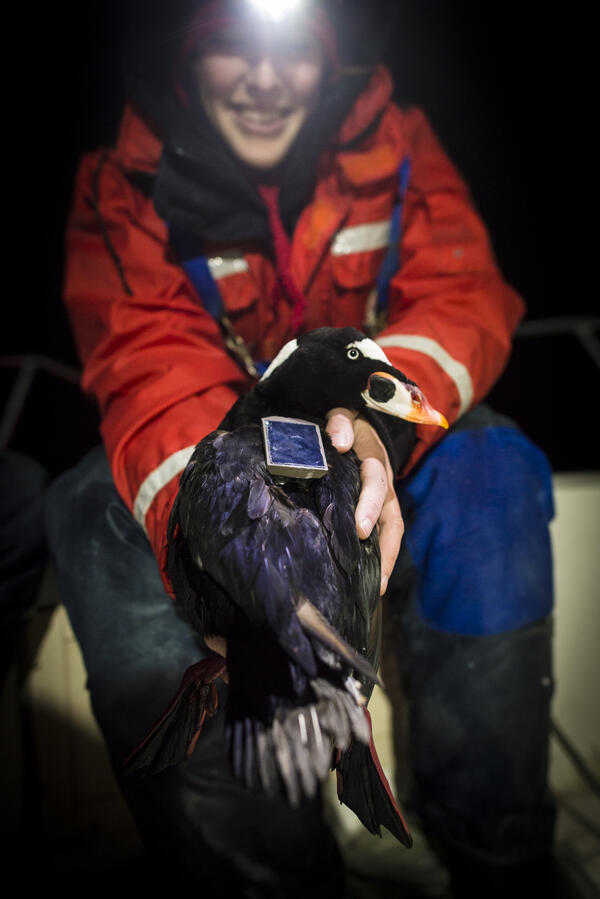
USGS scientist holds a surf scoter that has been tagged.
USGS scientist Sarah Fitzgerald holds a surf scoter that has been fitted with a satellite tag that works by transmitting the location of the birds to satellites that are orbiting the Earth. (Jonathan Fiely, USGS)
USGS scientist Sarah Fitzgerald holds a surf scoter that has been fitted with a satellite tag that works by transmitting the location of the birds to satellites that are orbiting the Earth. (Jonathan Fiely, USGS)
North American sea ducks generally breed in mid- to northern-latitude regions and nearly all rely upon marine habitats for much of their annual cycle. Most sea duck species remained poorly studied until the 1990s when declines were noted in several species and populations. Subsequent research, much of which was funded by the Sea Duck Joint Venture, began in the late 1990s with an...
Authors
John M. Pearce, Paul L. Flint, Mary E. Whalen, Sarah A. Sonsthagen, Josh Stiller, Vijay P. Patil, Timothy D. Bowman, Sean Boyd, Shannon S. Badzinski, H.G. Gilchrist, Scott G. Gilliland, Christine Lepage, Pam Loring, Daniel McAuley, Nic McLellan, Jason Osenkowski, Eric T. Reed, Anthony J. Roberts, Myra Robertson, Tom Rothe, David E. Safine, Emily D. Silverman, Kyle A. Spragens
We quantified variation in winter survival of Surf Scoters (Melanitta perspicillata (L., 1758)) across nearly 30° of latitude on the Pacific coast of North America to evaluate potential effects on winter distributions, including observed differential distributions of age and sex classes. We monitored fates of 297 radio-marked Surf Scoters at three study sites: (1) near the northern...
Authors
Brian D. Uher-Koch, Daniel Esler, Samuel A. Iverson, David H. Ward, Sean Boyd, Molly Kirk, Tyler L. Lewis, Corey S. VanStratt, Katherine M. Brodhead, Jerry W. Hupp, Joel A. Schmutz
Surf scoters Melanitta perspicillata are sea ducks that aggregate at spawning events of Pacific herring Clupea pallasi and forage on the eggs, which are deposited in abundance during spring at discrete sites. We evaluated whether migrating scoters followed a ‘silver wave’ of resource availability, analogous to the ‘green wave’ of high-quality foraging conditions that herbivorous...
Authors
Erica K. Lok, Daniel Esler, John Y. Takekawa, Susan E.W. De La Cruz, W. Sean Boyd, David R. Nysewander, Joseph R. Evenson, David H. Ward
Habitat conditions and nutrient reserve levels during spring migration have been suggested as important factors affecting population declines in waterfowl, emphasizing the need to identify key sites used during spring and understand habitat features and resource availability at stopover sites. We used satellite telemetry to identify stopover sites used by surf scoters migrating through...
Authors
Erica K. Lok, Daniel Esler, John Y. Takekawa, S.W. De La Cruz, Boyd W. Sean, D.R. Nysewander, J.R. Evenson, David H. Ward
Understanding interconnectivity among wintering, stopover, and breeding areas of migratory birds is pivotal to discerning how events occurring in each might have a cross-seasonal effect on another. Such information can guide the location and timing of conservation efforts. Thus, we examined spring migration routes, chronology, and stopover use of 85 surf scoters (Melanitta perspicillata...
Authors
Susan E.W. De La Cruz, John Y. Takekawa, M. T. Wilson, D.R. Nysewander, J.R. Evenson, Daniel Esler, W. S. Boyd, David H. Ward
Available here are tracking data of Surf Scoter, a duck species that breeds throughout higher latitudes of Alaska and Canada and winters along coastal areas of North America. These data were collected to better understand the timing and patterns of migratory movements between breeding and wintering areas.
Male Surf Scoter.(Credit: Dan Esler, USGS. Public domain.)
USGS Alaska Science Center scientists collect data from wildlife tracking devices to: determine locations of animals throughout their annual cycles, understand patterns of habitat use, quantify time spent on various behaviors, and identify geographic areas repeatedly used by wildlife that may indicate sites of importance to species and populations. Tracking data from other wildlife species can be found at: https://doi.org/10.5066/P9VYSWEH
Note: These maps serve only as a depiction of the geographic content of the specific data provided and may be inappropriate for inferences and interpretation outside the intent of the original study. For example, maps may portray only certain ages, sexes, limited numbers of animals or variable tracking duration and start times that may limit inference for other questions. Users are advised to read the publication(s) and data set metadata associated with these maps to understand appropriate use and data limitations.
Data Packages
Argos Satellite Telemetry Data
These data packages contain the data collected from satellite transmitters attached to free-ranging animals. The packages include both raw and processed location and sensor data. The raw data includes data as originally retrieved from the Argos System. The processed data have been filtered for location plausibility, and sensor data have been decoded into standard measurement units. For most users, the processed data will be preferred.
NOTE: Processed data contains both plausible (DAF_Filter=0) and implausible (DAF_Filter=1) locations as indicated by the column “Location_DAF_filter”. Before using these data, we recommend excluding locations flagged as implausible or apply an alternative filtering method of your choice.
Ward, D.H., Esler, D., Boyd, W.S., Douglas, D.C., 2020, Tracking data for Surf Scoters (Melanitta perspicillata) (ver 1.0, March 2020): U.S. Geological Survey data release, https://doi.org/10.5066/P9LUFGEF
Below are other science projects associated with Surf Scoter.
Scientists at the USGS Alaska Science Center have conducted research on waterfowl species (ducks, geese, and swans) in Alaska since the 1970s. Because Alaska is an international crossroads of migratory bird flyways, with millions of birds from Asia and North America breeding in Alaska each summer, USGS research has also taken place in adjacent countries (Russia, Japan, Canada, Mexico) and in the...
Scientists at the USGS Alaska Science Center have conducted research on waterfowl species (ducks, geese, and swans) in Alaska since the 1970s. Because Alaska is an international crossroads of migratory bird flyways, with millions of birds from Asia and North America breeding in Alaska each summer, USGS research has also taken place in adjacent countries (Russia, Japan, Canada, Mexico) and in the...
USGS research on sea ducks is designed to anticipate and address priority information needs of management agencies. Additionally, work is focused on individual species biology, migration and population status and trends because until recently, very little was known about sea ducks in Alaska.
USGS research on sea ducks is designed to anticipate and address priority information needs of management agencies. Additionally, work is focused on individual species biology, migration and population status and trends because until recently, very little was known about sea ducks in Alaska.
Understanding the short- and long-distance movements of wildlife is critical for a wide variety of ecological research studies and management decisions. Since the mid-1980s, the USGS Alaska Science Center has collected data from wildlife tracking devices to: determine locations of animals throughout their annual cycles, understand patterns of habitat use, quantify time spent on various...
USGS scientist holds a surf scoter that has been tagged.
USGS scientist Sarah Fitzgerald holds a surf scoter that has been fitted with a satellite tag that works by transmitting the location of the birds to satellites that are orbiting the Earth. (Jonathan Fiely, USGS)
USGS scientist Sarah Fitzgerald holds a surf scoter that has been fitted with a satellite tag that works by transmitting the location of the birds to satellites that are orbiting the Earth. (Jonathan Fiely, USGS)
North American sea ducks generally breed in mid- to northern-latitude regions and nearly all rely upon marine habitats for much of their annual cycle. Most sea duck species remained poorly studied until the 1990s when declines were noted in several species and populations. Subsequent research, much of which was funded by the Sea Duck Joint Venture, began in the late 1990s with an...
Authors
John M. Pearce, Paul L. Flint, Mary E. Whalen, Sarah A. Sonsthagen, Josh Stiller, Vijay P. Patil, Timothy D. Bowman, Sean Boyd, Shannon S. Badzinski, H.G. Gilchrist, Scott G. Gilliland, Christine Lepage, Pam Loring, Daniel McAuley, Nic McLellan, Jason Osenkowski, Eric T. Reed, Anthony J. Roberts, Myra Robertson, Tom Rothe, David E. Safine, Emily D. Silverman, Kyle A. Spragens
We quantified variation in winter survival of Surf Scoters (Melanitta perspicillata (L., 1758)) across nearly 30° of latitude on the Pacific coast of North America to evaluate potential effects on winter distributions, including observed differential distributions of age and sex classes. We monitored fates of 297 radio-marked Surf Scoters at three study sites: (1) near the northern...
Authors
Brian D. Uher-Koch, Daniel Esler, Samuel A. Iverson, David H. Ward, Sean Boyd, Molly Kirk, Tyler L. Lewis, Corey S. VanStratt, Katherine M. Brodhead, Jerry W. Hupp, Joel A. Schmutz
Surf scoters Melanitta perspicillata are sea ducks that aggregate at spawning events of Pacific herring Clupea pallasi and forage on the eggs, which are deposited in abundance during spring at discrete sites. We evaluated whether migrating scoters followed a ‘silver wave’ of resource availability, analogous to the ‘green wave’ of high-quality foraging conditions that herbivorous...
Authors
Erica K. Lok, Daniel Esler, John Y. Takekawa, Susan E.W. De La Cruz, W. Sean Boyd, David R. Nysewander, Joseph R. Evenson, David H. Ward
Habitat conditions and nutrient reserve levels during spring migration have been suggested as important factors affecting population declines in waterfowl, emphasizing the need to identify key sites used during spring and understand habitat features and resource availability at stopover sites. We used satellite telemetry to identify stopover sites used by surf scoters migrating through...
Authors
Erica K. Lok, Daniel Esler, John Y. Takekawa, S.W. De La Cruz, Boyd W. Sean, D.R. Nysewander, J.R. Evenson, David H. Ward
Understanding interconnectivity among wintering, stopover, and breeding areas of migratory birds is pivotal to discerning how events occurring in each might have a cross-seasonal effect on another. Such information can guide the location and timing of conservation efforts. Thus, we examined spring migration routes, chronology, and stopover use of 85 surf scoters (Melanitta perspicillata...
Authors
Susan E.W. De La Cruz, John Y. Takekawa, M. T. Wilson, D.R. Nysewander, J.R. Evenson, Daniel Esler, W. S. Boyd, David H. Ward