



A regional assessment of fish health in the Chesapeake Bay watershed
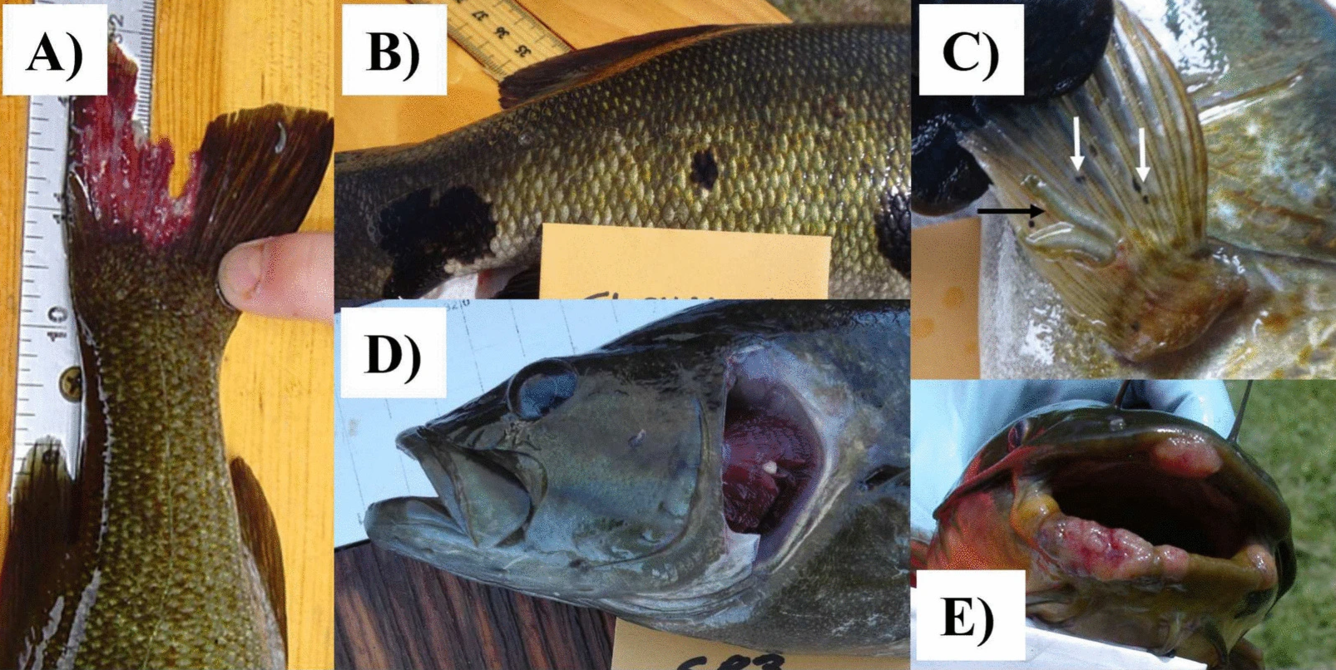
Fish diseases in freshwater ecosystems pose significant ecological and socioeconomic challenges; yet, monitoring them in wild populations is complex due to interactions between pathogens, hosts, and environmental conditions. External DELT (deformity, erosion, lesion, tumor, and parasite) data (fig. 1) provide a rapid and broad measure of fish health but are a relatively coarse indicator that cannot identify specific causes of disease. DELT data are collected broadly across the Chesapeake Bay watershed by federal, state, and local agencies to inform ecosystem health, but no efforts have been made to use these data in a spatial assessment of fish health across the watershed.
USGS Study
To help inform current and future land and aquatic management strategies, the USGS initiated a study to identify the most at-risk species and the potential landscape-scale drivers of fish DELT in the Chesapeake Bay watershed. The study was designed to: (1) estimate the probability of DELT occurrence; (2) identify potential ecological drivers of DELT by examining associations with a range of landscape predictors, while accounting for potential sources of variation introduced by different sampling agencies and ecological regions; and (3) identify potential limitations and knowledge gained to inform future data collection and monitoring strategies.
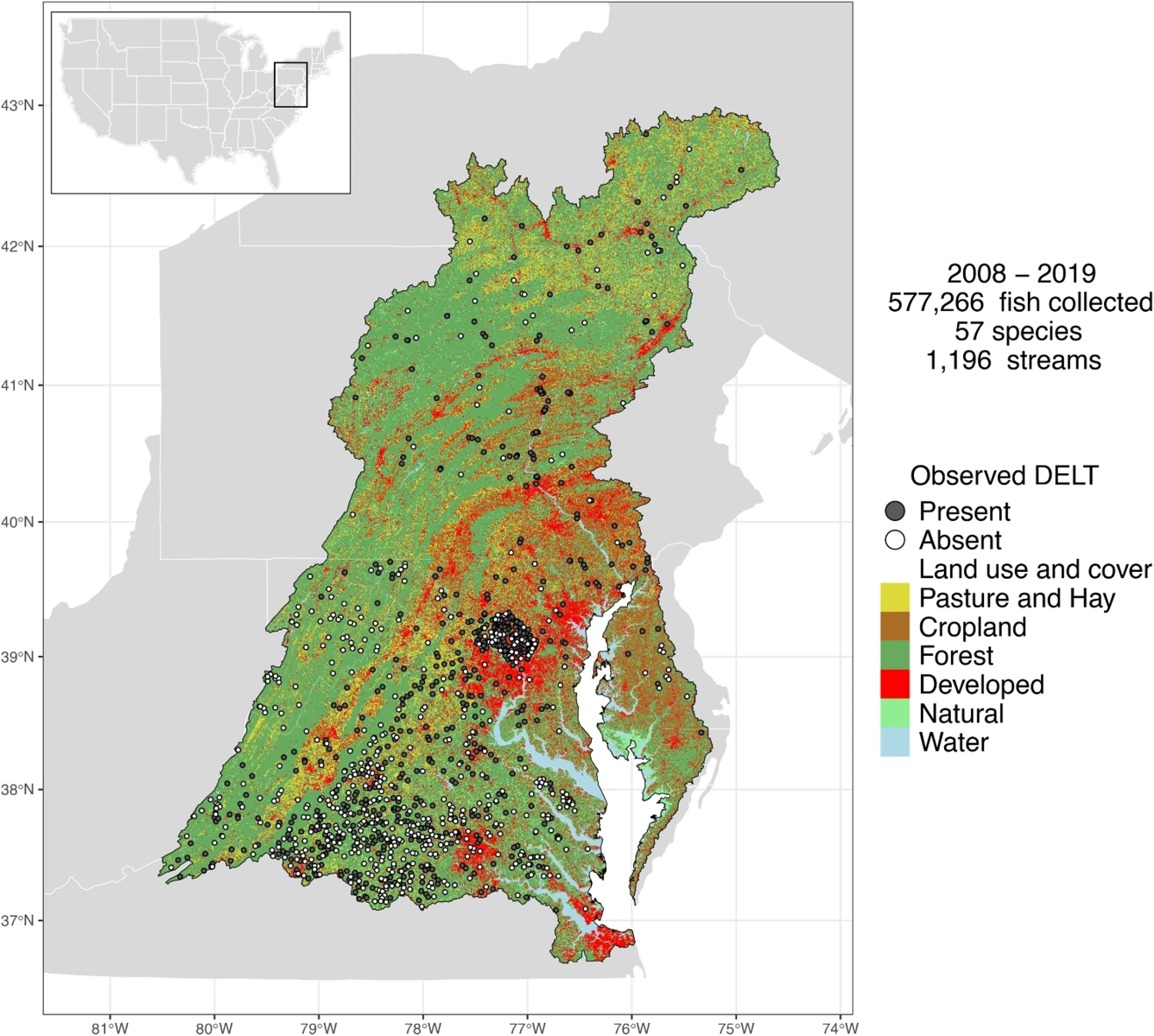
To accomplish this, USGS scientists compiled a large dataset of fish DELT collected by national, state, and local agencies that utilize standardized, community-based fish collection protocols within their respective areas of responsibility. External DELT anomalies in 57 riverine fish species (577,266 individuals collected from 2008 to 2019) from 1,196 streams in the freshwater portion of the Chesapeake Bay watershed were compiled (fig. 1).
Major Findings
The study presents a detailed assessment of DELT occurrence within the Chesapeake Bay watershed.
- Observed DELT prevalence in the Chesapeake Bay watershed was low (1.4%), while the prevalence of DELT in individual species ranged from 0% to 18.9%. When specific anomalies were reported by the collection agency, 61% of the anomalies were parasites.
- Six species exhibited a DELT prevalence greater than 5%, including the Channel Catfish, Golden Shiner, Rock Bass, Smallmouth Bass, Brown Bullhead, and Yellow Bullhead.
- DELT occurrence increased with increasing air temperature and runoff and decreased with increasing precipitation. Of 46 modeled landscape and watershed predictors, these weather-related terms had the strongest relations with overall DELT occurrence and probability.
- The spatial distribution of observed DELT anomalies showed a relation with land use. DELT presence was more commonly observed on developed lands in the southeastern and central areas of the watershed compared to forested and agricultural lands in the northern and southwestern areas of the watershed (fig. 2).
- Due to the low DELT prevalence across the watershed, uncertainty in the estimates related to landscape predictors remains high.
Management Implications
This initial landscape-level analysis serves as a crucial first step in directing future research towards potentially influential environmental drivers of fish health. Based on the compiled data, the prevalence of DELT in the Chesapeake Bay watershed is low, meaning DELT are rarely observed in most species. DELT were most frequently observed in several sensitive species, such as Rock Bass, Golden Shiner, Smallmouth Bass, Channel Catfish, Brown Bullhead, and Yellow Bullhead. These species could serve as regional indicators of environmental impacts on fish health. The study identified specific landscape features that have the potential to broadly affect fish health and warrant further investigation. To improve data quality and usability and reduce uncertainty in modeled estimates, resource managers could focus on clear and detailed descriptions of DELT anomalies and categories, supported by standardized training for all fish health observers.
For More Information
The full study is published online with open access: https://doi.org/10.1007/s10661-025-14412-9.
Fish diseases in freshwater ecosystems pose significant ecological and socioeconomic challenges; yet, monitoring them in wild populations is complex due to interactions between pathogens, hosts, and environmental conditions. External DELT (deformity, erosion, lesion, tumor, and parasite) data (fig. 1) provide a rapid and broad measure of fish health but are a relatively coarse indicator that cannot identify specific causes of disease. DELT data are collected broadly across the Chesapeake Bay watershed by federal, state, and local agencies to inform ecosystem health, but no efforts have been made to use these data in a spatial assessment of fish health across the watershed.
USGS Study
To help inform current and future land and aquatic management strategies, the USGS initiated a study to identify the most at-risk species and the potential landscape-scale drivers of fish DELT in the Chesapeake Bay watershed. The study was designed to: (1) estimate the probability of DELT occurrence; (2) identify potential ecological drivers of DELT by examining associations with a range of landscape predictors, while accounting for potential sources of variation introduced by different sampling agencies and ecological regions; and (3) identify potential limitations and knowledge gained to inform future data collection and monitoring strategies.
To accomplish this, USGS scientists compiled a large dataset of fish DELT collected by national, state, and local agencies that utilize standardized, community-based fish collection protocols within their respective areas of responsibility. External DELT anomalies in 57 riverine fish species (577,266 individuals collected from 2008 to 2019) from 1,196 streams in the freshwater portion of the Chesapeake Bay watershed were compiled (fig. 1).
Major Findings
The study presents a detailed assessment of DELT occurrence within the Chesapeake Bay watershed.
- Observed DELT prevalence in the Chesapeake Bay watershed was low (1.4%), while the prevalence of DELT in individual species ranged from 0% to 18.9%. When specific anomalies were reported by the collection agency, 61% of the anomalies were parasites.
- Six species exhibited a DELT prevalence greater than 5%, including the Channel Catfish, Golden Shiner, Rock Bass, Smallmouth Bass, Brown Bullhead, and Yellow Bullhead.
- DELT occurrence increased with increasing air temperature and runoff and decreased with increasing precipitation. Of 46 modeled landscape and watershed predictors, these weather-related terms had the strongest relations with overall DELT occurrence and probability.
- The spatial distribution of observed DELT anomalies showed a relation with land use. DELT presence was more commonly observed on developed lands in the southeastern and central areas of the watershed compared to forested and agricultural lands in the northern and southwestern areas of the watershed (fig. 2).
- Due to the low DELT prevalence across the watershed, uncertainty in the estimates related to landscape predictors remains high.
Management Implications
This initial landscape-level analysis serves as a crucial first step in directing future research towards potentially influential environmental drivers of fish health. Based on the compiled data, the prevalence of DELT in the Chesapeake Bay watershed is low, meaning DELT are rarely observed in most species. DELT were most frequently observed in several sensitive species, such as Rock Bass, Golden Shiner, Smallmouth Bass, Channel Catfish, Brown Bullhead, and Yellow Bullhead. These species could serve as regional indicators of environmental impacts on fish health. The study identified specific landscape features that have the potential to broadly affect fish health and warrant further investigation. To improve data quality and usability and reduce uncertainty in modeled estimates, resource managers could focus on clear and detailed descriptions of DELT anomalies and categories, supported by standardized training for all fish health observers.
For More Information
The full study is published online with open access: https://doi.org/10.1007/s10661-025-14412-9.