



Cycle of a Bird Band
A Blue-winged Teal banded in Louisiana becomes part of the North American Bird Banding Program, which tracks millions of records to guide waterfowl research and conservation. Recaptures and hunter reports reveal its multi‑year migration, contributing vital data for managing gamebird populations.
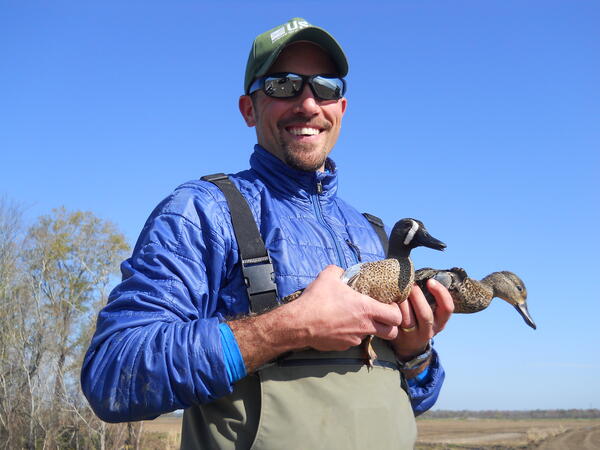
It’s spring 2023 in the marshes of Rockefeller Wildlife Refuge in the bayous of Louisiana, and a state waterfowl scientist wades into the brackish water to extract a Blue-winged Teal from a net rocket-launched just seconds ago. The scientist looks the bird over closely, measuring its weight, bill and wing; observing its plumage; and determining its age and sex. This one is an adult male. The scientist then affixes a metal band around its leg for later individual identification. They jot down all the information and within minutes release the duck back into the wild. The bird flies away, unaware that the band around his leg has now tied his life to a century-old scientific enterprise. Given the timing of the capture, this bird likely sits on his wintering habitat, preparing to fly north to his breeding grounds while the scientist sends the data to the USGS Bird Banding Laboratory (BBL) in Laurel, MD, where all bird banding and marking data from across the country are curated and archived.
The BBL along with the Canadian Bird Banding Office together form the North American Bird Banding Program (NABBP). These offices don’t just curate and archive incoming data – they also issue banding and marking permits and fulfill band orders allowing waterfowl scientists to band birds for study and research. Data from that Blue-winged Teal joins the growing archive of the other 8.5 million banding records housed in the NABBP database. Each year, the BBL receives banding data for approximately 330,000 gamebirds, including geese, ducks, and doves.
Each summer the BBL produces a Gamebirds data set, a cornerstone of science-based waterfowl management across North America. The BBL shares banding and recapture data, along with harvest reports, with researchers as a tool to understand waterfowl migration, to help determine sustainable hunting bag limits, and provide context for conservation and management strategies. This Louisiana teal’s banding record is now one of the thousands helping biologists understand how to better manage duck populations across North America.
It’s now December 2023, and refuge biologists in Louisiana are once again capturing and banding waterfowl. One of those birds, a Blue-winged Teal, already carries a metal band etched with numbers, letting the scientists know that this is the same bird they caught last spring. This bird has survived to breed over the summer, navigate its fall migration, and return to its wintering grounds.

Fast forward to January 2025, and the same teal is again caught in the same spot. For two years now, he has managed to complete his annual cycle, traveling up to his breeding grounds each spring and back to his wintering grounds in the fall. Many birds, including gamebirds, make an annual migration across North America. Scientists use banding and recapture data to follow individuals and determine a species’ flyway, stopover sites, and breeding grounds. The NABBP curate, consolidate, and distribute these data to federal and state agencies to help researchers make science-based decisions that help sustain healthy gamebird populations.
Later in 2025, a Blue-winged Teal is harvested in a large bean field just outside of Gretna, SD. It carries a metal band with an unique 9-digit number and a web address https://www.reportband.gov/. The hunter takes his prize and reports his harvest of the banded teal on the website directly to the BBL. For reporting his bird and band, the hunter will receive a certificate of appreciation that includes the bird’s individual information, its age and sex and where and when it was banded. During hunting season, encounter reports like these pour into the BBL. Over the course of one season more than 89,000 gamebird reports get reviewed by staff; 62,000 of those are harvested waterfowl alone. This Blue-winged Teal’s journey is now part of a larger scientific story. This single harvest record becomes part of the next summer’s Gamebirds data release, sent out to agencies to directly support future conservation efforts. And the cycle begins again.