



The Slime Trail: How USGS eDNA Efforts Are Revealing What Lives in the Deep Gulf
USGS scientists are using eDNA to piece together the story of deep-water ocean life in the Gulf and monitor the health of this unique ecosystem.
A small catshark swims along the bottom of the ocean. At around 150 meters deep, he resides within the mesophotic zone, which lies between the sunlit zone (above 50 meters) and the deep benthic zone (below 300 meters). While sunlight can still penetrate the water here, the percentage of light from the surface drastically decreases with depth; less than one percent of light reaches the bottom of the mesophotic zone. To the human eye, little more than silhouettes and shadows would be visible, but the catshark is able to navigate in the low light environment with ease.
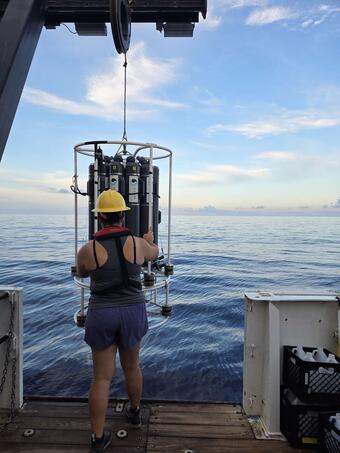
Out of the dark, a bright light moves toward the shark, revealing his surroundings. This light is affixed to a remotely operated vehicle (ROV), and as it moves, it illuminates schools of fish and a wide assortment of sponges and corals of different shapes and colors. The ROV resembles a box, affixed not only with lights, but also with a robotic arm, sample collection containers, cameras, and water collection bottles (Niskins). A cable attached to the vehicle leads back up to the ocean surface, where scientists control its movements from a ship. Its many features allow the ROV to perform a variety of tasks for our Eastern Ecological Science Center (EESC) scientists aboard the ship, and their partners.
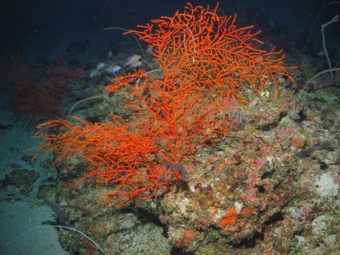
As the ROV propels forward, it spooks the catshark. He bolts, and brushes against a piece of coral as he flees. The contact wipes a layer of slime from the shark’s side, and it floats there, suspended in the water. That is, until the science team uses the ROV to trigger the endcaps of a Niskin bottle to close, trapping the water and a piece of the suspended slime within. The ROV continues forward, recording video footage of the coral habitats hundreds of feet below the surface. An orange fan coral, Swiftia exserta, comes into view and the ROV stops. The machine whirs as it slowly extends its arm towards the coral; it pinches a branch and spins its arm, cutting a small piece of coral, placing it within a collection box.
After its survey of the ocean floor, the ROV brings the water sample back to the ship, where scientists filter the sample. The filter is then frozen and sent to the EESC Leetown Research Laboratory in Kearneysville, WV. There, the slime and any other environmental DNA (eDNA) found within the water will be extracted and analyzed for genetic markers, allowing comparisons with marker libraries generated from previously collected specimens to identify the species that the eDNA came from. The coral sample, on the other hand, is sent to the Wetland and Aquatic Research Center in Gainesville, FL. Here, scientists will test water parameters and food types to identify the conditions for optimal growth rates and reproductive success.
This collection and analysis is just a fragment of the huge Mesophotic and Deep Benthic Communities (MDBC) restoration effort being conducted through a collaboration between the USGS, the National Oceanic and Atmospheric Administration, and many other governmental and non-governmental organizations all over the country. This portfolio of projects arose after the Deepwater Horizon oil spill with the goal of restoring injured mesophotic and deep seafloor habitats and filling gaps in our knowledge of these important Gulf resources to inform restoration efforts. The MDBC portfolio is advancing important science on a wide range of topics, including mapping the seafloor, studying how currents carry coral larvae and food, documenting how corals grow and reproduce, characterizing overall ecosystem biodiversity, and more.
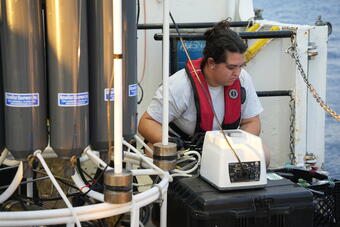
Niskin bottles, like the one attached to this ROV, have been deployed from ships throughout the Gulf of America, and have collected thousands of water samples since 2022 as a part of the MDBC portfolio. Environmental DNA found in these samples from cellular material shed by organisms allows scientists to identify species present in the area and characterize ecosystem biodiversity with far less impact on deep-sea communities than traditional methods like trawling. By analyzing the eDNA filtered from these water collections, USGS scientists can piece together an understanding of the organisms that inhabit these ecosystems and gain insights into how the biodiversity of communities impacted by the oil spill is changing over time. Studying impacted and reference areas gives scientists a better understanding of ecosystem health and recovery progress of various oceanic zones, from the surface to the seafloor.
Since the ROV collected that piece of coral from the deep four years ago, it grew at the Wetland and Aquatic Research Center and contributed tremendously to our knowledge of the life history of the species and is now being sent back out on another expedition. After being carefully fixed to a weighted base, the coral is lowered to the seafloor, settling back into the community of fish and other corals where it originated.
Learn more about EESC’s marine research
Related

Advancing the Environmental DNA Toolkit for Ecosystem Monitoring and Management

Mesophotic and Deep Benthic Communities: Coral Propagation Technique (CPT) Development Project
Related
Advancing the Environmental DNA Toolkit for Ecosystem Monitoring and Management